



Share This Article
Article Summary:
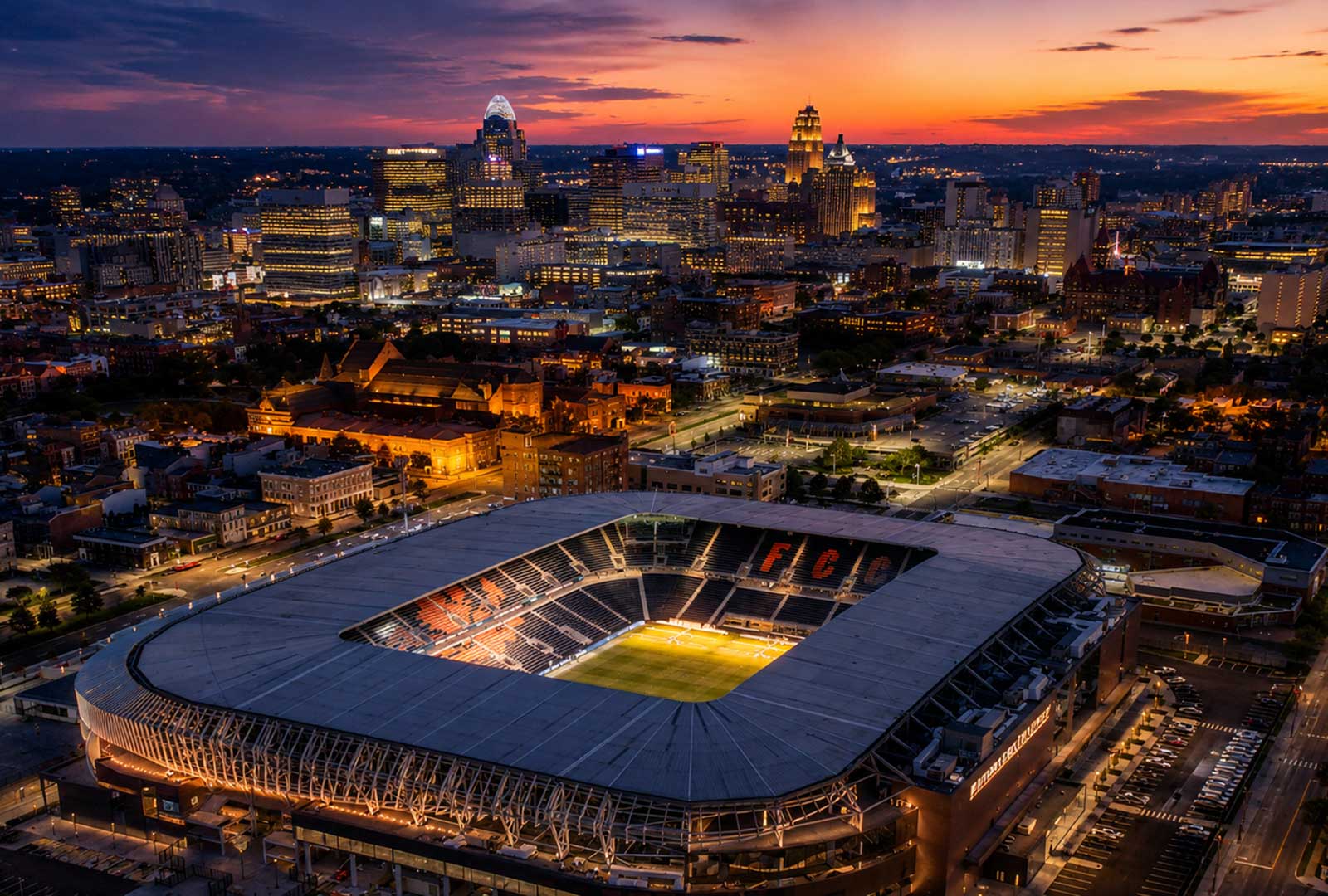
FC Cincinnati’s growth has become much bigger than soccer. Around TQL Stadium, the club is helping reshape the West End, driving new investment, foot traffic, and national attention toward a part of Cincinnati that spent decades disconnected from the city’s economic momentum.
But that transformation comes with tension, too. Rising property values, development pressure, and questions about who ultimately benefits are becoming harder to ignore as FC Cincinnati evolves from a sports franchise into one of the city’s most influential civic and economic forces.
FC Cincinnati development is no longer just about what happens on the field.
The club has become one of the most powerful engines shaping Cincinnati’s urban core, particularly in the West End and Over-the-Rhine corridor surrounding TQL Stadium.
What started as an unlikely lower-division soccer experiment now influences real estate, nightlife, tourism, city branding, and even how younger residents experience Cincinnati itself. The story of FC Cincinnati’s development has left a lasting mark on the entire city.
And honestly, the speed of it all still feels a little surprising if you remember what this area looked like fifteen years ago.
On matchdays, the energy spills well beyond the stadium. Vine Street fills. Washington Park stays active. Bars near Liberty Street and Findlay Market absorb crowds long before kickoff. You can feel the movement pushing north from downtown in a way Cincinnati leaders talked about for decades but struggled to consistently create.
That’s the real story now.
Not just soccer.
FC Cincinnati Development Changed the Rhythm of the City
There’s a noticeable difference in how downtown and the urban basin feel when FC Cincinnati plays at home.
The Bengals create massive spikes of attention, but only a handful of times each year. Reds games stretch across a long season but often disperse fans more gradually through the Banks and riverfront.
FC Cincinnati operates differently. The crowds arrive younger, denser, and more concentrated around walkable neighborhoods. The club built a routine around the city instead of just an event schedule inside it.
That matters.
Cincinnati spent years investing in physical redevelopment projects while still struggling to create sustained urban activity. Fountain Square improved. The Banks eventually gained traction. Over-the-Rhine slowly rebuilt momentum after years of uncertainty.
But FC Cincinnati may have accomplished something local governments and planners often can’t manufacture on their own: consistent cultural gravity.
People now organize weekends around matchdays. Restaurants and bars plan staffing around them. National broadcasts routinely showcase Cincinnati skyline shots and packed supporter sections that would have seemed almost impossible during the city’s more stagnant years.
The club helped make Cincinnati feel nationally relevant in a way that extends beyond sports.
The West End Benefits From Growth. It Also Carries the Pressure.
That doesn’t mean everyone sees this transformation positively.
The West End has lived through wave after wave of promised revitalization before. Residents have heard versions of “investment is coming” for generations, often without fully sharing in the long-term upside. That history matters when new development arrives attached to billion-dollar sports economics and rising land values.
Supporters of FC Cincinnati’s expansion point to obvious improvements:
- new business activity
- increased visibility
- infrastructure investment
- safer and more active streets
- growing tax revenue
- national exposure for Cincinnati
Those things are real.
At the same time, housing pressure across Cincinnati has accelerated over the last several years, especially in neighborhoods adjacent to growth corridors. Property values rise faster than incomes. Rent increases follow investment. Longtime residents begin wondering how long they can realistically remain in neighborhoods suddenly attracting outside attention and capital.
And unlike purely corporate office development, sports-driven growth changes the emotional identity of an area, too. Neighborhoods stop feeling entirely local. They start becoming destinations.
Some residents embrace that shift completely.
Others don’t.
That tension sits underneath nearly every major urban redevelopment story in America right now, and Cincinnati is not exempt from it simply because the stadium atmosphere feels exciting.
The strongest argument from FC Cincinnati supporters is also the simplest one: the alternative was stagnation. For decades, large sections of the urban core struggled with disinvestment, declining population, vacant properties, and limited economic momentum. If investment finally arrives, some disruption becomes unavoidable.
That argument carries weight.
But it also avoids a harder question Cincinnati will increasingly face over the next decade:
Who gets to remain part of the city once redevelopment succeeds?
Cincinnati Has Been Chasing This Feeling for Decades
There’s another reason this story resonates locally.
Cincinnati has spent roughly thirty years trying to reconnect downtown energy, neighborhood culture, and economic activity into something cohesive. Riverfront projects came and went. Civic campaigns promised revival after revival. Some worked. Some didn’t.
The city often built pieces without fully creating momentum.
FC Cincinnati changed that equation because sports culture operates differently than urban planning documents or development presentations. Fans return repeatedly. Rituals form. Businesses adapt around predictable traffic. Neighborhood familiarity grows organically instead of through marketing campaigns.
That consistency matters more than people realize.
The Banks succeeded once it became more than a collection of buildings. Washington Park transformed once people routinely used it instead of simply admiring the redesign. Over-the-Rhine stabilized once enough residents, bars, restaurants, and events created constant activity rather than occasional bursts.
FC Cincinnati fits directly into that pattern.
And in some ways, the club arrived at the perfect time. Younger professionals increasingly prioritize walkability and experiences. Remote work shifted how people use cities. Cincinnati finally started leaning into the neighborhoods and urban density it once seemed hesitant to fully embrace.
A soccer club didn’t create all of that by itself.
But it accelerated it.
The Soccer Team Is Becoming Something Bigger
The interesting part now is where this goes next.
Because the FC Cincinnati development increasingly makes the club feel less like a sports franchise and more like a civic institution shaping the future identity of the city itself. The organization influences development conversations, tourism patterns, national perception, and the economic direction of entire neighborhoods.
That’s a remarkable amount of influence for a club that only entered MLS seven years ago.
And it says something larger about modern Cincinnati, too.
The city once defined itself heavily through old corporate power, manufacturing history, and legacy institutions. Increasingly, it sells itself through experience, entertainment districts, walkable neighborhoods, sports culture, breweries, concerts, and urban lifestyle branding.
Some people love that transition.
Some think it risks turning Cincinnati into a more expensive version of itself.
Most cities would probably prefer having that problem over trying to reverse the decline.
But either way, FC Cincinnati is no longer just participating in Cincinnati’s growth story.
It’s helping write it.
FAQs
Where is TQL Stadium located?
TQL Stadium is located in Cincinnati’s West End neighborhood near Over-the-Rhine and downtown Cincinnati. The stadium opened in 2021 as the home of FC Cincinnati.
How has FC Cincinnati impacted the West End?
FC Cincinnati has brought increased foot traffic, new business activity, national visibility, and additional development interest to the West End surrounding TQL Stadium. The club has also contributed to broader conversations about housing costs, redevelopment, and neighborhood change.
What is the capacity of TQL Stadium?
TQL Stadium holds approximately 26,000 fans and regularly hosts some of the largest soccer crowds in Major League Soccer.
Why is FC Cincinnati considered important to Cincinnati’s growth?
Beyond sports, FC Cincinnati has helped drive tourism, nightlife activity, and investment near the urban core. Matchdays now create significant economic activity for restaurants, bars, and businesses across the West End and Over-the-Rhine.
Are there concerns about redevelopment around TQL Stadium?
Yes. While many residents support new investment and increased activity, others worry about rising housing costs, displacement pressure, and whether longtime West End residents will fully benefit from redevelopment.
When did FC Cincinnati join MLS?
FC Cincinnati joined Major League Soccer in 2019 after rapidly growing from a lower-division club into one of the league’s strongest attendance draws.
This article was created with the support of our proprietary AI-powered newsroom tools and reviewed by our editorial team for accuracy and clarity.