

Share This Article
Article Summary:
Artificial intelligence is changing how companies hire, but it is also making traditional resume screening far less reliable. Employers across Cincinnati and beyond are increasingly confronting AI-assisted candidate fraud, fabricated credentials, interview coaching tools, and polished resumes that reveal very little about how someone will actually perform on the job. The shift is pushing businesses toward deeper workforce evaluation strategies focused on behavioral fit, communication skills, adaptability, and long-term retention rather than credentials alone.
Artificial intelligence is reshaping hiring faster than many employers expected.
The spread of candidate fraud enabled by AI is part of this rapid change.
But the bigger story may be what happens after companies realize the traditional resume is becoming less trustworthy by the year. This is especially true in light of growing AI candidate fraud.
The fraud is no longer some hypothetical HR discussion happening at national conferences. Cincinnati-area employers, staffing firms, manufacturers, healthcare providers, and sales organizations are increasingly running into applicants using AI-enhanced resumes. In addition, they are seeing automated interview coaching tools, fabricated work histories, and exaggerated credentials that are becoming harder to detect during normal screening.
That matters because the cost of a bad hire rarely stays contained to HR, and AI-driven candidate fraud can magnify those costs.
It shows up in missed production targets, customer service failures, turnover, and burnout inside already stretched teams. In addition, managers spend months cleaning up hiring mistakes that could have been avoided earlier in the process; a scenario often connected to fraud.
Gartner recently projected that 25% of global job candidate profiles could be fake by 2028.
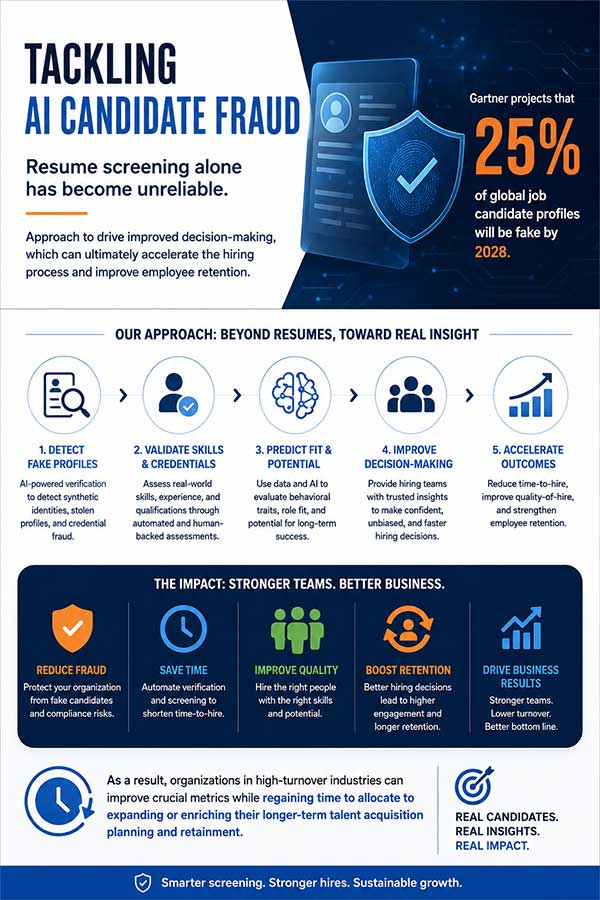
That number sounds aggressive at first. Then you look at how quickly generative AI tools have improved over the past 18 months. This progress is making candidate fraud more sophisticated. The reality is that resume screening alone is starting to break down because fraud is undermining trust in documentation.
AI Candidate Fraud Is Changing Workforce Decisions
For years, companies talked about skill-based hiring as a future trend. Increasingly, it is becoming a survival strategy, partly in response to candidate fraud challenges from AI.
Traditional hiring models often prioritize resumes, degrees, certifications, and keyword matching systems that were built for a very different labor market. However, those systems struggle to evaluate the things that actually determine whether someone succeeds long-term inside an organization. This is especially the case if AI is used to fabricate candidate records.
Communication.
Adaptability is crucial, especially during times when AI technologies make candidate fraud harder to detect for hiring managers.
Coachability is another skill that can’t easily be faked through AI candidate fraud.
Leadership tendencies are valuable and, thankfully, resistant to simple AI-driven fraud during hiring.
Emotional intelligence is a quality that’s tough to mimic, even with advanced fraud tools.
Workplace compatibility remains essential, despite candidate fraud efforts through AI.
Those qualities rarely show up accurately in a polished PDF resume, especially if fraud tactics have been used.
At the same time, AI tools are making it easier for candidates to manufacture credibility. Interview prep software can now feed real-time answers during virtual interviews. Resume generators can tailor experience to job descriptions within seconds. Deepfake concerns are beginning to enter remote recruiting conversations as well. This is why employers are increasingly wary of AI candidate fraud.
That creates a difficult tension for employers, who must now anticipate potential candidate fraud aided by AI technologies.
AI can dramatically improve efficiency in recruiting and workforce management. But it can also reduce confidence in the very information employers depend on to make decisions. This decline is due in part to candidate fraud issues powered by AI.
Why This Matters to Cincinnati Employers
This challenge hits Cincinnati differently than some coastal tech markets because the region still depends heavily on operational industries where reliability, retention, teamwork, and consistency matter enormously. In addition, AI candidate fraud threatens those values.
Manufacturing operations across Butler County and Northern Kentucky cannot afford constant turnover, making vigilance against fraud especially important.
Healthcare systems already dealing with staffing shortages cannot continuously retrain employees who are not the right fit. This issue is further compounded by fraud in applicant pools.
Logistics, hospitality, retail, and customer service companies throughout the Cincinnati metro are under pressure to fill positions quickly while also controlling labor costs. Now they also need to watch for AI-powered candidate fraud.
That combination creates incentives for companies to move beyond surface-level screening, particularly because candidate fraud driven by AI is on the rise.
The businesses that adapt fastest will likely focus less on resume volume and more on workforce intelligence: understanding how people actually communicate, solve problems, fit within teams, and respond to stress. Over time, companies will focus on how employees develop, rather than relying solely on resumes that could be altered through candidate fraud enabled by AI.
That shift extends well beyond recruiting as employers contend with increasing fraud risks.
Forward-looking companies are increasingly applying workforce evaluation tools to onboarding, leadership development, promotions, succession planning, team alignment, and retention strategies. In other words, hiring is becoming part of a larger data-driven workforce management system instead of a standalone process. This shift is also a response to candidate fraud risks fueled by AI innovations.
The Bigger Risk Is Not Just Fraud
There is another layer here that many companies still underestimate, even as AI candidate fraud grows more prevalent.
The danger is not only fake candidates. It is operational drag, often triggered by candidate fraud powered by AI tools.
Organizations that repeatedly hire the wrong people lose enormous amounts of time reacting instead of building. Managers spend months rehiring, retraining, resolving conflicts, correcting performance issues, and stabilizing teams. fraud can make these challenges even worse.
In a tight labor market, those hidden costs compound quickly, and candidate fraud from AI technologies can contribute to this escalation.
That is why many workforce strategists are pushing employers toward broader evaluation models focused on measurable skills, behavioral analysis, communication patterns, and long-term role fit rather than resumes alone. This trend is especially important for limiting the impact of fraud.
Critics of these systems raise legitimate concerns about privacy, bias, overreliance on analytics, and whether behavioral scoring tools can oversimplify human decision-making. Those concerns deserve scrutiny, especially as companies deploy more AI-assisted employment tools designed to combat candidate fraud.
But the counterargument from employers is becoming increasingly straightforward: the existing hiring process is already failing too often to detect fraud.
And many companies no longer believe resumes alone provide enough signal to make confident workforce decisions. That is why vigilance for candidate fraud connected to AI is becoming vital.
Workforce Intelligence May Become a Competitive Advantage
The companies that navigate this shift successfully will probably not be the ones that simply automate recruiting faster. Instead, they will be those who can effectively minimize risks associated with AI candidate fraud.
They will be the organizations that learn how to validate talent more effectively while developing employees more intentionally after hiring. These organizations will ensure that AI-driven candidate fraud doesn’t compromise their hiring standards.
That distinction matters, especially as candidate fraud enabled by AI becomes more sophisticated.
For Cincinnati businesses competing for talent against larger national employers, improving retention and internal workforce alignment may become just as important as attracting candidates in the first place. The fight against fraud will be part of this evolution.
The labor market is increasingly rewarding companies that can build stable, adaptable teams rather than constantly cycling through replacements. This turnover often happens due to candidate fraud from AI-driven resume manipulation.
As AI continues to reshape the employment landscape, businesses that modernize workforce evaluation strategies could gain a significant advantage in hiring accuracy, employee retention, leadership development, and long-term operational stability. At the same time, they will minimize candidate fraud risks from AI.
The resume is not disappearing, but it must be scrutinized more closely because of fraud.
But its dominance in hiring decisions probably is, and fraud plays a major role in this shift.