



Share This Article
Article summary
Cincinnati manufacturing jobs continue to grow in 2026 as employers expand hiring across production, logistics, and skilled trades. Industrial activity in the region has increased, supported by new investments in warehouses and advanced manufacturing facilities. Workforce demand remains strong, particularly for machinists, welders, CNC operators, and production workers across southwest Ohio. Economic reports show continued stabilization in manufacturing employment after prior fluctuations.
Cincinnati manufacturing jobs are expanding in 2026 as regional employers increase hiring across production, logistics, and advanced manufacturing sectors.
The manufacturing jobs continue to shape the local economy as companies invest in industrial facilities, workforce training, and automation technology.
The Cincinnati region entered 2026 with stronger industrial momentum after a mixed manufacturing environment in 2025. According to a recent report from the Ohio Manufacturers’ Association, U.S. manufacturing employment added 5,000 jobs in January 2026 after more than a year of declines. The organization said the shift reflects renewed confidence among manufacturers and growing demand for skilled workers.
Regional industrial activity also accelerated during the first quarter of 2026. A Colliers market report showed Cincinnati recorded more than 2.3 million square feet of industrial absorption during the quarter, driven by warehouse expansion and major manufacturing-related investments. Vacancy rates remained low while lease prices increased across several industrial corridors.
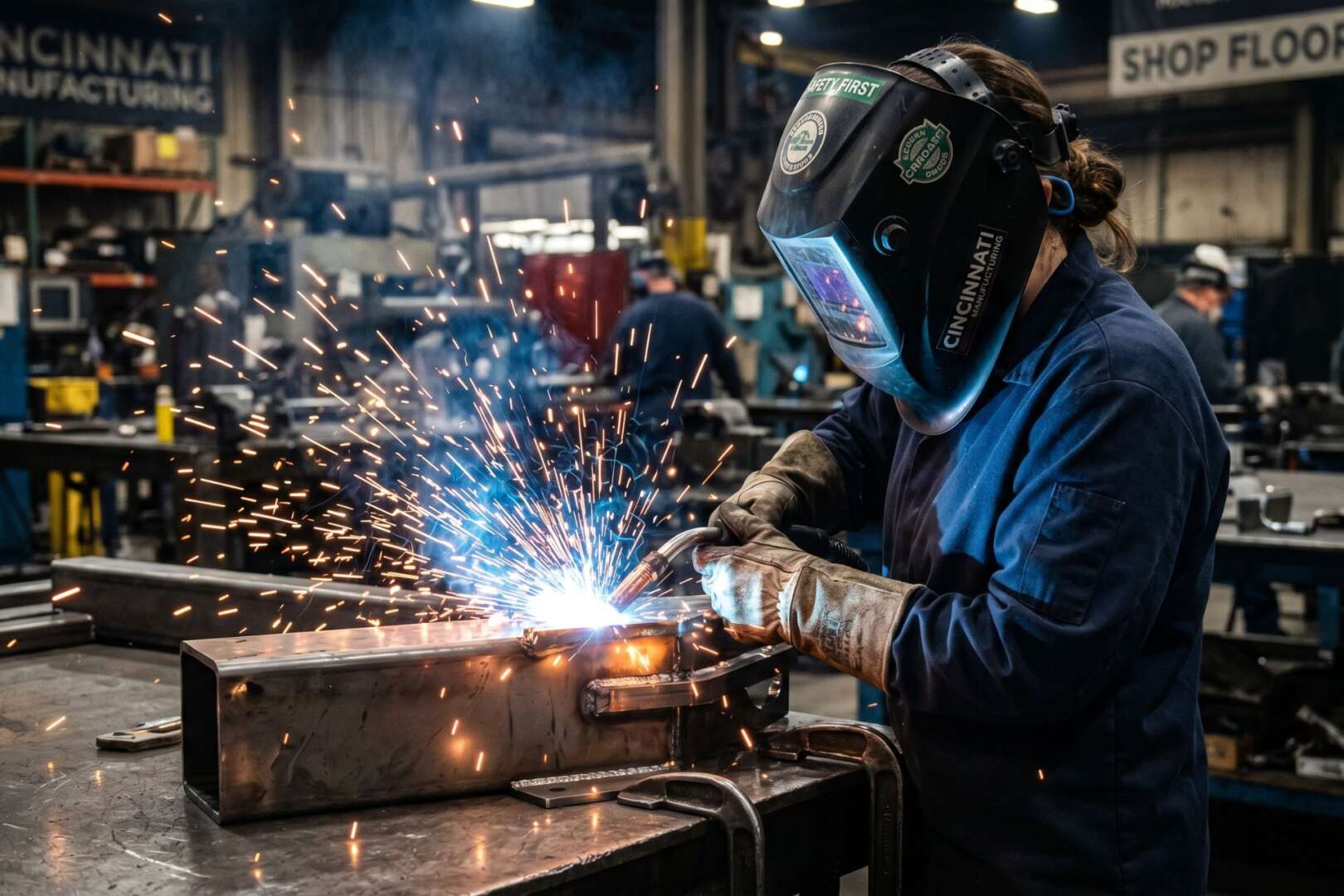
Local hiring data indicates factory jobs remain among the most active employment categories in southwest Ohio. Job listings compiled by Indeed showed continued demand for machinists, welders, CNC operators, assemblers, and production supervisors throughout the Cincinnati area.
Cincinnati manufacturing jobs support regional hiring
Manufacturing remains one of the largest employment sectors in Ohio and continues to provide middle-income career opportunities without requiring four-year degrees. According to the Ohio Manufacturers’ Association, Ohio manufacturers may need approximately 35,000 new workers each year to meet replacement and expansion demand.
Employers in the Cincinnati metro area have increasingly focused on workforce retention and technical training as labor shortages continue across skilled trades. Companies are recruiting workers for roles involving robotics, industrial maintenance, welding, machine operation, and quality control.
Recent labor data also showed manufacturing employment in Cincinnati rebounded during early 2026 after slowing late last year. A Newmark industrial market report said manufacturing employment growth reached 1.6% year over year as supply chains stabilized and orders improved in automotive and advanced manufacturing sectors.
Several industries continue driving industrial growth in Cincinnati, including:
- Aerospace manufacturing
- Automotive suppliers
- Food production
- Packaging and plastics
- Logistics and warehousing
- Advanced machinery and automation
The region’s location near interstate freight corridors and distribution hubs continues attracting industrial development. Northern Kentucky and suburban Cincinnati markets have also seen increased warehouse and production demand tied to e-commerce and domestic manufacturing growth.
According to Colliers, major industrial submarkets near the airport and Monroe/Middletown posted some of the strongest absorption numbers during the first quarter.
Industrial growth Cincinnati employers face labor pressure
Despite stronger hiring activity, many employers continue struggling to find qualified workers. Manufacturing groups and workforce analysts say retirements and population shifts have tightened the labor pool across Ohio.
A workforce analysis published by The Trak Group reported that only 38% of the Cincinnati region’s population falls within the prime working-age category of 25 to 54 years old. The report said skilled trades, maintenance, logistics, and operational roles are expected to remain in high demand throughout 2026.
Employers increasingly partner with community colleges and vocational programs to address shortages. According to Axios reporting from an Ohio workforce development event in Cincinnati, state leaders and business executives emphasized upskilling workers for advanced manufacturing jobs tied to automation and artificial intelligence.
Training programs now focus heavily on:
- CNC machining
- Robotics operations
- Industrial automation
- Electrical systems
- Welding certifications
- Maintenance technology
Manufacturing firms have also increased starting wages to compete for labor. Indeed data showed many Cincinnati-area machining and welding positions now pay between $25 and $29 per hour, while production supervisors often earn salaries exceeding $70,000 annually.
Online discussions among workers in Cincinnati and across Ohio reflect continued interest in skilled trades and industrial careers. Posts on Reddit forums focused on Ohio employment and manufacturing frequently mention welding, HVAC, electrical work, machining, and automation as stable long-term career paths.
Factory jobs Ohio outlook remains mixed
While hiring has improved, economists and manufacturers continue monitoring economic uncertainty tied to tariffs, inflation, and automation costs.
Reuters recently reported that some Ohio manufacturers still face operational pressure despite national reshoring efforts. One Ohio factory closure announced this spring will eliminate approximately 150 jobs after production shifts overseas.
At the same time, new industrial investments continue entering Ohio. JobsOhio announced in April that Whirlpool plans to invest $60 million into a new production facility in Perrysburg, creating up to 150 jobs tied to appliance manufacturing operations.
Manufacturing advocates argue that long-term growth will depend on workforce readiness and domestic supply chain investment. Ohio continues ranking among the nation’s largest manufacturing states, with industries tied to aerospace, machinery, automotive parts, defense systems, and electronics.
Some analysts caution that automation may reduce lower-skilled positions even as advanced manufacturing expands. Discussions across industry forums and labor groups increasingly focus on balancing technology adoption with workforce development.
Still, regional economic indicators suggest Cincinnati’s industrial economy remains stable entering the second half of 2026. Builder Magazine reported that manufacturing investment and steady employment growth continue supporting broader economic activity in the region.
Cincinnati manufacturing jobs tied to long-term economic development
Economic development agencies continue promoting Cincinnati as a manufacturing and logistics hub because of its transportation infrastructure and central Midwest location.
Industrial developers remain active across southwest Ohio as companies seek distribution and production space near major freight routes. According to the Colliers report, construction activity across the Cincinnati industrial market reached approximately 2.5 million square feet during the first quarter of 2026.
Manufacturing leaders say future growth will depend on attracting younger workers into industrial careers. Community colleges, apprenticeship programs, and technical schools throughout Ohio have expanded partnerships with manufacturers to create faster pathways into factory and skilled trade jobs.
Local officials also continue emphasizing workforce pipelines tied to aerospace and advanced manufacturing. Cincinnati remains home to major aviation and industrial employers that support thousands of regional jobs and supplier contracts.
For workers seeking stable employment, manufacturing continues offering opportunities across multiple experience levels. Entry-level assembly positions remain available, while specialized trades and technical roles command higher wages as employers compete for experienced talent.
According to the Ohio Manufacturers’ Association, companies are preparing for long-term expansion despite short-term economic uncertainty.
Additional workforce and manufacturing data is available through the Ohio Manufacturers’ Association and the Colliers Cincinnati industrial market report.
FAQs
What is driving growth in Cincinnati manufacturing jobs in 2026?
Growth is being driven by increased industrial investment, supply chain stabilization, and expansion in logistics and production facilities. Employers are also responding to higher demand in automotive, aerospace, and advanced manufacturing sectors.
Which factory jobs in Ohio are most in demand right now?
Machinists, welders, CNC operators, assembly line workers, and maintenance technicians remain in high demand. These roles are needed across manufacturing plants, distribution centers, and industrial facilities in the region.
How are employers addressing labor shortages in industrial growth Cincinnati sectors?
Companies are partnering with technical schools and training programs to develop skilled workers. Many are also increasing wages and offering certification-based training to attract and retain employees.
What are the long-term job market trends for manufacturing careers in Cincinnati?
Long-term trends show continued demand for skilled trades and advanced manufacturing roles. Automation is increasing efficiency, but employers still require trained workers to operate and maintain industrial systems.