


Share This Article
Article Summary:
Cincinnati Police Chief Teresa Theetge has been fired, effective immediately, by City Manager Sheryl Long. The decision ends months of paid leave, investigations, and internal hearings. But the tone of how it was delivered—and the lack of clear public explanation—is what’s driving the backlash.
So there it is.
The Cincinnati police chief firing is now official. City Manager Sheryl Long put it in writing and sent it out to the entire department.
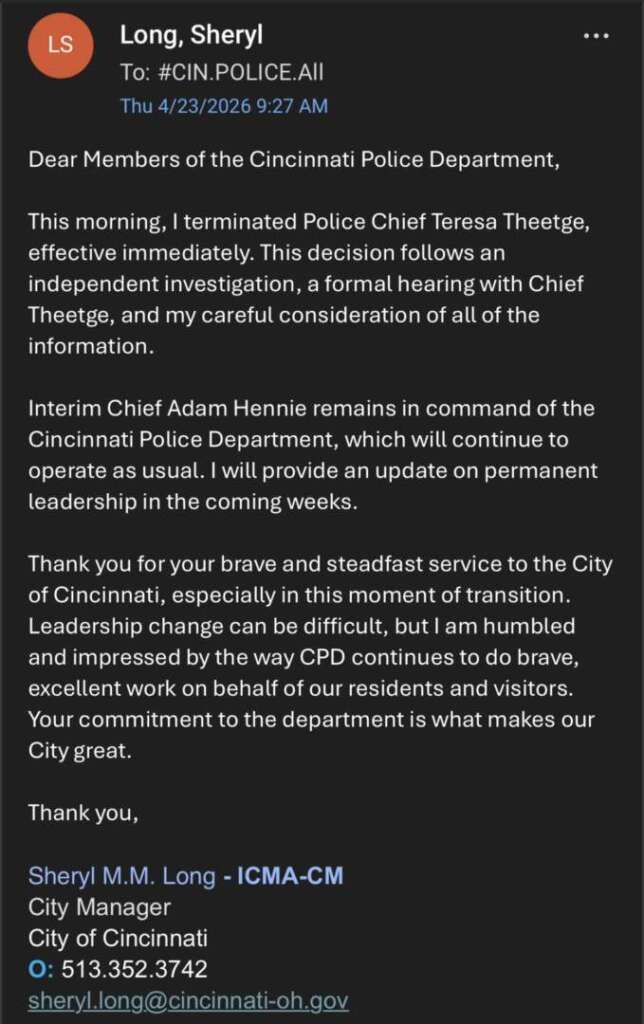
Chief Teresa Theetge is gone. Effective immediately. The Cincinnati police chief firing has left many in the community seeking answers.
After months of paid leave.
t=”831″ data-end=”834″ />>After outside investigations.
=”yoast-text-mark” data-start=”863″ data-end=”866″ />>After hearings.
After dragging the department through uncertainty, taxpayers picked up the bill.
And then the email lands.
Short. Cold. Almost detached.
“This morning, I terminated Police Chief Teresa Theetge…”
Just like that.
The Email vs. The Reality
The tone is what people are reacting to as much as the decision itself.
Because on paper, this reads like a routine personnel update. A clean, controlled message about process, consideration, and continuity.
But that’s not what this has been.
This has been months of instability inside the Cincinnati Police Department. Officers are unsure who’s really in charge. Command staff in limbo. The public left guessing what actually happened.
And now it ends with a sentence.
Thirty-five years on the job—rising through the ranks, leading the department, handling one of the hardest jobs in this city—and it closes out like a calendar notification.
That disconnect is hard to ignore.
What City Hall Is Saying—and Not Saying
Long’s explanation leans on process:
- Independent investigation
- Formal hearing
- Careful consideration
That’s the framework.
But the missing piece is still the same one people have been asking about for months:
What actually justified termination?</p>
t=”2129″ data-end=”2179″>Not suspension. Not discipline. Not reinstatement.
Termination.
Because that’s a different level of decision. And without specifics, it leaves a vacuum—and people fill vacuums with their own conclusions.
City Hall Decision: Where This Starts to Look Political
You don’t have to go far to hear the other interpretation.
That this wasn’t just about performance or conduct.
That this was about pressure. Optics. Timing.
Mayor Aftab Pureval is heading toward reelection. Public safety is always in that mix. City Council voices matter, whether officially or behind the scenes.
From that angle, this starts to look less like a clean personnel move and more like something shaped downtown.
Fair or not—that’s the perception taking hold.
Inside the Department, This Hits Differently
If you’re working in places like West Price Hill, Over-the-Rhine, or dealing with calls across the city every night, this doesn’t feel abstract.
It feels like another shift at the top.
Another reminder that leadership can disappear overnight.
And not after a clear explanation, everyone understands—but after months of uncertainty that never really got resolved publicly.
That kind of instability doesn’t just stay at the top. It trickles down and affects trust, morale, and how people see the job they’re being asked to do.
The Other Side of It
To be fair, there is a legitimate argument here.
If the investigation found serious issues, then leadership had to act. That’s the job. You don’t keep someone in place if the findings don’t support it.
And from City Hall’s perspective, that’s exactly what this was: a process that led to a necessary decision.
That argument holds—if the reasoning eventually comes out in a way people can evaluate.
Right now, it hasn’t.
What Comes Next Isn’t Quiet
This doesn’t just end with an email.
Situations like this usually move into legal territory. Disputes over termination. Questions about process. Damage to reputation.
That means time. And money. Taxpayer money.
So now the questions shift:
What did this cost already?
What’s still coming?
And was there ever a way this ends without it turning into something bigger?
Bigger Than One Chief: The Police Department Upheaval
This is where it lands.
This isn’t just about Teresa Theetge anymore.
It’s about who actually controls public safety leadership in Cincinnati.
Because if the top job in the police department can be sidelined, investigated, and removed without a clear public explanation, people start asking whether leadership serves the public—or serves the political structure around it.
That’s not a small question. And it doesn’t go away with one email.
Our Thoughts on the Teresa Theetge termination
The Cincinnati police chief firing was supposed to close a chapter.
Instead, it opened a new one.
City Hall says the decision was careful and justified. A lot of people—inside the department and outside it—aren’t convinced yet.
Until the “why” is clear, this won’t feel settled. It’ll feel unfinished.
FAQs
Why was Cincinnati Police Chief Teresa Theetge fired?
City Manager Sheryl Long said the decision followed an independent investigation and a formal hearing. However, the city has not publicly detailed the specific findings that led to termination.
How long was Chief Theetge on leave before being fired?
She had been on paid administrative leave for several months while investigations and internal reviews were conducted.
Who is leading the Cincinnati Police Department now?
Interim Chief Adam Hennie remains in charge of the department following Theetge’s termination.
Was the Cincinnati police chief firing decision political?
City Hall has framed the move as procedural and based on investigative findings. Critics argue the timing and handling raise questions about political influence, especially with upcoming elections.
How much has the Cincinnati police chief firing cost taxpayers?
The exact total has not been publicly disclosed, but costs likely include paid leave, external investigations, legal expenses, and potential future litigation.
This article includes analysis and commentary based on publicly available information and statements at the time of publication. Some perspectives reflect opinion, including reactions from within the law enforcement community and public discourse. Details related to internal investigations or potential legal actions may evolve as more information becomes available.
This article was created with the support of our proprietary AI-powered newsroom tools and reviewed by our editorial team for accuracy and clarity.