



Share This Article
Article Summary:
Campaign Zero’s report on Cincinnati police stops concludes that racial disparities persist even after accounting for neighborhood crime rates. In this opinion piece, Christina Holbrook argues that important factors such as police deployment, calls for service, traffic patterns, and enforcement strategies may not have been fully incorporated into the analysis, leaving significant questions about the report’s conclusions.
A statistical model is only as reliable as the variables it includes, and this report may be missing some of the most important ones.
For example, Campaign Zero’s analysis often highlights just how much data selection can impact results.
What Campaign Zero Claims
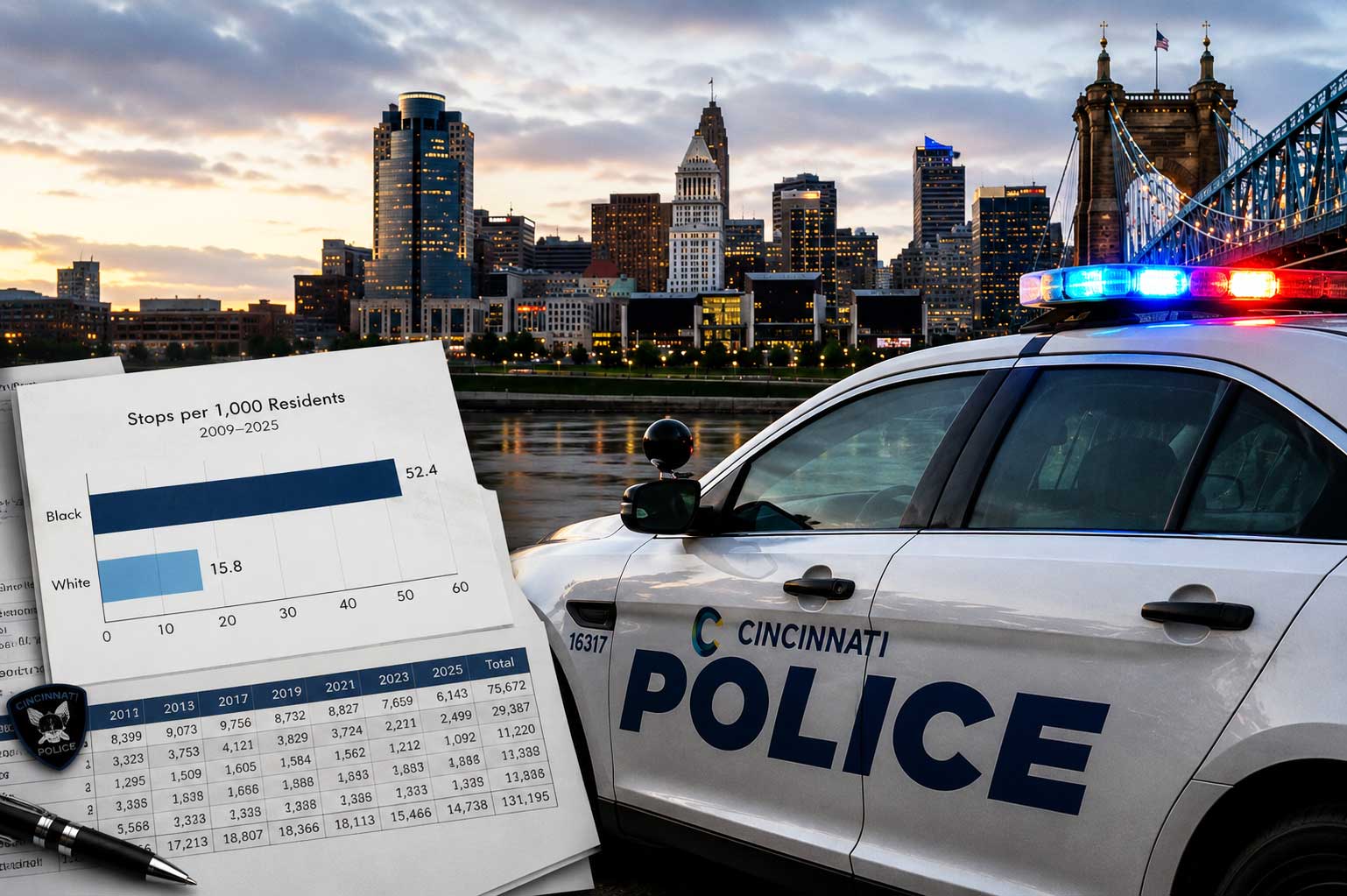
Campaign Zero’s report, Contact Cards in Cincinnati: A Review of Racial Bias in Police Stops, 2009-2025, has generated significant attention throughout Cincinnati. The report reviewed hundreds of thousands of police contact cards and concluded that Black residents are stopped at disproportionately higher rates than White residents, even after neighborhood crime rates are considered.
Those findings have been embraced by activists, cited by media outlets, and presented as evidence of systemic bias within the Cincinnati Police Department. The report raises important questions. Whether it fully answers them is another matter.
The report is detailed, contains statistical modeling, charts, appendices, and extensive analysis, and is clearly intended to present itself as a rigorous examination of police activity in Cincinnati. The problem is not that the report lacks data. The problem is whether the variables included in the model are sufficient to support the conclusions being drawn from them.
After reading the report, I remain unconvinced that they are. The issue is not whether Campaign Zero found patterns. It clearly found patterns within the framework of its analysis. The issue is whether the report has adequately demonstrated that those patterns are caused by racial bias rather than other factors that may not have been fully measured or incorporated into the model.
The Difference Between Finding a Pattern and Explaining a Pattern
One of the most common mistakes in public policy discussions is treating an observation as though it automatically explains itself. Campaign Zero observed disparities. The report identifies differences in stop rates and argues that these differences persist even when crime rates are taken into account. Next, the report attempts to explain why those disparities exist.
A statistical model can only evaluate the variables that are included in the model. If important variables are excluded, the conclusions may reflect the model’s limitations rather than the full complexity of reality. This is not a criticism unique to Campaign Zero. It applies to every statistical model ever built. Researchers constantly debate which variables belong in a model and which variables deserve greater weight. Small changes in assumptions can produce dramatically different conclusions.
The Crime Concentration Problem
One of the strongest arguments in the report is that crime rates do not adequately explain the observed disparities. Crime is not distributed evenly throughout Cincinnati. Certain neighborhoods account for a disproportionate share of shootings, robberies, aggravated assaults, repeat calls for service, gun complaints, and violent crime investigations.
Anyone familiar with Cincinnati understands that police activity in Avondale, parts of Price Hill, or sections of Over-the-Rhine is not distributed the same way it is in Hyde Park, Mount Lookout, or other lower-crime neighborhoods. Police departments do not respond to those realities by distributing officers evenly throughout a city. They deploy resources where incidents occur and where residents demand intervention.
When police deployment becomes concentrated, police contacts become concentrated. When police contacts become concentrated, stop data becomes concentrated. The question is whether the report adequately captures the realities that drive those deployment decisions.
A neighborhood crime rate tells us something important, but it does not tell us how many calls for service officers responded to, how many directed patrols were assigned to an area, or whether a neighborhood was the focus of a gang initiative, traffic enforcement campaign, or violent crime suppression strategy.
Crime Rates Are Not Police Deployment
Police departments make deployment decisions based on far more than crime statistics. Calls for service, community complaints, school zones, entertainment districts, business corridors, staffing realities, special operations, intelligence gathering, and departmental priorities all influence where officers spend their time.
If a model does not adequately account for the factors that determine officers’ deployment, it becomes difficult to conclude that race is the primary explanatory variable. That is not a minor methodological disagreement. It goes directly to the foundation of the report’s central conclusion.
The Exposure Problem
Campaign Zero relies heavily on residential population figures when calculating disparities. Police officers do not stop census populations. They stop drivers and pedestrians. Those populations are not always the same.
People travel through neighborhoods where they do not live. Workers commute to business districts. Visitors travel to entertainment areas. Major roads carry traffic from outside the city. Traffic volume, commuting patterns, vehicle miles traveled, and licensed-driver populations may significantly influence police contact rates. Yet those variables receive comparatively little attention in the report.
The result is a model that may not fully account for who is actually being exposed to police activity.
The Missing Variables Problem
The strongest criticism of the report is not that it lacks sophistication. The strongest criticism is that even sophisticated models can produce misleading conclusions when important variables are omitted.
Campaign Zero devotes substantial attention to crime rates. It devotes considerably less attention to calls for service, deployment decisions, traffic exposure, directed patrols, special enforcement operations, and neighborhood-specific policing realities. A model can only evaluate what it measures. If important influences on police behavior are not included, the resulting conclusions may reflect the model’s limitations rather than the realities of the street.
The Limits of Statistical Modeling
A model is not reality. A model is an attempt to simplify reality so that it can be studied. Every model requires assumptions, choices, and judgments about which variables deserve attention. That process inevitably introduces limitations.
Campaign Zero’s report appears to assume that once neighborhood crime rates are incorporated into the model, competing explanations become significantly less persuasive. That assumption deserves scrutiny because crime rates are only one of many factors influencing police activity. A neighborhood’s reported crime rate does not tell us how many citizens called the police requesting assistance, how many traffic complaints resulted in enforcement, or how many special operations were underway.
Why Omitted Variables Matter
The concept of omitted variables is one of the most important principles in statistical analysis. If a factor influences the outcome being studied but is not included in the model, the model may mistakenly attribute that influence to another variable.
Neighborhoods differ in traffic flow, commercial activity, commuting patterns, population density, calls for service, public events, school activity, and community expectations. Each of these factors may influence police activity in ways that are difficult to fully capture. That is why many readers remain skeptical of reports that present highly confident conclusions regarding causation.
The Difference Between Data and Interpretation
Data can tell us what happened. Interpretation attempts to explain why it happened. Those are not the same thing.
Campaign Zero interprets the data as evidence that racial composition remains a significant explanatory factor after crime rates are considered. Critics argue that additional variables should have been incorporated before reaching that conclusion. Reasonable people can disagree about which interpretation is more persuasive, but an interpretation should not be treated as an unquestionable fact simply because a statistical model exists.
What the Report Does Not Measure
The report discusses searches, arrests, warnings, citations, and use-of-force incidents. However, there appears to be limited discussion regarding search success rates, contraband recovery rates, weapon recovery rates, and similar outcome measures.
Those metrics matter because they provide additional context regarding officer decision-making. Without those outcome measures, readers are left with only part of the story and may lack the information needed to fully evaluate the significance of the disparities discussed.
Why Cincinnati Should Demand an Independent Review
Perhaps the most productive outcome of this report would be independent replication. If Campaign Zero’s conclusions are correct, they should withstand additional scrutiny using alternative methodologies, benchmarks, deployment variables, and expanded outcome measures.
Independent review is particularly important when reports have the potential to influence public policy, police practices, funding priorities, and community trust. Decisions of that magnitude should be based on evidence capable of surviving rigorous examination from multiple perspectives.
Correlation Is Not Causation
Campaign Zero has identified patterns and relationships between variables. What remains open to debate is whether those relationships establish the causal explanation being offered.
Neighborhood racial composition may correlate with police stop patterns. It may also correlate with other factors that are difficult to fully capture within a statistical model. The existence of a correlation does not automatically tell us which variable is driving the outcome. That is why replication, scrutiny, and continued examination matter.
Cincinnati Deserves Better Answers
None of this means Campaign Zero should be ignored. The report raises important questions and contributes valuable information to an ongoing public discussion. However, it should not be treated as the final word.
The report asks Cincinnati residents to accept a very specific explanation for the disparities it identifies. I remain unconvinced that the analysis has adequately accounted for all of the variables necessary to support that conclusion.
Campaign Zero may have identified a pattern within its chosen model and assumptions. Whether that pattern is primarily the result of racial bias, deployment decisions, traffic exposure, calls for service, or some combination of factors remains open to debate. The report has already shaped public discussion in Cincinnati. Given the significance of its conclusions, it deserves the scrutiny any influential public policy document should receive.
FAQs
What is the Campaign Zero Cincinnati report?
The Campaign Zero Cincinnati report analyzes police contact card data from 2009 through 2025 and concludes that Black residents are stopped at disproportionately higher rates than White residents, even after accounting for neighborhood crime rates.
What are police contact cards?
Contact cards are records created by Cincinnati police officers documenting interactions with members of the public, including traffic stops, pedestrian stops, and other police contacts.
Why does this opinion piece question the report's conclusions?
The article argues that factors such as police deployment, calls for service, traffic exposure, directed patrols, and special enforcement operations may not have been fully incorporated into the statistical model used by Campaign Zero.
Does this article claim the Campaign Zero report is wrong?
No. The article acknowledges that the report identifies real disparities in police stop data. The question raised is whether the report has adequately demonstrated the cause of those disparities.
What are omitted variables in a statistical model?
Omitted variables are factors that may influence an outcome but are not included in a model. If important variables are excluded, a model may incorrectly attribute their effects to other measured factors.


