
Share This Article
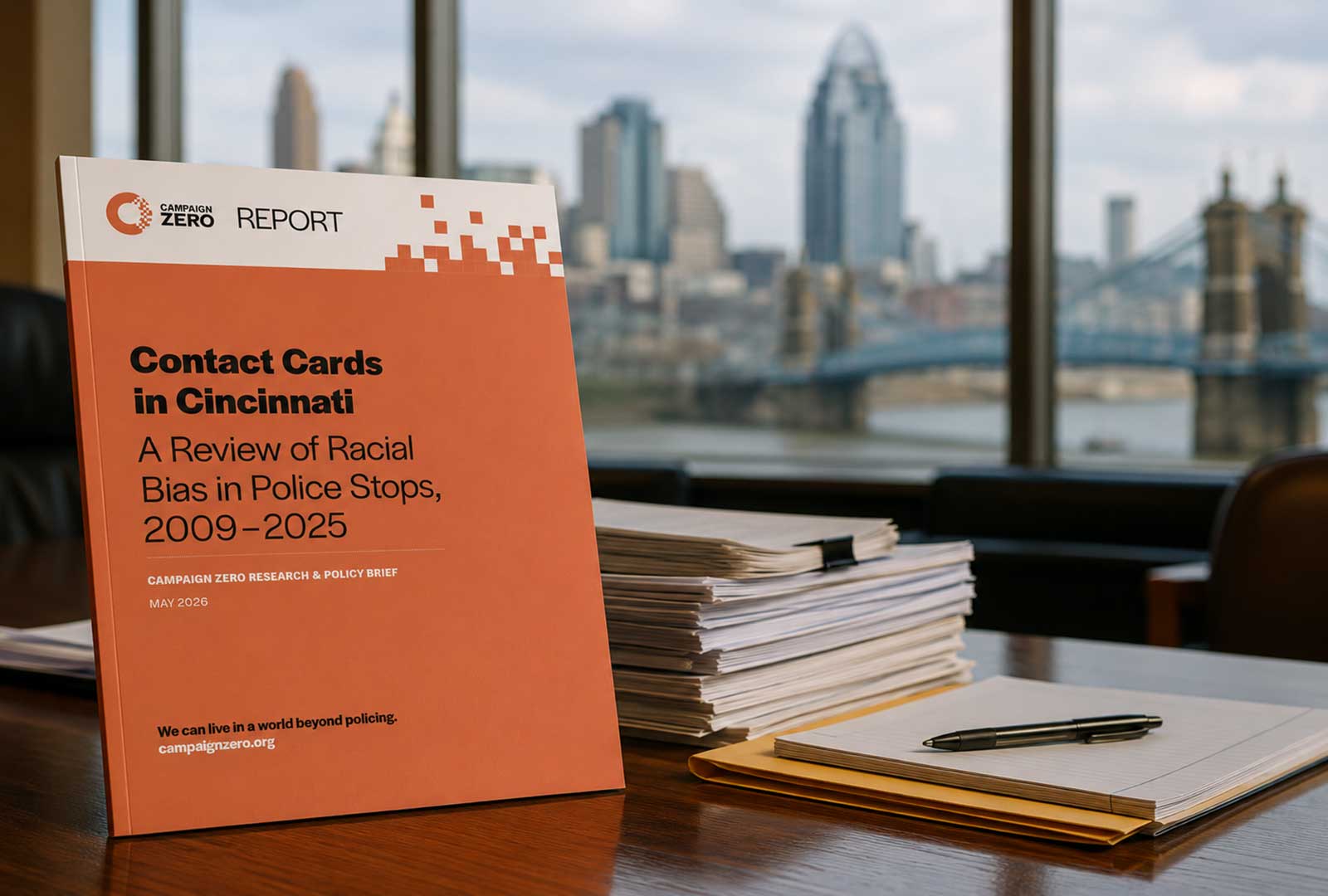
A report commissioned by the Hamilton County Public Defender’s Office and analyzed by Campaign Zero found wide racial disparities across 16 years of Cincinnati police stops.
Police leadership called the Cincinnati police stops report misleading before the public saw it.
Some of the sharpest questions surrounding the Cincinnati police stops report come from inside the process itself. Campaign Zero’s own researchers have acknowledged important gaps in the analysis. In addition, a CPD data analyst has raised concerns about portions of the underlying data. City Hall’s independent review will focus heavily on those questions.
The Contact Cards Exist Because Of Timothy Thomas
When Cincinnati Police Officer Stephen Roach shot and killed the 19-year-old in Over-the-Rhine in April 2001, the city entered a period that reshaped local policing. The unrest that followed produced the Collaborative Agreement. This was a nationally watched effort to improve police accountability and community trust. City leaders also created a system that documented police contacts in far greater detail than most departments around the country maintain today.
More than two decades later, those records have become the foundation of another debate.
This month, the Hamilton County Public Defender’s Office released a report from Campaign Zero, a national police-reform organization, analyzing 472,666 Cincinnati police contact cards spanning 2009 through 2025. The Cincinnati police stops report concludes that officers stop, search, arrest, and use force against Black residents at disproportionately higher rates than white residents. According to the analysis, officers stopped Black residents 3.4 times more often than white residents in 2025. Furthermore, officers stopped Black pedestrians at 5.4 times the rate of white pedestrians.
The findings drew responses from nearly every corner of Cincinnati’s policing debate. Police Chief Adam Hennie criticized the methodology before the report became public. City Manager Sheryl Long called for an independent review. FOP President Ken Kober challenged parts of the analysis. Longtime Collaborative Agreement figures, including consultant Iris Roley and former officer Cecil Thomas, said the findings deserved a closer look.
The debate now extends beyond the stop data itself. Cincinnati officials, police leaders, reform advocates, and researchers disagree over what the records can actually prove. They also disagree about whether policymakers are drawing conclusions faster than the evidence allows.
Why The Report Was Commissioned
The Hamilton County Public Defender’s Office did not commission the study to determine whether disparities existed. Attorneys there had already concluded that something unusual was happening.
According to statements released alongside the report, public defenders repeatedly observed similar patterns among clients moving through the criminal justice system. They wanted to understand whether those experiences reflected a broader trend. The office obtained CPD contact-card records through public records requests and then asked Campaign Zero to analyze them.
The Public Defender’s Perspective
The office occupies a unique position in Cincinnati’s criminal justice system. Public defenders represent people who have been stopped, arrested, charged, or convicted of crimes. This means they encounter police activity from a very different vantage point than most residents.
That perspective helped drive the project. Attorneys wanted to know whether the experiences they were seeing in courtrooms, client meetings, and case files were isolated incidents or part of a larger pattern across the city.
The Iris Roley Question
Kober says Iris Roley, the longtime Collaborative Agreement consultant and Cincinnati Black United Front figure, asked to participate in the report’s development, and Campaign Zero declined. Roley has spent much of the past twenty-five years working at the intersection of police accountability, community relations, and the Collaborative Agreement process.
If Kober’s account is accurate, one of Cincinnati’s most prominent, if controversial, voices on police oversight was not involved in developing one of the most significant police-accountability reports in recent years.
Who Conducted The Analysis
Campaign Zero analyzed the data, but the organization did not enter the project as a neutral observer.
Founded after the Ferguson protests, Campaign Zero advocates reducing reliance on traditional policing and pursuing what it describes as a world beyond policing. The organization’s website outlines a broader goal of reducing police contact. In addition, it aims to reduce the criminal justice system’s footprint and advance alternatives to law enforcement.
Another Interested Party In The Debate
Campaign Zero is hardly the only participant in this story with a point of view.
Kober leads the police union. The Hamilton County Public Defender’s Office commissioned the study after attorneys observed troubling patterns among clients. CPD leadership has publicly challenged the report’s methodology. Roley has spent decades working on police accountability issues through the Collaborative Agreement and the Cincinnati Black United Front.
The underlying data came from Cincinnati Police Department contact cards. No one disputes the records’ origin. The disagreement begins after that, when different groups try to explain what those records mean and what policy changes, if any, should follow.
Even Campaign Zero Says Some Answers Are Missing
Andrew Zaharia, one of the researchers who worked on the project, told WVXU that deployment decisions remain one of the biggest unknowns in the analysis. Researchers can see where officers made stops and where those stops were recorded. However, they cannot see every decision that placed officers in those locations in the first place.
Deployment Remains A Major Unknown
Zaharia described deployment patterns as “big unknowns” that could significantly influence the disparities identified in the Cincinnati police stops report.
Police do not patrol Cincinnati evenly. Command staff assign resources based on shootings, robbery patterns, calls for service, ongoing investigations, warrant activity, staffing levels, and other operational priorities. Therefore, a neighborhood receiving additional police attention will naturally generate more police contacts than one receiving less attention.
How much those deployment decisions contribute to the disparities identified by Campaign Zero remains unresolved.
Questions About The Underlying Location Data
A separate concern came from a CPD data analyst who questioned how large datasets handle location information.
According to the analyst, several high-traffic areas around Cincinnati are routinely miscoded. This creates situations where activity recorded in one location may appear somewhere else in the data. The issue is relevant because Campaign Zero identified Avondale, Over-the-Rhine, East Price Hill, and Downtown as major concentrations of stop activity.
The analyst did not challenge the existence of the disparities. The concern was narrower: whether location errors could affect conclusions drawn from neighborhood-level patterns.
Both questions — deployment and geocoding — are issues an independent review can examine directly.
Campaign Zero Says Crime Doesn’t Explain The Gap
Campaign Zero argues that crime rates do not account for the disparities highlighted in the report, especially in predominantly white neighborhoods, where officers stop Black residents at significantly higher rates than white residents. This point recurs throughout the report and forms the core of its broader argument that crime alone does not fully explain these racial disparities.
However, this conclusion raises one of the report’s biggest unanswered questions. Zaharia pointed out that deployment decisions are among the largest unknowns in the analysis. Researchers can track where stops occurred, but they cannot fully reconstruct the specific decisions that led officers to be assigned to those locations. Factors such as calls for service, staffing levels, directed patrols, specialized assignments, warrant activity, and ongoing investigations all influence where officers focus their time.
Cincinnati’s independent review will need to address a straightforward question: if deployment remains a significant unknown, how confidently can anyone dismiss it as a contributing factor?
The answer to this question could sway the findings in either direction. If deployment explains little or none of the disparity, the report’s conclusions strengthen. Conversely, if deployment accounts for a substantial portion of the gap, the report’s conclusions weaken. Resolving this issue could shift the discussion from competing assumptions toward definitive answers.
Avondale Is Not Hyde Park
A drive from Hyde Park Square to Reading Road in Avondale takes less than ten minutes. The conditions facing an officer can change dramatically along that route.
CPD’s own crime reports show shootings, robberies, and aggravated assaults concentrated in specific parts of Cincinnati. Campaign Zero’s report similarly identifies Avondale, Over-the-Rhine, East Price Hill, and Downtown as major centers of stop activity.
Population Is Not Deployment
Campaign Zero compares stop activity to population figures. Police activity, however, is not distributed solely by population. For example, a neighborhood that accounts for a small share of Cincinnati’s residents can generate a much larger share of emergency calls, investigations, warrants, and police activity.
That reality does not make the disparities identified by Campaign Zero disappear. However, it raises a question neither supporters nor critics have fully answered: how much of the disparity reflects where officers are deployed, and how much reflects what happens after they arrive?
Those are two very different explanations, and the distinction sits at the center of the current debate over Cincinnati police stop data.
The Officers Behind The Largest Ratios
Kober’s most specific criticism focuses on the officers that Campaign Zero identified as having the largest disparity ratios.
According to Kober, many of those officers work in specialized units, such as the Violent Crime Squad and the Crime Gun Intelligence Center, rather than in routine patrol assignments. The Crime Gun Intelligence Center focuses on gun-violence investigations and also follows leads from shootings, firearms recoveries, and related investigations.
Does Assignment Explain The Gap?
Kober’s explanation may account for where some officers work, but it does not address what happens during those encounters or whether the disparities persist within those units.
A better question is whether the disparities persist when analysts evaluate specialized units separately from routine patrol officers.
Neither the report nor Kober’s response fully answers that question.
An independent review could.
What The Cincinnati Police Stops Report Needs To Answer
Supporters of the report argue that disparities this large cannot be ignored. Critics argue that the report leaves too many important questions unresolved.
The next phase of Cincinnati’s policing debate should focus on questions that investigators can actually answer.
Three Questions That Matter
How much do deployment decisions influence the disparities identified by Campaign Zero in the Cincinnati police stops report?
Do geocoding issues affect the findings in areas such as Avondale, Over-the-Rhine, East Price Hill, Downtown, or other high-activity neighborhoods?
Do disparities among officers persist when analysts examine specialized units concerning their specific assignments and caseloads?
These questions go beyond the headline ratios and directly challenge the assumptions behind them. City Manager Sheryl Long has ordered an independent review to address these questions. The value of the review will not come from producing a different number; instead, it will come from determining whether deployment patterns, location data, and specialized assignments affect how Cincinnati interprets the disparities identified in the report.