



Share This Article
Article Summary
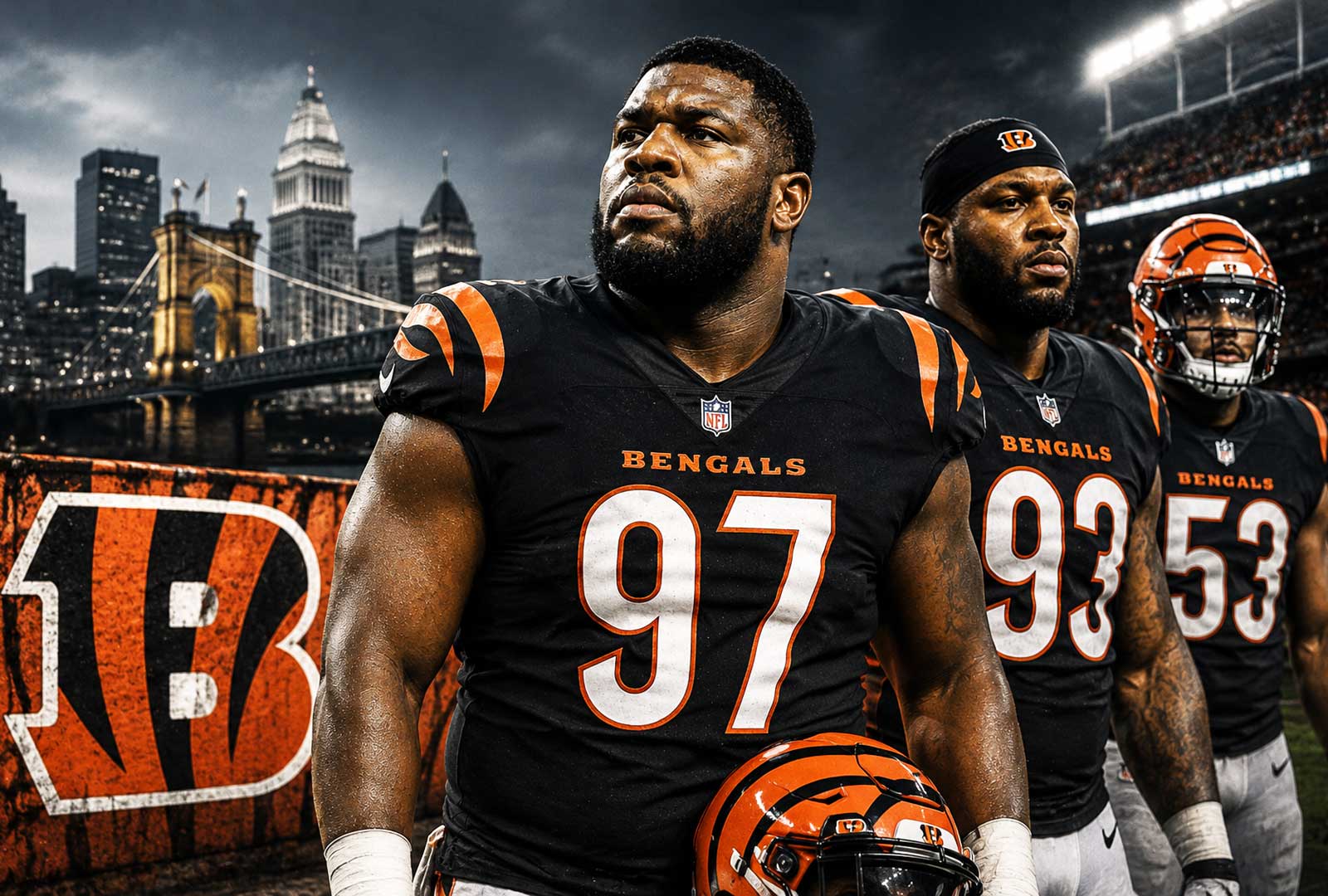
The Bengals entered the offseason with one of the NFL’s worst defenses and responded with one of the most aggressive defensive rebuilds in franchise history — trading a top-10 pick for Dexter Lawrence, signing Jonathan Allen and Boye Mafe, and investing heavily in the defensive front. The moves addressed an obvious weakness. Whether they addressed the most important one is still an open question.
At this point last season, the Bengals were posting defensive numbers that looked more like a statistical anomaly than those of a playoff contender.
Through the first eleven weeks of 2025, Cincinnati allowed 0.205 EPA per play on defense.
No other team in the league was above 0.148. The Bengals defense struggled mightily last season. The Bengals ranked at or near the bottom of the NFL in points allowed, rushing yards allowed, and total yards allowed — and for a stretch in November, several advanced metrics had them on pace for one of the worst defensive performances in the history of the metric, full stop. Not one of the worst in recent memory. One of the worst ever recorded.
The Bengals defense improved during the final six weeks, finishing 13th in EPA per play allowed over that span. Coaches pointed to improved communication and a younger secondary beginning to settle into Al Golden’s system. Skeptics noted that much of the improvement came against backup quarterbacks and teams already drifting out of playoff contention. Both things are true, which is part of why the offseason spending felt less like optimism and more like acknowledgment.
62 Defensive players drafted by the Bengals since 2011.
Pro Bowl selections from that group: zero.
Why The Bengals Rebuilt The Defensive Line
Since 2011, the Bengals have drafted 62 defensive players without producing a single Pro Bowl selection. That number does not explain every problem Cincinnati had last season, but it does explain why the front office abandoned a draft-and-develop approach and turned to proven veterans instead.
The centerpiece was Dexter Lawrence — traded from the Giants for the 10th overall pick, then signed to a one-year, $28 million extension. Lawrence had generated 198 quarterback pressures between 2022 and 2025, fourth-most among all defensive tackles in the league. He also came with a caveat: he had just finished the worst season of his career, recording half a sack in 17 games. The Giants’ reluctance to pay him is exactly what made the deal possible for Cincinnati.
The less-discussed piece is Jonathan Allen, and it deserves more attention than it has received. Allen signed a two-year deal at $25 million and, over the past five seasons, generated 64 quarterback pressures after being double-teamed — fifth-most in the NFL. Put him next to Lawrence, and offensive lines face a decision with no clean answer: double Lawrence and Allen goes free, double Allen and Lawrence goes free. That’s not a hypothetical. It’s what those two players have done consistently when lined up together, and it’s what opposing offensive coordinators will be planning around starting in September.
Cincinnati also added edge rusher Boye Mafe on a three-year deal at $20 million per year and safety Bryan Cook, while rookies Cashius Howell and Tacario Davis came in through the draft. Bleacher Report still ranked the Bengals 28th in their preseason defensive rankings. Their argument, essentially, was that a great defensive line doesn’t fix linebackers or a secondary — and last year, linebackers and the secondary were a substantial part of what broke.
They’re not wrong.
Defensive Tackles Don’t Cover Tight Ends
Some of last season’s most damaging failures occurred well beyond the line of scrimmage.
According to midseason tracking, the Bengals were on pace to allow 179 targets, 128 receptions, 1,647 yards, and 20 touchdowns to tight ends. Josh Allen put up 328 total yards and four touchdowns against them in a single December game in Buffalo. Opposing offenses repeatedly found easy throws underneath against linebackers who couldn’t carry receivers across the middle, and a secondary that couldn’t rotate fast enough to compensate.
Lawrence and Allen improve the pass rush. They make life harder for opposing running games. What they cannot do is directly fix a coverage breakdown that happens twelve yards downfield after the snap. A stronger pass rush often makes coverage look better — quarterbacks have less time to wait for routes to develop, and that creates conditions where secondary mistakes matter less. The Bengals are betting that the relationship holds. Critics point out that the 2025 defense wasn’t just getting beaten on timing routes; it was getting carved up by tight ends on third-and-medium, where even a mediocre quarterback can find the window if a linebacker is a step slow.
The Myles Murphy Factor
Joe Burrow’s most interesting defensive comment this offseason had nothing to do with Dexter Lawrence or Jonathan Allen.
At OTAs, Burrow singled out Myles Murphy, the 24-year-old edge rusher Cincinnati selected in the first round of the 2023 draft. Murphy spent much of his first two seasons struggling to meet expectations before showing significant improvement during the final stretch of 2025.
“Myles is walking around with a little more pep in his step this year,” Burrow told team writer Geoff Hobson. “I think he grew in confidence from the last five, six games. We need to carry that over, and I’m excited to see that.”
That observation may be more revealing than anything Burrow said about Lawrence or Allen. The Bengals know exactly what they purchased in those veterans, and preseason projections already account for their production. Murphy remains the variable.
If his late-season emergence proves sustainable, Cincinnati’s defensive line becomes deeper and more disruptive than many analysts currently project. If it doesn’t, the Bengals may find themselves relying heavily on four expensive starters while facing a significant drop-off whenever injuries force reserves into larger roles.
For all the attention paid to Lawrence and Allen, Murphy may be the player who determines whether Cincinnati’s defensive rebuild reaches its full potential.
Why Week 7 Will Tell You Most Of What You Need To Know
Joe Burrow does not need to prove he can play championship football. That question was settled years ago. The question facing this team is whether the defense can hold up when the AFC’s best offenses start pushing back.
Last season the Bengals allowed 27 or more points in nine consecutive games, tying the NFL record for the longest such streak. They set a separate record allowing at least 14 points in the fourth quarter for five straight games. Those numbers didn’t happen because Cincinnati couldn’t score. They happened because the defense couldn’t stop anyone, and eventually Burrow ran out of margin for error.
The new defensive line is the most credible answer the Bengals have had to that problem since Burrow arrived. Whether it’s the right answer — or whether this is an expensive front four playing in front of the same vulnerable second level — will start to become clear on October 19th, when Lamar Jackson comes to Paycor Stadium and the AFC North begins to sort itself out. Whatever happens that afternoon will tell you more about this defense than anything happening in Bengals training camp right now.
FAQs
Did the Bengals fix their defense in the 2026 offseason?
The Bengals made their most aggressive defensive investment in years, trading the 10th overall pick for Dexter Lawrence and signing Jonathan Allen and Boye Mafe. The defensive line is significantly improved on paper. Whether it solves the coverage and linebacker issues that caused most of the damage in 2025 is the question the season will answer.
Why did the Bengals trade for Dexter Lawrence?
Lawrence generated 198 quarterback pressures between 2022 and 2025, fourth-most among all NFL defensive tackles. Cincinnati traded the 10th overall pick to the New York Giants to acquire him, then signed him to a one-year, $28 million extension. The move was possible because Lawrence had just finished the worst season of his career, giving the Giants reason to move on.
Who is Myles Murphy and why does he matter for the 2026 Bengals?
Murphy is a 24-year-old edge rusher the Bengals drafted in the first round in 2023 who struggled before breaking through in the final six weeks of 2025. Joe Burrow specifically called him out at OTAs as a player whose confidence grew late last season. If that development carries into 2026, Murphy makes the defensive line deeper than any preseason ranking currently accounts for.
When will we know if the Bengals defense is for real?
October 19th, when Lamar Jackson and the Ravens come to Paycor Stadium. By that point, the Bengals will have played six games, the new defensive pieces will have had time to settle in, and the AFC North will have started sorting itself out. That game is the first real pressure test.
Portions of this article were researched, organized, and edited using proprietary artificial intelligence tools developed by Content Credits and The Cincinnati Exchange. All content is reviewed by a human editor prior to publication.


