
Share This Article
Key Points:
- Gloria’s Place opened Aug. 20 with 44 apartments and no sobriety requirement.
- Permanent housing took $24.5 million of OH-500’s $32.1 million fiscal 2024 HUD award.
- HUD data show 16.9% of Cincinnati permanent-housing leavers returned to homelessness within two years.
Article Summary:
Cincinnati built its federally funded homelessness system around Housing First, and HUD’s fiscal 2026 competition now scores service participation requirements, treatment, and returns to homelessness. HUD’s own data show Cincinnati beating most Continuums on exits and income while trailing on returns and retention.
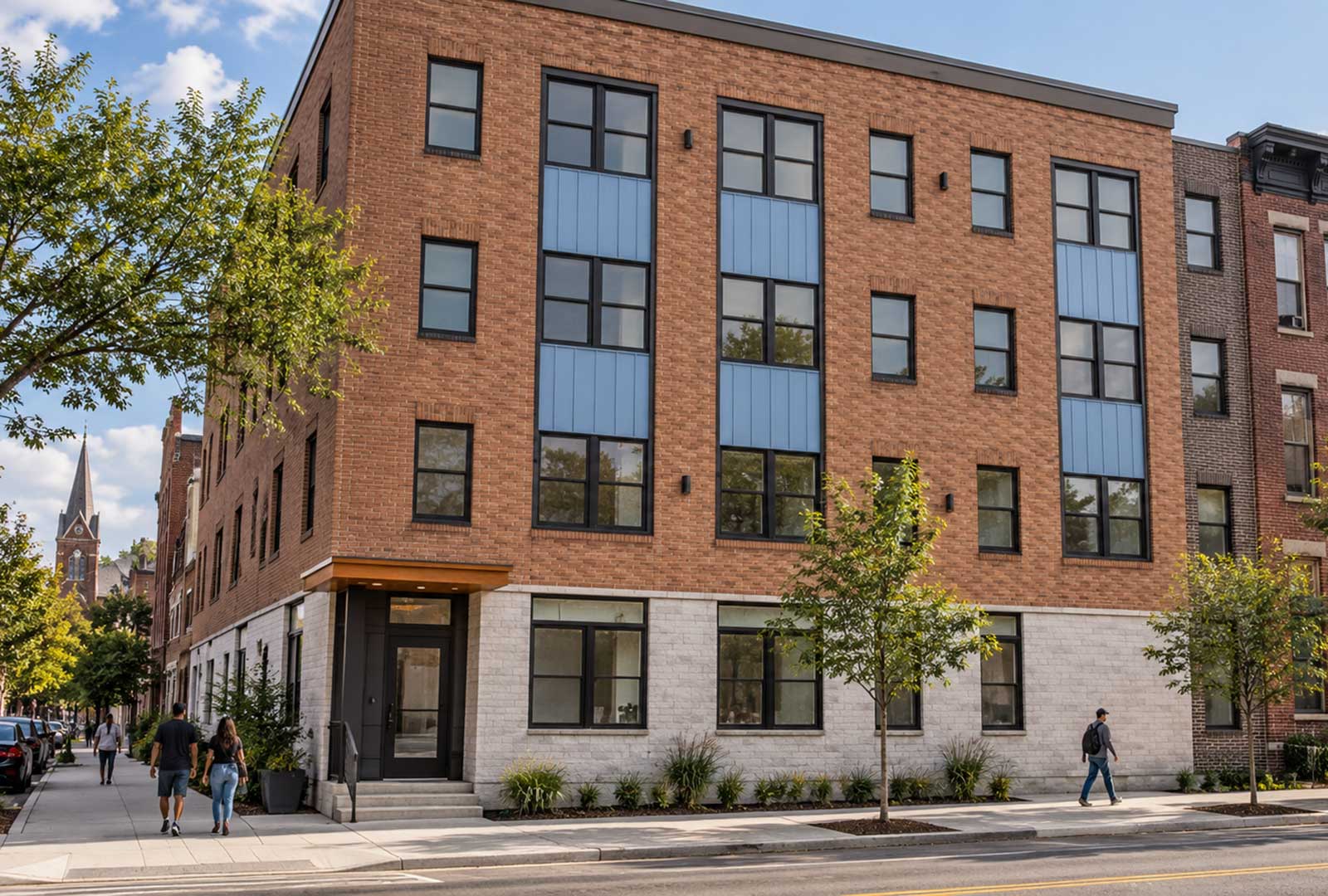
Gloria’s Place opened on Dunlap Street last month with 44 apartments and no sobriety requirement at the door.
The federal agency that helps fund supportive housing like it closes a competition on Sept. 30 that rewards something else.
Cincinnati built its homelessness system on federal Housing First funding, and HUD now says that experiment failed. Over-the-Rhine Community Housing cut the ribbon at 2000 Dunlap Street on Aug. 20, two blocks from Findlay Market. The building sits inside the Vine Street corridor the Exchange mapped in August. It holds 44 studio and one-bedroom apartments for people who have experienced chronic homelessness.
OTRCH puts the total development budget at $14.7 million, including $10 million in Low-Income Housing Tax Credits. The Exchange tested Cincinnati LIHTC rents against market rates last week. WVXU reported $14.9 million at the ribbon cutting. Model Group, whose construction arm is a listed project partner, also leads the Wesley Baymiller renovation that drew a $1.85 million city pledge.
OTRCH describes the model without hedging: permanent housing “without requiring sobriety as a condition of entry.” WVXU reported that residents will not have to prove sobriety or take part in treatment to keep their apartments. Strategies to End Homelessness fills those units through its coordinated entry list. President and CEO Kevin Finn called Gloria’s Place “exactly the type of supportive housing that our community needs to reduce homelessness” in a statement.
What Cincinnati Told HUD About Housing First
The commitment runs deeper than one building. The City of Cincinnati’s 2023 performance report to HUD went out for public comment in March 2024. It puts 100% of the Continuum of Care’s rapid re-housing projects and 98% of its permanent supportive housing projects under “Housing First principles.” Those principles, the report says, mean low entry barriers and termination “only after significant intervention.” One CoC-funded sober-housing project is the lone exception. Even there, participants “are not immediately evicted if relapse occurs.”
The same report records a choice that matters now. The federal government, it says, “continues to prioritize Rapid Re-housing over Transitional Housing models.” So the community “has decreased transitional housing capacity over the years.” Strategies and the Homeless Clearinghouse agreed to keep phasing it out, except for some treatment, youth and domestic-violence programs. HUD’s new notice says the national supply of transitional housing fell 59.5% since 2007. In other words, Cincinnati shrank the exact category HUD now wants to grow.
HUD’s 2026 Rules Reward Treatment and Transitional Housing
HUD released its fiscal 2026 Continuum of Care notice on June 1. It rewrites the terms of Housing First funding nationwide. The notice itself calls Housing First “a profound failure by any measure.” The department offered $4.04 billion and set aside $1.3 billion for new projects, prioritizing transitional housing and supportive-services-only projects. Tier 1, the share of renewal funding shielded from competition, drops from 90% in 2024 to 60%.
The mechanics matter more than the rhetoric. Applicants must certify they will not run drug-injection sites or knowingly permit illicit drug use on property they control. The notice says that certification “is not a requirement that projects condition assistance on sobriety or treatment,” though both stay allowed. So Washington is not mandating sobriety. Instead, it is scoring for something Housing First projects have avoided.
A Continuum earns eight points if every housing project it submits requires residents to participate in services such as case management. Each project competing in Tier 2 also earns up to 10 points of 100 for the same requirement. Twenty more points ride on treatment and recovery, including on-site addiction treatment at 30% of housing projects and at least one sober-housing project. Federal rules still bar requiring mental health or medical services to stay in a program, outside substance-abuse treatment projects. The notice also reminds Continuums that some permanent housing residents “may be eligible for Transitional Housing.” Separate HUD guidance limits such moves to residents facing imminent loss of housing or fleeing domestic violence.
Where Housing First Funding Goes in Cincinnati
HUD’s fiscal 2024 award report lists 46 grants to the Cincinnati/Hamilton County Continuum of Care, known as OH-500. They total $32,125,343. The Exchange sorted every grant by the component abbreviation in its name. Twenty-two permanent supportive housing grants carry $13.9 million. Another 14 rapid re-housing grants carry $10.6 million. Together, permanent housing takes $24.5 million, or 76 cents of every dollar in the award. Meanwhile, the only transitional housing money is in three joint transitional-and-rapid-rehousing grants totaling $3.5 million.
Five of the permanent supportive housing grants are labeled “OTR PSH,” totaling $2,548,272. HUD’s sheet does not say which buildings those grants support. So nothing here should read as $2.5 million flowing to Gloria’s Place. Roughly three-quarters of OH-500’s fiscal 2024 award went to permanent supportive housing and rapid re-housing projects. Those are the categories that carry Cincinnati’s Housing First funding, and the new $1.3 billion set-aside does not prioritize them. HUD’s 2026 estimate puts OH-500’s renewal demand at $31,496,065 and Tier 1 at $18,897,639. That leaves $12.6 million to compete on score.
The Competition Is Already Underway in Cincinnati
Strategies, which serves as OH-500’s collaborative applicant and unified funding agency, opened the round ahead of a June 24 orientation. Applicants, it said, “will be scored using the Goals, Objectives, and performance expectations” in HUD’s 2026 notice, plus local criteria. It also went out of its way to invite “new organizations, including faith-based partners.”
Then the courts intervened in the Housing First funding fight. On Aug. 7, U.S. District Judge Mary S. McElroy in Rhode Island set aside the notice “in its entirety.” She found HUD skipped the notice-and-comment process the McKinney-Vento Act requires before it rewards “any other activity” beyond permanent housing. The $1.3 billion set-aside, she wrote, “undoubtedly incentivizes grantees to conform their CoC programs to HUD’s goals.” She did not rule on whether the policy itself is lawful. Twenty-three states and jurisdictions, led by Washington, brought one suit. Cities, counties and the National Alliance to End Homelessness brought the other.
A Court Stay Reopens the Continuum of Care Round
HUD appealed. On Sept. 16, the First Circuit granted a stay pending appeal. It wrote that “HUD has made a strong showing that it is likely to succeed on the merits.” HUD then reopened the competition Sept. 18 with a Sept. 30 deadline and plans to announce awards by Dec. 1. It has also published a Federal Register notice seeking comment through Oct. 13 on which activities deserve incentives. That is the process the district court said it skipped.
Finn saw this coming in June. “Unfortunately, we are likely going to spend the better part of the year watching court cases,” he told WVXU. Housing, he said, “is absolutely critical to people being able to appropriately address” the problems that made them homeless. He said he does not “completely disagree with the emphasis on making housing programs as short as necessary.” But “most of our homeless folks are not substance users, are not mentally ill or that sort of thing,” he said.
Two Definitions of Success
HUD’s case for redirecting Housing First funding rests on its own point-in-time count. On one night in January 2025, 745,652 people were homeless nationally, and 266,320 of them were unsheltered. HUD dates its comparison to 2013, the year the notice says it first mandated Housing First. Since then, it reports, homelessness is up 27%, unsheltered homelessness 36% and chronic homelessness 81%. Taxpayer-funded beds rose 151% and Continuum of Care spending 111%. Those numbers are simultaneous trends, not a causal finding. The National Low Income Housing Coalition, for instance, points to rising rents, lagging wages and cuts to housing aid over the same years. The same report shows a 3% decline from 2024, the first since 2016.
HUD’s release adds a second number: 1,456,923 people “either homeless or living in taxpayer subsidized/funded housing for the homeless.” That is not 1.46 million homeless people. A resident who moves into Gloria’s Place leaves the point-in-time count that night. Public money, though, keeps paying for the apartment and the caseworker. The notice goes further, saying rapid re-housing “artificially” lowered the count by classifying people in short-term assistance as permanently housed. Whether any of that counts as success is the actual point of contention over Housing First funding.
What the Research Says About Housing First
The strongest evidence for Housing First is its impact on housing stability. A 2019 systematic review in the Journal of Epidemiology and Community Health pooled four randomized trials. Housing First participants were 2.46 times as likely to be in stable housing at 18 to 24 months. They also made fewer emergency department visits. The review, however, found “no clear difference in substance use” and rated every trial at high risk of bias. A 2021 PLOS ONE review of reviews agreed. On the other hand, a 2025 review found abstinence-based recovery housing beat usual care on abstinence and employment. It rested on five eligible studies of a different population.
What HUD’s Own Scorecard Says About Cincinnati
HUD already keeps a scorecard for the Housing First funding it sends Cincinnati. Its system performance measures dataset, built from each Continuum’s HMIS records, covers every CoC from fiscal 2015 through fiscal 2024. It counts every project reporting to the local system, not only HUD-funded ones. The Exchange pulled OH-500’s ten-year record and ranked it against roughly 380 other Continuums. The file also shows the annual award growing 79%, from $17.98 million in fiscal 2015 to $32.1 million. In fiscal 2024, 94.9% of the 2,089 people in Cincinnati’s permanent housing programs other than rapid re-housing either stayed or left for other permanent housing. That is HUD’s retention measure, and it excludes rapid re-housing. Cincinnati posted 97.6% in fiscal 2016. It has slipped below the median among reporting Continuums (96.0% last year) in each of the last three years.
Returns to Homelessness Run Above the Median
Returns tell a harder story. Of 1,256 people who left Cincinnati permanent housing programs for permanent destinations, 16.9% were back in the homeless system within two years. The median Continuum was 10.7%, based on an unweighted comparison across all that report. Cincinnati has run five to eight points above that median every year since HUD began reporting the measure by project type in 2018. On the other side of the ledger, 48.0% of people leaving Cincinnati shelters, transitional housing and rapid re-housing went to permanent housing. That beats roughly three-quarters of Continuums. Cincinnati also beat the median on income: 20% of adults leaving its HUD-funded programs had gained earned income, against 12.9% for the median Continuum. Finally, one data-quality flag sits in the same file. Cincinnati recorded an unknown destination for 10.8% of its permanent supportive housing exits, more than twice the median Continuum’s 4.3%.
HUD’s New Rubric Applied to Cincinnati
HUD’s new notice turns those measures into points. Full credit for returns requires a rate under 8% at two years, with one point for under 16%. Across all program types, 18.0% of Cincinnati’s exits to permanent housing returned within two years, so it clears neither. It would take one of three points on the 12-month measure and none of two for exits below 50%. It would also take none of the 12 for earned income, where HUD wants 20% of participants and 25% of leavers to gain wages. The bar is high for everyone. Only 52 of 385 Continuums beat 8% on two-year returns, and among the 61 systems with at least 2,000 exits, two did. Only 12 Continuums had 20% of program stayers gaining earned income. The competition will likely use fiscal 2025 data, which HUD has not yet published. The Exchange’s scoring is its own calculation, not HUD’s.
What Cincinnati Measures on Its Own
Strategies reports that 6,821 people experienced homelessness in Hamilton County in 2025, 23% of them children. That is a full-year figure, not a one-night snapshot, so it cannot sit beside HUD’s point-in-time count. Its shelter system, funded by the county indigent care levy under the Homeless to Homes plan, served 3,448 people in 2025. Strategies reports that 69.5% of households exited to positive housing, and 80% remained stably housed for 24 months. Those are strong shelter numbers. Still, they are not permanent supportive housing numbers, and they say nothing about Gloria’s Place.
What neither HUD’s file nor Strategies publishes is the rest of what HUD now says Housing First funding should buy. HUD’s measures track one year of retention, not three or five. Nor do they track treatment engagement, exits to unsubsidized housing, deaths in housing or cost per resident. The new notice scores a Continuum on whether 20% of its permanent housing exits go to unsubsidized housing. The Exchange could find no Cincinnati source that has published that figure. Cincinnati’s own 2023 report does mention a pilot to shift capacity “from permanent supportive housing to Rapid Re-Housing.” Local officials, it seems, had begun asking a version of HUD’s question before HUD did.
Open Questions for Strategies, OTRCH and City Hall
The Exchange is putting these questions about Housing First funding and outcomes to Strategies, Over-the-Rhine Community Housing and the city’s development department:
- Is the 98% Housing First share reported in 2023 still accurate, and how many OH-500 projects now require service participation?
- Which properties do the five “OTR PSH” grants fund, and how much Continuum of Care money will support Gloria’s Place?
- Did any Cincinnati provider apply to convert a permanent supportive housing project into transitional housing this round?
- Why do Cincinnati’s returns to homelessness from permanent housing run above the median among Continuums, and why are 10.8% of PSH exit destinations unknown?
- What share of permanent supportive housing exits go to unsubsidized housing, and what does Gloria’s Place count as success beyond a resident staying?
Same Corridor, Different Question
The question the Exchange raised in August stays separate. Whether Housing First works for the person in the apartment is one question. Whether one half-mile of north Over-the-Rhine should house so many supportive-housing and recovery beds is another question. No data in this reporting ties that concentration to crime, vacancy or drug activity, and nothing here claims it does.
The record shows a city that shaped its homelessness system for more than a decade around the Housing First funding Washington offered. It shrank transitional housing as federal priorities shifted in that direction. Now it faces a Sept. 30 deadline in a competition that rewards the reverse. Washington has changed its definition of success for Housing First funding. The numbers HUD has published for Cincinnati measure housing stability, returns, permanent exits and income. They do not directly measure treatment engagement, recovery, deaths in housing or the other outcomes HUD’s new policy emphasizes. Until someone publishes those, the ribbon at Gloria’s Place records a building opened, not an outcome measured.
FAQs
What is Housing First?
Housing First moves people experiencing homelessness into permanent housing without requiring sobriety, treatment participation or employment first, then offers supportive services once they are housed. HUD’s earlier funding notices defined it as housing with no preconditions. Cincinnati’s 2023 performance report to HUD said 98% of its permanent supportive housing projects and all of its rapid re-housing projects followed it.
Does Housing First require sobriety?
No. Housing First does not condition a lease on sobriety or treatment. Gloria’s Place, which opened in Over-the-Rhine on Aug. 20, 2026, provides permanent housing without requiring sobriety at entry, according to Over-the-Rhine Community Housing. HUD’s 2026 funding notice also does not require participants to be sober, though it now prioritizes treatment-focused projects.
What changed under HUD's 2026 homelessness funding rules?
HUD’s fiscal 2026 Continuum of Care notice offers $4.04 billion and sets aside $1.3 billion for new projects, prioritizing transitional housing and supportive services. Tier 1 renewal protection falls from 90% to 60%. The notice does not require sobriety but awards points for service-participation requirements and on-site treatment. The First Circuit let the competition proceed Sept. 16, 2026, pending appeal.
How does Cincinnati perform on HUD's homelessness measures?
HUD’s system performance data for fiscal 2024 show 94.9% of people in Cincinnati permanent housing programs other than rapid re-housing stayed or exited to permanent housing, just below the 96.0% median Continuum. Of those who left permanent housing programs, 16.9% returned to homelessness within two years, against a 10.7% median. Cincinnati beat most Continuums on permanent-housing exits and earned-income gains.
Is Gloria's Place a Housing First development?
Yes. Over-the-Rhine Community Housing describes Gloria’s Place, at 2000 Dunlap Street, as permanent supportive housing for people who have experienced chronic homelessness, provided without requiring sobriety as a condition of entry. It has 44 studio and one-bedroom apartments, 24-hour front-desk staffing and on-site case management. OTRCH reports a $14.7 million development budget; WVXU reported $14.9 million.
This article was researched and drafted with assistance from The Cincinnati Exchange’s proprietary AI article system, drawing on primary sources, government records and on-record local reporting, with facts independently verified before publication. This is a reported analysis: conclusions drawn from the documents are the author’s, and documented facts and attributed statements are distinguished throughout. Litigation over HUD’s fiscal 2026 Continuum of Care funding notice is ongoing; the First Circuit’s Sept. 16, 2026 order is a stay pending appeal, not a final ruling on the merits.