
Share This Article
Article Summary:
An opinion column argues Cincinnati is turning a single half-mile of Vine Street into the city’s default social-service corridor, adding Gloria’s Place, a new Housing First building, to a stretch that already holds several other supportive-housing and recovery facilities, right as the federal government pivots away from the Housing First model it relies on. It argues for measurable outcomes and a more even geographic distribution of services, not for cutting them.
Walk north from Findlay Market along Vine Street, and you pass a permanent supportive housing building, a recovery house, a supportive building, a halfway house, then another recovery program, in roughly the space of ten blocks.
Cincinnati has spent decades trying to turn that same stretch into the connective tissue between Downtown and Uptown, and the two goals are starting to collide.
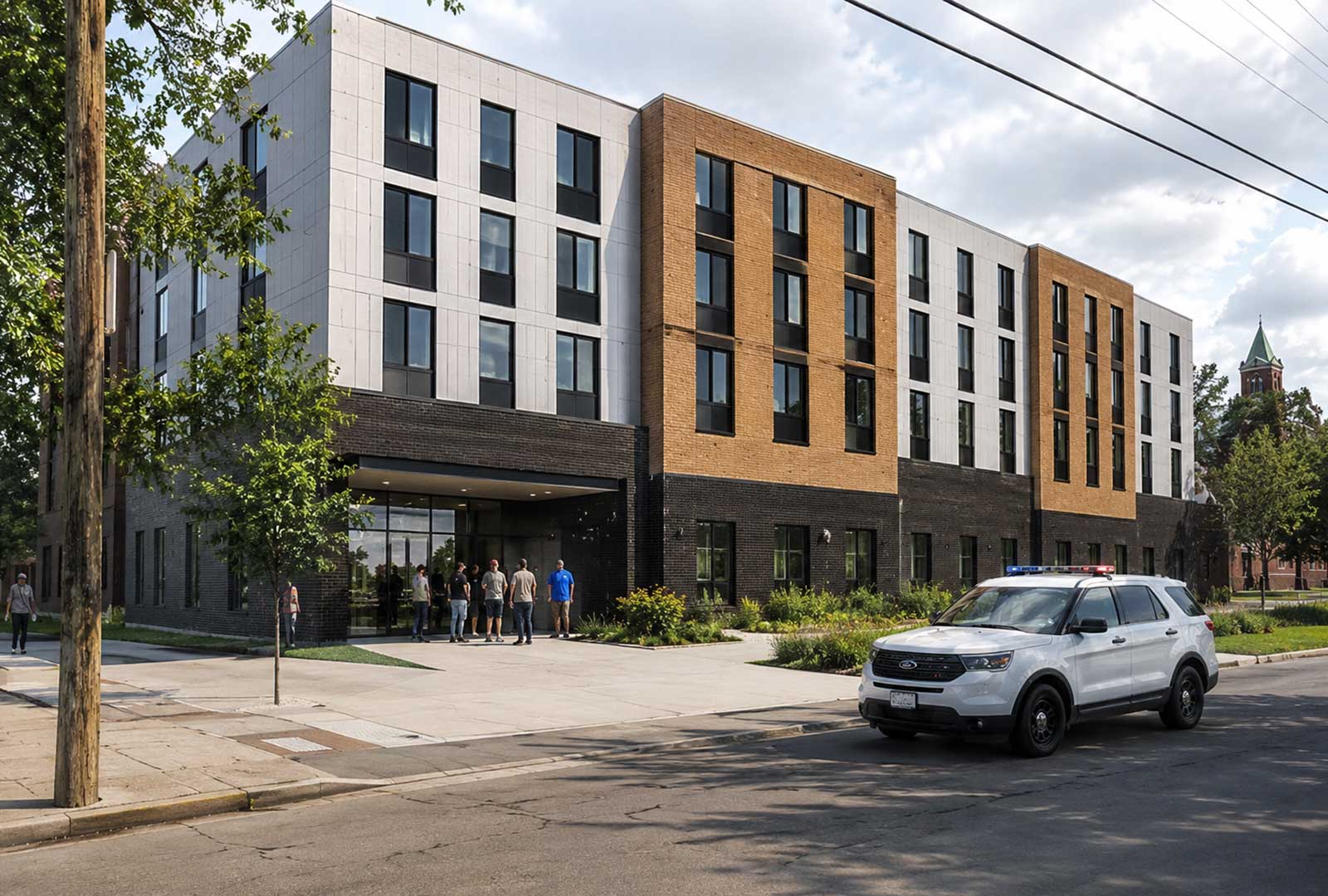
Gloria’s Place, OTRCH’s new 44-unit building at 2000 Dunlap Street, opens this week. It’s the newest addition to Vine Street supportive housing, and at least four other permanent buildings already operate within blocks of it. None of these facilities individually looks like bad policy. Together, they raise a question Cincinnati hasn’t had to answer out loud. This particular corridor keeps absorbing the city’s hardest social-service infrastructure. Neighborhoods a few miles away absorb almost none of it.
Vine Street Supportive Housing Goes Well Beyond Gloria’s Place
Four other permanent supportive housing buildings operate within roughly a mile of Gloria’s Place. Buddy’s Place, at 1300 Vine Street, houses 20 formerly homeless adults. Jimmy Heath House, at 114 West 14th Street, has run 25 units under OTRCH’s Housing First model since 2010. Logan Towers, which Talbert House operates at 1817 Logan Street, holds 63 units. Its residents have histories of chronic homelessness, mental illness, or substance use.
OTRCH also operates Nannie Hinkston House, a 12-bed transitional facility at 45-47 E. McMicken Avenue, which it opened in 2007 in partnership with the Drop Inn Center for homeless people recovering from substance abuse. Carrie’s Place, a 43-unit OTRCH program on East Clifton Avenue toward Uptown, mixes preserved affordable family housing with additional supportive units. OTRCH’s own program figures list 43 units in total, but property records for the single address most commonly cited for Carrie’s Place show a much smaller building, suggesting the program spans more than one site. Neither OTRCH nor state housing records make the exact supportive-unit count or site breakdown public.
Recovery and transitional housing cluster along the same stretch of Vine. It serves a legally and practically different population than permanent housing does. Charlie’s 3/4 House, at 2121 Vine Street, houses up to 50 men in sober living. Talbert House’s Cornerstone program, at 2216 Vine Street, houses justice-involved clients with substance use disorders. Gateway House, at 2232 Vine Street, holds 50 transitional beds for men in recovery. Tender Mercies operates several additional supportive buildings nearby in the West End. Harkavy Hall and the recently renovated Spaeth and Kelly Hall are both on West 12th Street. Together they serve roughly 200 adults with mental illness a year. The organization is also preparing to renovate Glen Wright Place, a 25-unit building at 1440 Pleasant Street. A 2025 tax-credit award funds the renovation.
None of that includes ordinary affordable housing without a homelessness or recovery component. Mid Line, OTRCH’s planned 57-unit income-restricted building at Vine and Polk streets near Inwood Park, is one example. OTRCH’s own project page describes Mid Line as still unbuilt, with financial closing and construction expected to begin in spring 2026. Conflating a project that has no residents yet with buildings already housing formerly homeless adults would be inaccurate. An affordable apartment isn’t a halfway house, and a sober-living facility isn’t a homeless shelter. They serve different populations under different funding rules. But someone living on this stretch of Vine experiences geography, not funding categories. Put the addresses on a map, and a pattern emerges: no single approval created on its own.
How the City Got 44 Units Instead of 14
Gloria’s Place’s own approval shows how that pattern forms one decision at a time. The site’s zoning allowed 14 units. Cincinnati’s Historic Conservation Board denied OTRCH’s request for a variance to build more. City council responded by passing a “notwithstanding ordinance,” a legal mechanism that allows the council to override its own zoning code outright. Council member Reggie Harris, not OTRCH itself, requested it. It passed unanimously, and the density more than tripled to 44 units.
Cincinnati resident Mark Miller sued, arguing the notwithstanding process itself was an improper use of council authority. A trial court dismissed his case in 2023 for lack of standing. The First District Court of Appeals upheld that dismissal in 2024. It ruled Miller hadn’t shown he was vindicating a public interest, as Ohio’s taxpayer-suit rules require. His substantive argument about the ordinance was therefore moot, the court found, because the standing question alone resolved the case. The fight didn’t end there.
Miller took it to the Ohio Supreme Court, where it sat for more than a year. It drew an amicus brief from the Ohio Municipal Attorneys Association. The brief warned the outcome could affect how any Ohio taxpayer sues their own city. The court closed the case within the past year. It denied Miller’s motion for reconsideration on January 20, 2026. Chief Justice Kennedy and Justice Hawkins dissented, according to the court’s own case announcement. That dissent means even the Ohio Supreme Court wasn’t unanimous. Justices disagreed about whether Miller deserved his day in court over how this specific density decision got made.
What the City Says Caused the Republic Street Crisis
The clearest evidence that concentration carries real costs, not hypothetical ones, sits four blocks from Gloria’s Place. St. Francis Seraph Church spent roughly eight years informally sheltering homeless people on its property. Security costs of about $10,000 a month forced it to lock its doors in March 2024. Surveillance video documented open drug use, public sex, and defecation outside the building. Police tied roughly 150 arrests and 400 charges to the area in 2023 alone. Cincinnati barricaded Republic Street near Green Street for six months starting that May.
Assistant City Manager Virginia Tallent was careful, in comments to WCPO at the time, not to blame the neighborhood’s own residents. “What we’re really facing in north Over-the-Rhine is more related to vacancy and blight, and it has less to do with the population that lives there,” she said. “We’re really talking about people who aren’t residents. It’s a lot of folks who are chronically unhoused. It’s folks coming up from low-barrier night shelters and frequenting service providers and choosing to spend time in the vicinity.” She also pointed to “third parties” who bring “resources to the doorstep of the church” through meals and giveaways, saying their behavior “really would be useful” to change.
That distinction matters, and this piece deliberately makes it: the city’s own account blames traffic and behavior connected to services concentrated in one place, not the people the services exist to help. Cincinnati Police District One Capt. Matthew Hammer, who oversaw the barricade, put it more bluntly to WCPO: officers wanted drug buyers to conclude “they’ll see too much risk” and go elsewhere.
Two years later, the city and 3CDC are spending roughly $5 million to acquire the closed church campus, and officials have described the deal as preserving its services. That’s accurate only in the short term. St. Francis Seraph Ministries board president Sofie Snauwaert said the organization will “continue to serve our clients during this transition period and until we move.” The city’s actual plan is to relocate St. Anthony Center and its partner agencies to a new “Center of Care” at a site not yet chosen, with Downtown, Over-the-Rhine, Queensgate and the West End all still under consideration. Once that site opens, 3CDC will redevelop the church property itself.
Until that relocation happens, the same warming shelter that draws 150 to 200 people on a typical activation day, and the same dining room that serves 354 meals a day, will keep operating on the current campus. Nobody involved has explained why the conditions that led to a street barricade in 2024 won’t recur before the move happens, or what changes to the surrounding blocks will occur once services relocate.
The Case for Housing First, and the Case for Scrutinizing It
Gloria’s Place follows the Housing First model: residents first receive a lease without sobriety or treatment requirements. Supporters include Strategies to End Homelessness CEO Kevin Finn. They argue someone battling addiction or serious mental illness stabilizes more easily after securing permanent housing than before it. That’s a real, evidence-informed argument. It deserves a fair hearing.
It shouldn’t end the conversation, though. Cincinnati and OTRCH haven’t published the outcome data needed to determine whether Housing First is working here. Cincinnati hasn’t said how many residents of Gloria’s Place or Jimmy Heath House eventually move into unsubsidized housing, or how many complete treatment. It hasn’t said how long the average resident stays or how much the city spends per successful transition. A ribbon-cutting measures activity. It doesn’t measure whether fewer people are chronically homeless five years from now than are today. Until the city publishes those numbers, “we opened another building” and “the problem is getting better” stay two different claims. Only one of those claims has evidence behind it so far.
That scrutiny isn’t just local anymore. HUD Secretary Scott Turner announced in June 2026 that the department was redirecting its $4.04 billion Continuum of Care program away from Housing First. He called it “the ‘housing first’ experiment” that “failed Americans by warehousing the vulnerable without results,” and pointed to homelessness reaching record levels despite the spending. In August, HUD joined the White House drug policy office and Health and Human Services to release a “Treatment First” toolkit instead. Turner argued, “housing alone is not enough.” Strategies to End Homelessness, the same organization backing Gloria’s Place, is applying for FY2026 funding under that same reoriented federal competition. Cincinnati is opening a new Housing First building in the same year its program’s largest federal funder started walking away from the model.
San Francisco Shows What Concentrated, Under-Resourced Supportive Housing Can Become
San Francisco offers a cautionary comparison, not a prediction for Cincinnati. The San Francisco Chronicle’s “Broken Homes” investigation, published April 26, 2022, examined a permanent supportive housing system that houses roughly 6,000 people across about 70 single-room-occupancy hotels at a cost of about $160 million a year. The Chronicle found at least 166 people fatally overdosed in city-funded hotels during 2020 and 2021. Those buildings held less than 1% of San Francisco’s population. They accounted for 14% of the city’s confirmed overdose deaths.
The Chronicle tracked 515 people after they left federally funded permanent supportive housing in 2020. About a quarter of them, 131 people, died while still enrolled in the program. Roughly one in five returned to homelessness, temporary housing or an institutional setting. Another quarter reached other permanent housing, often another subsidized building or a relative’s home, and the remainder left for a destination the city couldn’t track. The Chronicle also reported case managers carrying caseloads as high as 85 tenants, five times the federal standard, and documented more than 1,600 building-code violations at these hotels since 2016.
The Chronicle’s own conclusion was narrower than the raw numbers might suggest: it found inadequate staffing, weak oversight and deteriorating buildings behind these outcomes, the same conditions Cincinnati officials cited when explaining what went wrong on Republic Street. Gloria’s Place is a new building with 24-hour staffing, not a converted SRO hotel, and this comparison doesn’t presume it will repeat San Francisco’s failures. The relevant lesson is narrower still: concentrating hard-to-manage caseloads in one place raises the stakes when staffing and oversight fall behind, the same geographic pattern Cincinnati is now building on Vine Street.
Follow Where the Money and the Incentives Point
There’s a version of this argument that accuses somebody of corruption, and this isn’t that version. Nothing here suggests OTRCH, Strategies to End Homelessness, Talbert House, or Tender Mercies is doing anything other than its mission. The people doing casework and counseling for Cincinnati’s homeless population are doing difficult work most residents wouldn’t volunteer for.
But a project like Gloria’s Place still runs through developers, architects, a contractor, attorneys, and financing professionals before it opens. Administrators, caseworkers, and property managers take over after it does. The money comes through Low-Income Housing Tax Credits, HUD and HOME funds, the Federal Home Loan Bank, city financing, and philanthropy.
Reported figures for the total project cost have varied by construction stage, ranging from $14 million at groundbreaking to $14.9 million by the time it opened. This piece uses the more recent ribbon-cutting-stage figure, which comes to roughly $339,000 per apartment. None of the organizations receiving that money has the same built-in incentive a private business has to finish the job and close up shop. Their funding depends on the problem persisting at some scale. That doesn’t make anyone dishonest. It’s a structural reason taxpayers should demand outcome measurements, not just accept dollars spent and beds opened as evidence of success.
An Over-the-Rhine Resident Speaks Out
Not every objection to Gloria’s Place has come through a lawsuit or a public meeting. John Donaldson, a longtime Over-the-Rhine resident, sent his reaction directly to Cincinnati Exchange rather than through a published statement. He called the project “the last thing the struggling families in our neighborhood need.” Also accused what he called “professional poverty pimps” of benefiting from a system that leaves the neighborhood in the same disorder. He says that pattern repeats year after year.
Gloria’s Place has 44 units, and the most recent reported development cost is $14.9 million, or about $339,000 per apartment, which is at the high end of a range that started closer to $14 million at groundbreaking. As someone who works in the neighborhood every day, you could see another project like this as demoralizing and counterproductive to further investment in the neighborhood. How many other people are feeling this way after years of city officials promoting investment from independent business owners and residents like Mr. Donaldson?
What the Corridor’s Investors Weren’t Told
City planning documents once studied Vine Street as the route for an Uptown streetcar extension. They described the corridor as the link between Downtown and the University of Cincinnati’s medical and employment district. Planners anticipated that better transportation would raise property values and draw development. Private investors responded. People bought and renovated houses. Restaurants and shops opened around Findlay Market. The city and 3CDC are now investing roughly $100 million in north Over-the-Rhine, including the $47 million Findlay Community Hub, set to open in January 2027.
City Center Properties CEO Chris Frutkin put the tension plainly to WCPO in 2024: “You can’t put investment dollars in a neighborhood that’s out of control.” No city budget line captures what a restaurant loses when a regular customer stops coming back. Nor does any line capture what a developer gives up when a renovation gets shelved over what might open next door. Cincinnati spent decades encouraging people to bet their own money on this corridor’s future. It owes those investors a clear account of why the same corridor is also its preferred site for the hardest social services.
A Different Cincinnati Neighborhood Made the Same Argument
North Over-the-Rhine isn’t the only Cincinnati neighborhood raising this question. The comparison cuts in a more complicated direction than a simple “even they agree” would suggest. In May 2024, ten West End residents filed a federal complaint that HUD accepted for investigation. They argued Cincinnati violated the Fair Housing Act and Civil Rights Act. The complaint says the city steered tax credits toward predominantly Black neighborhoods already saturated with subsidized housing. Attorney Laura Beshara, representing the residents, said the concentration is “extreme.” The complaint cites West End’s low-income tax-credit units roughly doubling to 1,750 between 2005 and 2021. That’s against just 623 such units across every Cincinnati-area neighborhood that’s at least 75% white.
That concentration isn’t new. The city itself once tried to stop it. Then-Councilman John Cranley pushed what became a formal “housing impaction” policy in his first term in 2001. He wrote at the time that the West End’s “high concentration of low-income residents” was “creating a domino effect of declining property values relative to inflation and increasing social ills.” The resulting city policy committed Cincinnati to opposing new publicly assisted low-income rental housing in neighborhoods that already had a disproportionate share of such housing. It made an exception for senior housing. That policy remained on the books throughout the exact period covered by the 2024 HUD complaint. It didn’t stop West End’s low-income tax-credit units from roughly doubling anyway.
That HUD complaint is a civil-rights claim about racial segregation. It isn’t a generic land-use objection, and this piece doesn’t treat it as one. OTRCH itself rejected the comparison publicly. It called the complaint an attempt to “corrupt” the Fair Housing Act in service of “pro-gentrification and ‘Not In My Back Yard’ interests.” Readers should weigh that rebuttal seriously. They shouldn’t treat West End’s complaint as simple confirmation of a North OTR argument. The two neighborhoods aren’t making identical claims, and the same organization at the center of the Gloria’s Place story has already said so on the record.
What both disputes share is narrower and harder to dismiss than either complaint alone. Residents in two different, historically low-income Cincinnati neighborhoods reached the same conclusion independently. The city keeps routing subsidized and social-service infrastructure toward places that already have a lot of it. A 23-year-old city policy was supposed to prevent exactly that. HUD has not announced a resolution as of this story’s publication.
The Strongest Argument for Keeping Services Together
Supportive-housing advocates have a genuine answer to all of this. People experiencing homelessness often need housing, medical care, addiction treatment, meals, transportation, and case management at the same time. Clustering providers close together lowers the practical barriers between someone and the help they need. That’s real efficiency, not an excuse.
It isn’t the only public interest Cincinnati has to weigh, though. Neighborhood stability matters. So does the money private investors have already put into this corridor on the strength of the city’s own redevelopment promises. So does the question of whether Cincinnati’s other 51 neighborhoods should stay exempt from hosting a comparable share of this infrastructure. Efficiency for a service network is a real value. It isn’t automatically the only one that outranks the rest.
Nobody Voted to Build a Corridor
No single meeting produced this outcome. Twenty units got approved here. Then 25. Then 44, over a Historic Conservation Board’s objection. A recovery house opened down the block from a day center. That center sits blocks from a supportive building, which sits blocks from another one. Each decision had its own hearing, its own file, and its own individually defensible justification. The cumulative geography that resulted was never put to a single vote.
The Findlay Community Hub is rising a few blocks from where Gloria’s Place just opened. Farther down the hill, Cincinnati is investing $4 million to keep St. Anthony Center’s services at St. Francis Seraph. Continue north past Findlay Market and the recovery houses start appearing along Vine, one after another. They keep appearing before the corridor reaches Inwood Park. Cincinnati has spent decades and real public money trying to make this half-mile the link between Downtown and Uptown. It has never spent a single public meeting asking whether that same half-mile should also be the city’s default answer to homelessness, addiction, and mental illness. At some point, those two plans for the same street become incompatible. City Hall, not the neighborhood, should be the one to say which one wins.
FAQs
Is the Gloria's Place zoning lawsuit still active?
No. The Ohio Supreme Court closed the case, most recently denying a motion for reconsideration on January 20, 2026, with two justices dissenting.
How many supportive and recovery housing facilities are near Gloria's Place?
At least four other permanent supportive housing buildings and three recovery/transitional facilities operate within roughly a mile of one another, not counting additional Tender Mercies properties nearby in the West End.
What happened on Republic Street in 2024?
Cincinnati barricaded the street for six months after an open-air drug market, which city officials attributed to non-residents connected to nearby shelters and service providers, produced roughly 150 arrests and 400 charges in 2023.
Did West End residents raise a similar concentration concern?
Yes, but on different legal grounds, and it isn’t new. Ten West End residents filed a federal fair-housing complaint in 2024 alleging racial discrimination in subsidized-housing placement, more than two decades after a 2001 city policy was supposed to prevent exactly that kind of concentration. OTRCH has publicly disputed the 2024 complaint as a gentrification-driven objection.
Does this piece argue against helping people experiencing homelessness?
No. It argues that Cincinnati should distribute supportive and recovery services more evenly across the city and publish outcome data, not that services should be reduced.
Is Cincinnati's day center staying at St. Francis Seraph permanently?
No. The city and 3CDC have described the deal as preserving services, but officials say St. Anthony Center will eventually relocate to a new “Center of Care” at a site not yet chosen, with Downtown, Over-the-Rhine, Queensgate, and the West End still under consideration.
Has the federal government changed its position on Housing First?
Yes. HUD Secretary Scott Turner announced in June 2026 that the department was redirecting its $4.04 billion Continuum of Care program away from Housing First, and in August 2026, HUD joined HHS and the White House drug policy office to promote a “Treatment First” approach instead.
This article was researched and drafted with AI assistance, drawing on primary sources, official statements, and direct reporting, with facts independently verified before publication. This is an opinion piece; the views expressed are the author’s interpretation of the reported facts and are clearly distinguished from documented facts throughout.