
Share This Article
Key Points:
- Cincinnati’s DCED conditionally committed up to $1.85 million in TIF set-aside money to Wesley Baymiller in a June 5, 2025 City Manager memo.
- On that date, city inspectors had two roof-leak cases at Final Notice at 76 E McMicken Ave, a building within the city’s stated Wesley Baymiller project site.
- City rental inspectors found all 12 apartments at 76 E McMicken code-compliant in December 2025, while fire escape repair orders stayed open into 2026.
- The city’s May 2026 notice calls Wesley Baymiller a $26 million project, up from a $19.3 million estimate in the June 2025 memo.
Article Summary:
Wesley Baymiller is a 60-unit affordable housing rehab by Model Group and POAH in Cincinnati. The city conditionally committed up to $1.85 million in TIF funds on June 5, 2025, when its own inspectors issued two Final Notices for roof leaks at 76 E McMicken Ave, a building on the project site. Public records don’t show whether DCED’s promised underwriting checked those files, and the project’s stated cost has since risen from $19.3 million to $26 million.
When Cincinnati committed $1.85 million to Wesley Baymiller in June 2025, one of its buildings faced two city Final Notices.
No public record shows whether the city’s development office checked its own inspection files before committing.
Wesley Baymiller would renovate 13 older buildings holding 60 subsidized apartments and five commercial spaces. Model Group leads the development, and Preservation of Affordable Housing, the Boston nonprofit known as POAH, holds a position in the ownership structure. After construction, POAH’s management company would run the buildings. Tenant complaints about POAH’s Cincinnati properties led to a citywide inspection sweep in 2025, WCPO reported. Legal Aid attorney Nick DiNardo told the station that “a lot of basic preventive maintenance is not getting done.”
The dollar amount hasn’t changed since the Exchange first reported the proposal in May. The record around it has.
What the Wesley Baymiller Commitment Actually Is
The $1.85 million first appears in a June 5, 2025 City Manager memo to Council. It lists a conditional commitment from the Department of Community and Economic Development. The entry shows 60 units, POAH and Model Group as the team, and an estimated cost of $19.3 million. It carried three conditions: final DCED underwriting, City Council approval of funding “if not previously approved,” and a state tax credit award. In addition, the memo explains why these commitments exist. DCED issues “Letters of Support” to 9% credit applicants “to improve application competitiveness and project financial feasibility.”
For its part, the state held up its end. The Ohio Housing Finance Agency reserved 9% low-income housing tax credits for the project in May 2025. A year later, OHFA approved a $1.75 million Housing Development Loan for the project.
Where the Baymiller TIF Money Comes From
Specifically, the city money would come from the affordable housing set-aside in the Downtown/Over-the-Rhine East tax increment financing district. City Planning’s project page says those dollars will only be used to renovate buildings within that district. So the $1.85 million doesn’t cover all 13 buildings. The city also proposes a 15-year, net 67% Community Reinvestment Area property tax exemption.
| Public support | Type | Amount or term | Source |
|---|---|---|---|
| City TIF set-aside | Direct assistance | Up to $1.85 million | City Manager memo, June 2025 |
| CRA exemption | Property tax break | 15 years, net 67% | City Planning |
| Federal 9% LIHTC | Tax credits sold to investors | $14,999,990 over 10 years, about $13.19 million in equity | OHFA application |
| Housing Development Loan | State loan | $1.75 million | OHFA, May 2026 |
| Housing Assistance Payment contracts | Federal rental subsidy | Two 20-year contracts covering all 60 units | City Planning |
Of course, those rows aren’t interchangeable. Tax credit equity, a loan, a tax exemption and rent subsidies are different kinds of money, and adding them into one total would mislead. Still, the city’s check is a small slice of a much larger public stack.
What the City’s Files Showed on June 5, 2025
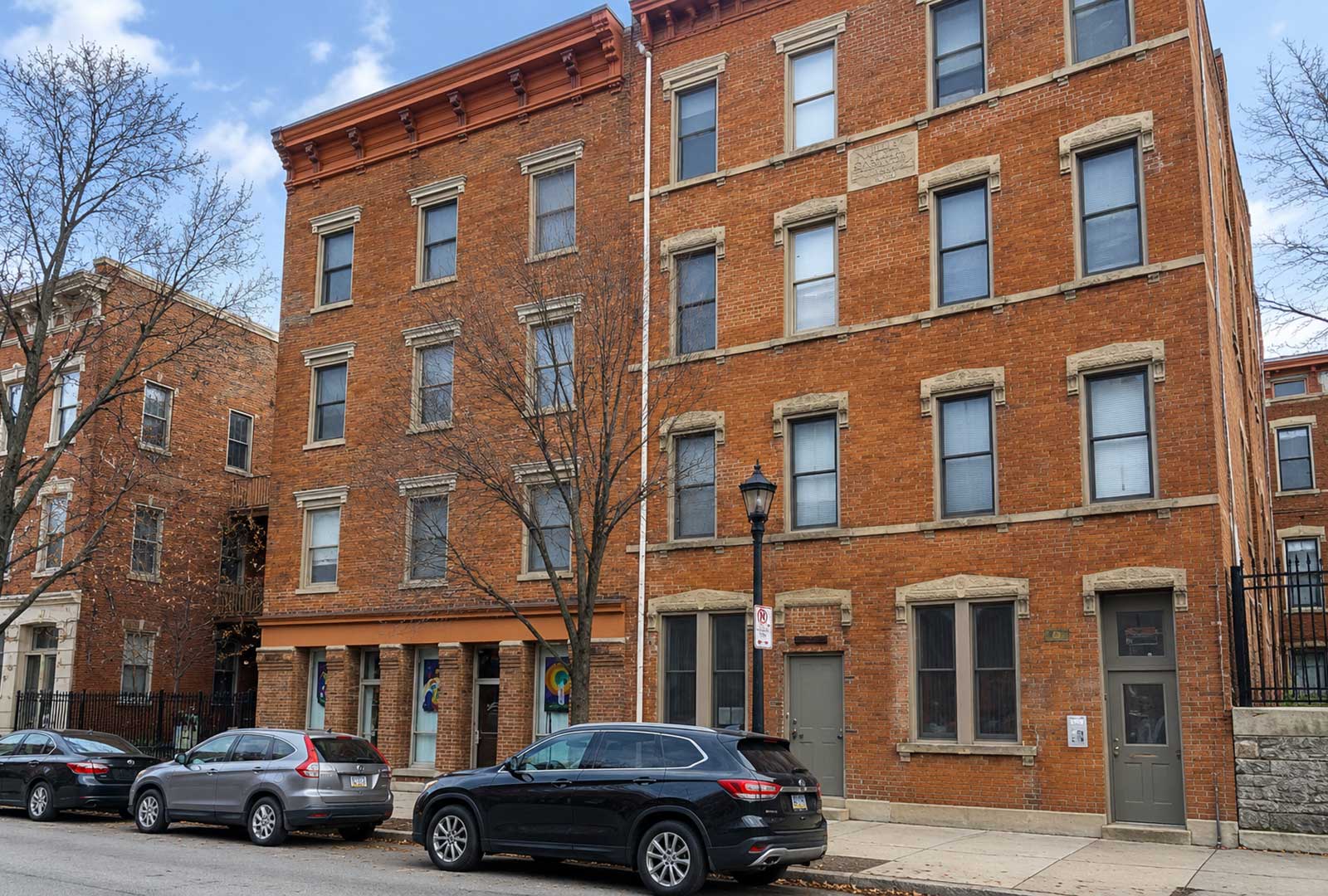
The city’s May 2026 meeting notice lists the project location as “70 E McMicken Ave (includes 70-80 E McMicken Ave and 1705 Lang St).” The accompanying map marks that site and 1622 Logan St as subject sites. County property records list Wesley Estates Limited Partnership as the owner of the 70 E McMicken site. POAH’s 2024 audited financial statements list that partnership as 100% owned by POAH.
By the time of the June 2025 memo, city inspectors already had two open cases at 76 E McMicken Ave. Both involved the roof.
In June 2024, an inspector found an overflowing gutter had damaged the family room ceiling in unit 8, according to case BC20240540. By October, the inspector wrote “roof repairs not complete.” In November, the city mailed a Final Notice and posted it again on March 13, 2025.
Later, a second case opened in November 2024. The inspector found “Water leak from roof/gutter caused drywall damage in family room” and ordered roof and plaster repairs, per case B202407166. On March 13, 2025, the inspector recorded “No further progress towards compliance.” The city mailed a Final Notice on April 11, 2025, eight weeks before the commitment.
Both cases stayed open until Dec. 17, 2025. That day, inspectors closed them and referred future enforcement to a new rental inspection case. Even so, the records don’t say whether anyone fixed the roof. They also don’t show whether anyone at DCED looked, and the June memo doesn’t say whether DCED reviewed building-level inspection records.
A Repair Order at 76 E McMicken
The city’s rental inspection sweep reached the building late in 2025. On Dec. 10, inspectors checked 12 apartments, and all 12 unit records list them as code compliant. Outside the apartments, the building fared worse. A Feb. 26, 2026 re-inspection in case CRI2500272 notes “Fire Escape has not been repaired.” Fire escape repair orders from December 2025 remained open when the Exchange reviewed them.
The September 2026 Order
A building that Cincinnati identifies as part of the Wesley Baymiller project had a repair order issued in September 2026, with the cited conditions still listed as “In Violation” in the city case record at the time of review. The Exchange reviewed the record on Sept. 24.
Most recently, case B202606427 at 76 E McMicken Ave opened on Sept. 2. A city inspector visited on Sept. 18 and issued recommended orders. A supervisor confirmed them Sept. 21, and the inspector posted them at the building the next day. Overall, the repair items read like a punch list for an aging building. For example, the inspector noted “AC not working,” defective plaster in a closet, and leak damage, also in a closet.
For now, the public record doesn’t show the deadline for those repairs, so calling them overdue would be premature.
The September case is only a few weeks old, and leaks or broken air conditioners happen everywhere in occupied buildings. The clean unit inspections count for something, too. Also, the case doesn’t establish that TIF dollars will touch 76 E McMicken. Only the funding agreement or a building schedule can confirm which buildings receive the money, and the Exchange doesn’t have either yet.
The question for DCED is simpler. Did anyone there check these inspection files, and does an open order matter for underwriting, disbursement or closing?
Where the POAH Cincinnati Inspections Stand
The city’s broader POAH review started after WCPO’s July 2025 reports, according to the station. A city spokesperson told WCPO that inspectors would cover all 148 POAH buildings and 969 apartments. In April 2026, the spokesperson said inspectors had issued active violations at 102 units, and POAH had corrected about 500 violations. Sevara Davis, chief operating officer of POAH Communities, told WCPO the city had completed its inspections and more than 80% of units complied. She said POAH had put $5 million into renovations.
An Exchange analysis found 317 building code cases since January 2024 among 180 Cincinnati parcels whose tax bills list POAH’s local office or its Boston headquarters. Of those, 36 remained open as of Sept. 23. However, the count reflects cases rather than individual violations, and the location matching is approximate. It comes from the city’s open-data code enforcement dataset, which includes complaint cases but excludes rental inspection results. Those appear address by address in the county’s property activity reports, so the Exchange couldn’t check the city’s portfolio totals independently.
The $26 Million Question
Then there’s the price tag. The city’s May 2026 meeting notice describes the project as “a $26 Million LIHTC (Low Income Housing Tax Credit) rehabilitation project.”
But that’s not the number from a year earlier. The June 2025 memo estimated $19.3 million. OHFA’s 2025 proposal-stage application summary put total development costs at $19,287,643, or about $321,000 per apartment. The memo says that final applications were due to OHFA on Sept. 18, 2025, so the budget may have changed by that time.
In other words, the gap runs about $6.7 million, roughly 35%. Yet the Exchange found no public document explaining it. Scope, construction, acquisition or financing costs could each account for part of it. The developer fee can climb too, since state rules tie it to eligible costs, up to $3 million.
It also changes the math on the city’s share. By the Exchange’s calculation, $1.85 million equals about 9.6% of a $19.3 million project and about 7.1% of a $26 million one. On one hand, a smaller share could look like a better deal for taxpayers. On the other, it could mean someone else absorbed a big cost increase. Nobody knows which without the underwriting.
What the City Told Reporters About Terri Manor
Wesley Baymiller isn’t POAH’s only recent city award. On Sept. 16, 2025, City Manager Sheryl Long announced $1 million for Terri Manor, POAH’s 81-unit complex in Lower Price Hill.
WCPO reported the award amid tenant complaints about rats, sewage backups, mold, lack of hot water, and broken stoves. A city spokesperson told the station the “(NOFA) grant” depended on two demands. POAH had to prioritize critical repairs at Terri Manor and continue working with the city on its entire portfolio.
However, the memo itself tells a thinner story. It never uses the words “grant” or “condition.” Instead, it describes the program as “gap financing loans for up to 40% of total project costs” and says “Funding will be disbursed once agreements are executed.” Nowhere does it mention repairs, inspections or POAH’s portfolio.
Still, that doesn’t mean the conditions don’t exist. They may sit in the executed funding agreement. The difference matters because conditions only protect taxpayers if they can be enforced, and enforcement requires a written document.
The Case for Renovating Now
The strongest argument for the project comes from its own paperwork. OHFA’s application states that the buildings date from 1855 to 1891 and last underwent renovations with tax credits in 2004 and 2005. Twenty years on, it says, “there is significant need for updates to systems, exteriors, windows, and interior finishes.”
Read that next to the 76 E McMicken order. A dead air conditioner and a leaking closet fit the kind of work the application describes. Because of that, supporters would argue that delaying the money leaves tenants living with those conditions longer. Meanwhile, the HAP contracts keep all 60 apartments affordable, and the application reports 95% occupancy.
That argument carries real weight and settles the question of whether the buildings need work. They do. However, a rehab replaces systems and finishes, not the management company. After the renovation, OHFA’s application lists POAH Communities as property manager. The June 2025 memo promised “final underwriting by DCED” before any money moves. So the open question is whether that review weighed the operator’s record, including the Final Notices already in the city’s own files. A second question is whether the city’s agreement sets any terms for maintenance or monitoring.
What the City Hasn’t Said About the Baymiller TIF
The public record leaves five questions open:
- Approval. Does the $1.85 million need a Council ordinance? A comparable award suggests it does. Model Group’s Reid Flats project drew $2,227,016 from the Over-the-Rhine West TIF district’s affordable housing set-aside, and Council approved it by ordinance in June 2025. That ordinance lists every building address. The City Business List and Temporary Prohibition List, which track pending incentive legislation, showed no Wesley Baymiller entry as of Sept. 23.
- Cost. What turned $19.3 million into $26 million, and did DCED re-underwrite?
- Buildings. Does 76 E McMicken receive TIF proceeds?
- Underwriting. Did DCED’s final underwriting check inspection records for the project’s buildings, and did it weigh POAH’s management record?
- Terri Manor. Did POAH satisfy the conditions the city described, and where are they written down?
FAQs
What is Wesley Baymiller?
Wesley Baymiller is an affordable housing renovation of 13 older buildings holding 60 apartments and five commercial spaces in Cincinnati. Model Group leads development, and Preservation of Affordable Housing (POAH) is part of the ownership structure. Two 20-year federal Housing Assistance Payment contracts subsidize all 60 units, which serve households at 60% of area median income or less.
How much has Cincinnati committed to Wesley Baymiller?
A June 5, 2025 City Manager memo lists a conditional DCED commitment of up to $1.85 million from the Downtown/Over-the-Rhine East TIF district’s affordable housing set-aside. The city also proposes a 15-year, net 67% Community Reinvestment Area tax exemption. The commitment depends on final DCED underwriting and, if needed, Council approval of funding.
Why did the Wesley Baymiller cost change?
The June 2025 memo estimated $19.3 million, and OHFA’s 2025 proposal-stage application listed $19,287,643. The city’s May 2026 meeting notice calls it a $26 million project. No public document reviewed by The Cincinnati Exchange explains the roughly $6.7 million increase, which may have come at the September 2025 final application stage.
What did city inspectors find at 76 E McMicken Ave?
Two roof-leak cases opened in 2024 reached Final Notice before the June 2025 commitment and closed in December 2025 without a recorded repair. Rental inspectors found all 12 apartments code-compliant that month, but fire escape repairs stayed open into 2026. A September 2026 order cites a nonworking air conditioner and closet leak damage.
Did POAH meet the conditions on its Terri Manor award?
Unknown. A city spokesperson told WCPO the $1 million award required priority repairs and portfolio-wide cooperation. The Sept. 16, 2025 City Manager memo announcing it lists no conditions. The executed funding agreement would show whether the conditions exist in writing, and the city has not made it public.
The Cincinnati Exchange’s proprietary AI article system assisted with research, verification, and drafting. A human editor reviewed and approved the article before publication. Tenant complaints described in this article were reported by WCPO and have not been independently verified by The Cincinnati Exchange. City code enforcement records reflect inspector findings and case status, not court judgments.