



Share This Article
Article Summary
Cincinnati officials are reviewing policing policies and procedures as part of a renewed commitment to the Collaborative Agreement, a police reform framework first established in 2002. The announcement follows a Campaign Zero report that found Black residents were stopped by Cincinnati police at disproportionately higher rates than white residents over a 15-year period. City leaders plan to conduct an independent review of police contact card data while continuing to implement recommendations from the agreement’s 2018 refresh.
Cincinnati officials have announced a renewed commitment to the Collaborative Agreement.
They are launching a review of policing policies and procedures following new concerns about racial disparities in police stops.
The announcement came during a community meeting in Roselawn on Thursday. At this meeting, city leaders, police officials, and residents discussed the future of bias-free policing and community trust.
The meeting was organized by the Cincinnati Black United Front and drew about 100 attendees. Officials said the effort builds on the city’s long-standing commitment to police accountability. It also addresses recommendations identified through previous reform efforts. According to WVXU, the renewed initiative follows a recent analysis by police reform nonprofit Campaign Zero. The nonprofit examined more than 15 years of Cincinnati Police Department contact card data.
The Collaborative Agreement was created in 2002 as part of a settlement to a federal lawsuit filed by the Cincinnati Black United Front and the American Civil Liberties Union (ACLU) of Ohio. The lawsuit alleged racially biased policing within the Cincinnati Police Department following years of community tension and the 2001 police shooting of Timothy Thomas. That shooting sparked widespread unrest. Although the city has not been legally required to follow the agreement since 2008, Cincinnati has continued using many of its principles. These include community-oriented policing and police contact cards. According to city officials, those commitments remain in place today.
Collaborative Agreement review follows disparity report
The city’s renewed review comes weeks after Campaign Zero released a report alleging significant racial disparities in Cincinnati police stops between 2009 and 2025. The nonprofit analyzed more than 472,000 police contact cards and concluded that Black residents were stopped, searched, and subjected to force at disproportionately higher rates than white residents. Furthermore, Campaign Zero reported that in 2025, Black residents were stopped approximately 3.4 times more often than white residents.
City officials acknowledged the report but said additional context and independent analysis are needed before drawing conclusions. According to WLWT, City Manager Sheryl Long said the city had not been consulted before the report’s publication. She also emphasized that the administration takes allegations of racial bias seriously. She announced plans for an independent third-party review of the department’s contact card data.
Speaking at Thursday’s meeting, Long said the administration welcomes difficult conversations and intends to focus on lasting improvements rather than avoiding criticism. She also noted that compliance with the Collaborative Agreement has already been incorporated into police department performance metrics. This performance change was implemented before the Campaign Zero report became public.
Interim Cincinnati Police Chief Adam Hennie also reaffirmed the department’s commitment to the reform agreement. He told attendees he expects to be held accountable for implementing recommendations from the agreement’s 2018 refresh. He will regularly report progress to city leadership.
Collaborative Agreement actions move forward
City officials outlined several initiatives designed to strengthen accountability and improve public confidence in policing.
Current efforts include:
- Reviewing proposals for an independent analysis of police contact card data.
- Continuing implementation of recommendations from the 2018 Collaborative Agreement refresh.
- Expanding community action teams focused on police technology, data analysis, and mental health.
- Evaluating updates to digital contact cards to improve data collection.
- Preparing for a Collaborative Agreement Conference scheduled for Sept. 10 through Sept. 12, 2026.
Officials said the city released a request for proposals in June seeking an outside organization to evaluate contact card data independently. Preliminary findings are expected later this summer after the review process is completed.
The city also reported progress on recommendations adopted during the Collaborative Agreement’s 2018 refresh. Officials said 35 of the 52 recommended actions have either been completed or remain in progress. Those initiatives include expanding police data analysis, improving records management, and strengthening Community Problem-Oriented Policing programs.
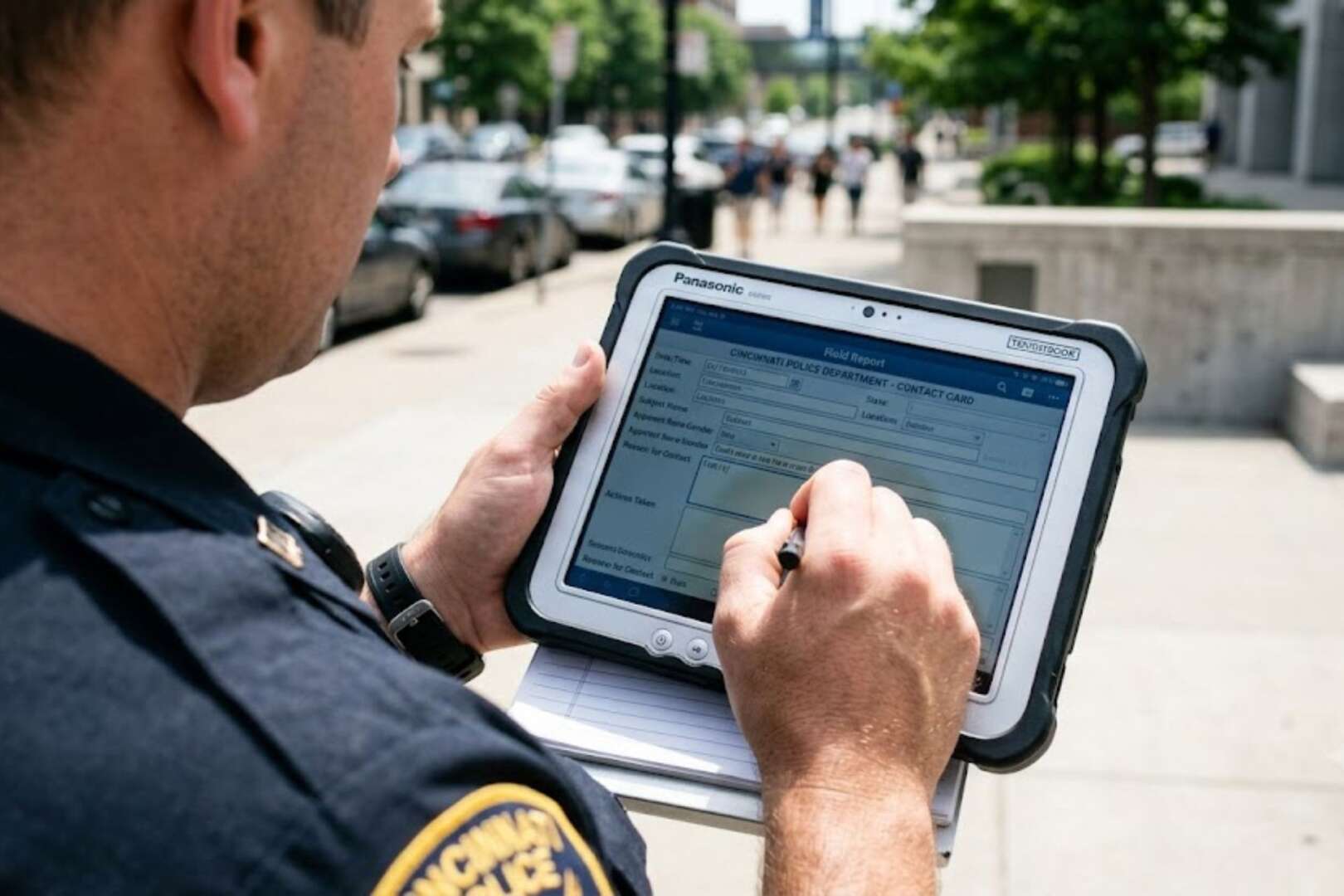
In addition, officials are considering changes to digital contact cards that officers complete after traffic and pedestrian stops. Proposed revisions include requiring officers to identify every responding officer at an incident. These revisions will also require officers to record beat assignments and document which officer initiated the contact. City leaders believe those updates could improve transparency and strengthen future analyses of policing practices.
Community leaders call for continued participation
Community advocates encouraged residents to remain involved as the city evaluates its policing practices.
Iris Roley, co-founder of the Cincinnati Black United Front and one of the original negotiators of the Collaborative Agreement, said meaningful progress depends on continued collaboration between city leaders, police officers, and residents. She pointed to ongoing public safety efforts throughout downtown and transit areas. Additionally, she encouraged more community participation in problem-solving initiatives.
The Citizen Complaint Authority, which was created through the original Collaborative Agreement, is expected to continue playing a central role in community engagement and oversight as the review moves forward. Action teams are expected to provide recommendations on policing technology, mental health response, and data transparency. However, meeting schedules have not yet been announced.
The upcoming Collaborative Agreement Conference in September will bring together city officials, community organizations, and residents. They will review the history of Cincinnati’s police reform efforts. They will discuss progress achieved over the past two decades. In addition, they will identify additional opportunities to strengthen trust between law enforcement and the community.
For many city leaders, the renewed commitment represents an opportunity to revisit one of Cincinnati’s most influential police reform agreements. It is also an opportunity to respond to modern concerns raised through recent data analysis. Whether the independent review confirms or challenges Campaign Zero’s findings, officials say the goal remains the same. That goal is maintaining transparent, accountable, and bias-free policing throughout Cincinnati.
Also read:
Campaign Zero recommendations call for Cincinnati police reforms after racial bias report
FAQs
What is the Collaborative Agreement?
The Collaborative Agreement is a police reform framework created in 2002 to settle a federal lawsuit alleging racial bias in Cincinnati policing. It promotes bias-free policing, community engagement, problem-oriented policing, and independent oversight.
Why is Cincinnati reviewing the Collaborative Agreement now?
The city announced the review after a Campaign Zero report identified racial disparities in police stops using more than 15 years of contact card data. Officials said they will evaluate existing policies and conduct an independent analysis of the findings.
What changes are city officials considering?
Officials are reviewing police policies, updating digital contact card procedures, and expanding community action teams focused on policing technology, data, and mental health. The city is also continuing work on recommendations from the agreement’s 2018 refresh.
What happens next in the review process?
Cincinnati plans to hire an independent organization to analyze police contact card data and report its findings. The city will also host a Collaborative Agreement Conference in September 2026 to discuss progress and future policing initiatives.


