
Share This Article
Key Points:
- Cincinnati police coded 1 of 287 homicide incidents as gang-related in 2021-2024 FBI data.
- Cincinnati coded 71 of 28,569 eligible offenses as gang-involved, a 0.25% rate.
- Three 2021 killings a prosecutor tied to rival gangs went to the FBI coded “No Gang Involvement.”
Article Summary:
FBI files show Cincinnati police coded 71 of 28,569 eligible offenses and one of 287 homicide incidents as gang-related from 2021 through 2024. CPD keeps a separate gang database, but no public procedure governs the federal gang code.
Gunfire killed 18-year-old Avante Baker Beatty on Lexington Avenue in Avondale at 4:28 p.m. on Sept. 27, 2021.
Cincinnati police reported his killing to state and federal crime databases under the code Ohio labels “No Gang Involvement.”
His record is one line in Cincinnati gang data, and the data almost never says “gang.” In fall 2022, then-Hamilton County Prosecutor Joseph Deters announced a 20-count indictment of Michael Madaris, a teenager who was 15 at the time of the shootings. “It is believed that the three homicide victims were targeted by Madaris because they were potentially identified as rival gang members,” the prosecutor’s office said.
Beatty was one of them. Yarsellay Sammie, 39, died in Evanston on Oct. 12. Javier Randolph, 16, died there the next day. In the FBI’s crime files for Cincinnati, all three killings carry the same code Beatty’s does.
That’s not a quirk of one case. The Cincinnati Exchange pulled five years of FBI incident data for Ohio. From 2021 through 2024, Cincinnati police coded one of 287 homicide incidents as gang-related. Columbus coded 22. City Hall leans on that same police data to defend its policies, including the parking security mandate the mayor tied to stolen guns. Those numbers have come up short before. In August, The Exchange found the 2005 benchmark often used for Over-the-Rhine’s crime numbers rests on two conflicting totals with no located CPD source.
What Signal 99 Got Right
The question started on X. On Oct. 4, Signal 99 Cincinnati, a local account that covers police and public safety, posted a five-part thread about it. The account said the thread drew on 18 months of conversations with officers, detectives and command staff. The FBI counted more than 69,000 gang incidents nationwide from 2021 through 2024, the account noted, “while Cincinnati reported ZERO.” Those sources, the account wrote, say district commanders scrub gang references from federal reports on the city’s orders.
On the zero, the data says otherwise. In the FBI files, Cincinnati gang data shows police coded 71 offenses as gang-involved in those four years, most of them assaults. The scrubbing claim comes from sources the account didn’t name. The Exchange couldn’t confirm it, and the FBI data alone can’t prove or rule it out.
But the thread got the thing that matters right. When someone dies in Cincinnati, the federal record almost never mentions a gang, even when a prosecutor later does.
One Gang Killing in Four Years
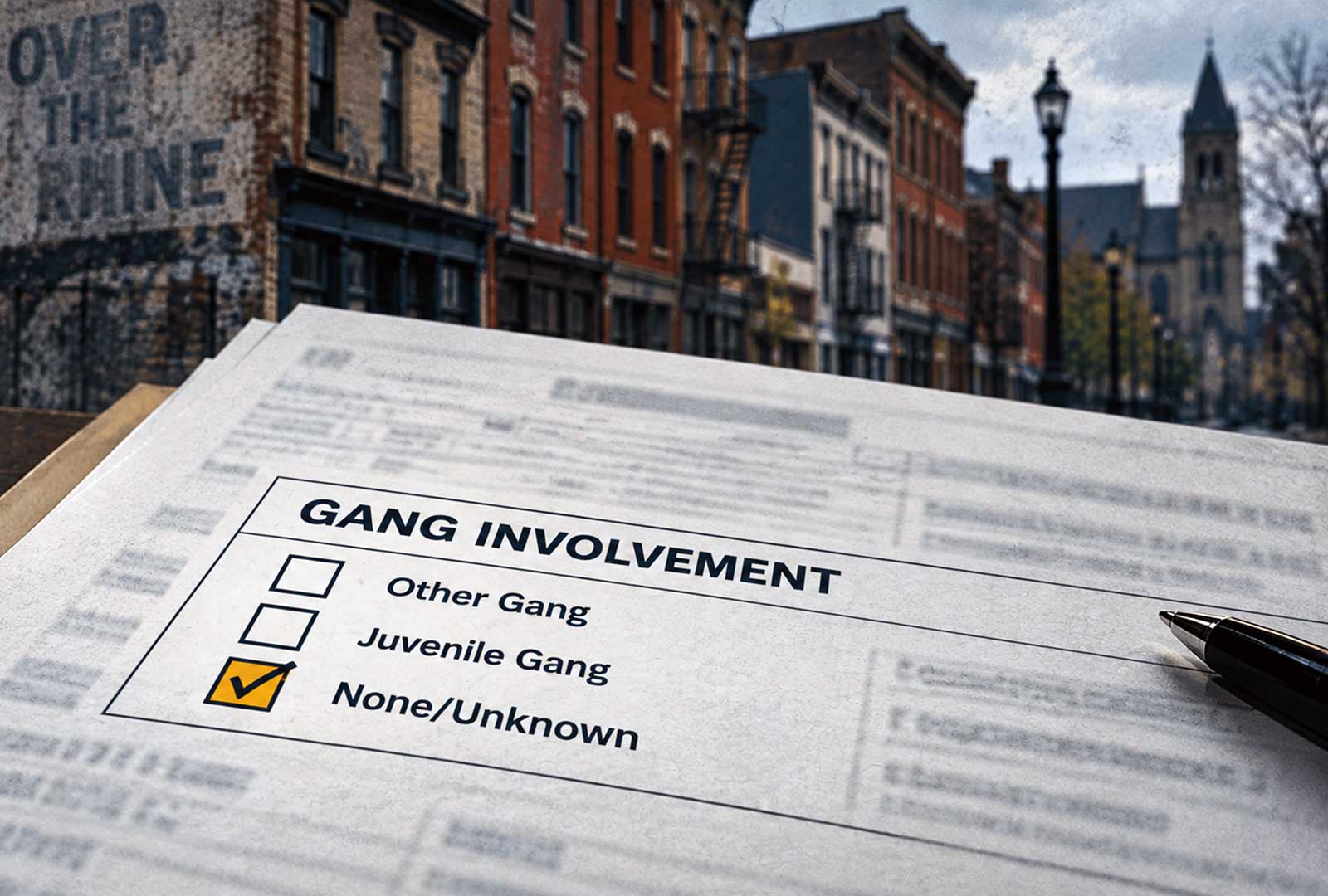
Ohio police departments send their crime reports to the FBI through the state’s Incident-Based Reporting System. For homicides, assaults, robberies, kidnappings and sex offenses, it carries a gang field with three choices: Other Gang, Juvenile Gang, or the code Ohio’s specifications label “No Gang Involvement.” The FBI’s files label that last code “None/Unknown,” which is a meaningfully different thing to call it.
From 2021 through 2024, CPD sent 28,569 offenses that could take a gang code. It marked 71 of them gang-involved, or 0.25%. Every other one got “None/Unknown.” Not one came in blank.
Homicides tell the story fastest. CPD reported no gang-related murders at all from 2021 through 2023, then one in 2024. The 2025 file adds one more, out of 64. Here’s how that compares with the rest of Ohio’s big cities.
| Department | Eligible offenses, 2021-2024 | Gang-coded | Share | Murder incidents | Gang-coded murders |
|---|---|---|---|---|---|
| Cleveland | 84,403 | 1,141 | 1.35% | 518 | 25 |
| Columbus | 73,506 | 206 | 0.28% | 508 | 22 |
| Toledo | 50,673 | 685 | 1.35% | 179 | 5 |
| Cincinnati | 28,569 | 71 | 0.25% | 287 | 1 |
| Akron | 23,829 | 340 | 1.43% | 107 | 8 |
| Dayton | 17,947 | 0 | 0.00% | 131 | 0 |
| All Ohio agencies | 575,901 | 4,942 | 0.86% | Not calculated | |
Source: The Cincinnati Exchange’s analysis of FBI NIBRS incident files for Ohio. Eligible offenses are the categories that take a gang code. Murder counts track incidents, not victims, as of each year’s FBI release.
How Cincinnati Compares With Columbus
Cincinnati’s overall rate looks a lot like Columbus’s. The killings don’t. Cleveland and Toledo flagged gang involvement at more than five times Cincinnati’s rate. Dayton, meanwhile, reported no gang codes in any of the five years, so Ohio does have a city whose federal data says zero. It just isn’t Cincinnati.
Put Cincinnati on Columbus’s footing and the gap gets concrete. At Columbus’s rate, about a dozen of Cincinnati’s 287 murder incidents would carry a gang code. At that rate, the chance of landing at one or fewer by luck is roughly 1 in 24,000. That isn’t random noise. Something about how CPD codes killings differs from its neighbors.
Matching Three Killings to the Federal Record
The FBI files don’t carry names, so The Exchange matched the Madaris cases by date, hour, victim age and sex. Cincinnati’s 2021 file holds an 18-year-old male killed in the 4 p.m. hour on Sept. 27, a 39-year-old male on Oct. 12 and a 16-year-old male on Oct. 13. No other Cincinnati murder record fits those dates.
The latest submission date on Beatty’s record is Feb. 16, 2022, three months after police charged another teenager as the driver in his killing. It still says “No Gang Involvement.” Deters made his gang statement in October 2022, the same month the FBI finalized its 2021 file. Federal rules let agencies send updated incidents, but The Exchange found no rule requiring it.
Prosecutors didn’t charge Madaris with participating in a criminal gang, either. His indictment listed murder, felonious assault, kidnapping and other counts, and the release mentions no gang specification. He later pleaded guilty to involuntary manslaughter and kidnapping in a 20-year deal, FOX19 reported. A search of Hamilton County prosecutor releases and local coverage since 2021 turned up no Cincinnati case with that gang charge.
A Gang Database That Doesn’t Talk to the Crime Report
CPD doesn’t ignore gangs. It tracks them, just somewhere else. Procedure 12.330, “Gang Investigations,” orders officers to document “all suspected or confirmed street gang activity.” Verified entries go into a database the procedure calls the Ohio attorney general’s “Gang Unit Access Research Database,” or GUARD. The Exchange couldn’t find a single attorney general document that names it.
Getting into GUARD isn’t hard. Any two of nine criteria make someone a gang member, and one makes them an associate. Five of the nine can rest on what “law enforcement or … a reliable informant/source” says. The procedure also requires the Intelligence Unit commander to “conduct quarterly audits of data transactions” and send a written report up the chain.
So CPD can label someone a gang associate on a single informant’s identification, once an anti-gang officer reviews it. Yet nothing in its public procedures tells an officer when to label a crime. Procedure 12.330 never mentions federal crime reporting. The incident-reporting procedure, 12.400, lists “NIBRS required fields” and never uses the word “gang.” CPD updated that one in December 2025, while the gang procedure still carries a 2019 revision date.
Then there’s the blank that never happens. In four years and 28,569 eligible offenses, CPD never once left the gang field empty. That’s what a records system looks like when it fills in “None/Unknown” automatically and waits for someone to change it. CPD hasn’t said whether that’s how its system works.
Where the “Zero” Probably Came From
The FBI’s 2025 gang report, the one the thread cites, contains no city figures at all. Look there for Cincinnati and you’ll find nothing, which is easy to read as zero. The real Cincinnati gang data sits only in the raw incident files.
Those files also explain one of the thread’s anonymous quotes. A command staff member told the account that federal reports get “sanitized to say, ‘Subject died of Homicidal Violence.'” But the FBI’s files hold no narrative text, only codes. A gang mention in a written report never reaches the FBI under any system. The code is the only way it gets there, and in Cincinnati’s homicide records it almost never does.
Could Scrubbing Gang Codes Break Ohio Law?
The thread cites Ohio’s tampering and falsification laws. Tampering with records covers anyone who alters data “knowing the person has no privilege to do so.” It also requires a “purpose to defraud” or knowledge of facilitating a fraud. For government records, it’s a third-degree felony. Falsification covers knowingly false statements tied to “a report or return that is required or authorized by law,” usually a first-degree misdemeanor.
Both laws turn on intent. A default code that nobody bothers to change wouldn’t qualify. A supervisor who swapped a gang code for “None/Unknown” to make the numbers look better could face exposure under either one. The FBI data shows which code went out, not who chose it or why.
Groups, Not Gangs?
Cincinnati officials used to say “gang” without flinching. A National Network for Safe Communities guide counts about 60 Cincinnati street groups in 2008, with roughly 1,500 members. Those people, about 0.3% of the city’s population, could be “directly linked to nearly 70 percent of the homicides in the entire city,” the guide says. In 2010, police and federal agents identified “approximately 70 members of the Tot Lot Posse” in the West End, FOX19 reported.
By November 2023, Police Chief Teresa Theetge put it differently to a council committee. “We do have groups that operate together towards a goal of theirs, you could say,” she said. “But we do not see the structured gang problems like many large cities see,” Local 12 reported.
What National Gang Research Shows
National research complicates the chief’s distinction. In the violence-reduction framework Cincinnati adopted, “group” isn’t the opposite of “gang.” The National Network for Safe Communities, which criminologist David Kennedy co-founded, defines a group as any network whose members commit violent crimes together. Gangs, posses, sets and crews, it says, “are names for groups.”
Criminologists have also known for decades that the definition drives the count. Cheryl Maxson and Malcolm Klein tested that on Los Angeles cases. They found in 1990 that counting only killings with a gang motive produced about half as many gang homicides as counting any killing involving a gang member. CIRV’s researchers used the broader, member-based test. CPD hasn’t said which standard, if any, its officers apply to the federal code.
Still, take the definitions argument seriously, because it’s the best case for CPD’s numbers. The 2008 figure counted killings tied to members of violent street groups, a much wider net than a gang code. The FBI’s definition of a juvenile gang describes members with “common identifying signs and symbols,” and a loose crew of neighborhood kids may not fit. If that’s the reason, though, it should apply evenly. CPD’s own database tags people as gang associates on far less. And the city’s CIRV page still talks about “Our gangs.”
What Cincinnati Gang Data Can’t Measure
Cincinnati isn’t alone in having a weak federal number. In 2010, Scott Decker and David Pyrooz compared national sources of gang homicide data. Specialized counts gathered from police gang units outperformed the FBI’s general-purpose homicide reports. The general-purpose system was the weaker way to measure gang killings.
The most innocent explanation starts with timing. Officers file the first report long before detectives know who pulled the trigger, and when the shooter is unknown, so is any gang tie. “None/Unknown” is an honest answer on day one. Nothing in CPD’s public procedures makes anyone revisit it on day 300.
Dayton shows how much the code depends on habit. Its police reported no gang codes across nearly 18,000 eligible offenses in five years, and nobody would argue Dayton has no gangs. The field measures what a department chooses to record, not what’s happening on its streets.
Cincinnati Used to Count Gang Killings
Cincinnati didn’t always have this blind spot. When University of Cincinnati researchers evaluated CIRV, they titled their 2013 study “Reducing Gang Violence” and tracked “Group/Gang Member Involved” homicides as their main measure. In 2011, Kennedy, whose Ceasefire strategy CIRV followed, told CityBeat that “gang homicide’s steady at about a 41 percent reduction” in Cincinnati.
The city once counted gang killings and reported the results. Today, the federal field shows almost none, and The Exchange found no recent CPD figure for how many killings involve gangs or street groups. Council members can’t see it. Neither can residents, and the city can’t use public data to show whether its group-violence strategy works. CPD may know far more inside GUARD, but the public doesn’t. Cincinnati could have a growing gang problem or a shrinking one, and the official numbers would look exactly the same.
What CPD Can Show
The records that would settle this already exist, and they would explain Cincinnati gang data in ways the FBI files can’t. The Exchange is seeking:
- Quarterly GUARD audit reports that Procedure 12.330 requires, from 2021 through 2025.
- Any directive or Axon Records setting that governs the gang field, including whether it defaults to “None/Unknown.”
- Records showing who can edit that field and whether the system logs changes.
- Whether CPD ever updated the 2021 Madaris homicide records after the indictment.
- The investigative files on the Beatty, Sammie and Randolph killings. The Ohio Supreme Court ruled in 2016 that most investigation records lose their exemption once the trial police gathered them for ends. Madaris’s case ended with a guilty plea in 2024.
- Any current CPD count of group- or gang-involved homicides, the measure CIRV once tracked.
Procedure 12.330 says a commander writes those audit reports every quarter. Somewhere in CPD’s system, a setting either fills in “No Gang Involvement” on its own or it doesn’t. Either way, that’s the code the FBI has on Avante Beatty’s killing.
FAQs
Does Cincinnati report gang crime to the FBI?
Yes, but rarely. The Cincinnati Exchange’s analysis of FBI incident files found Cincinnati police coded 71 of 28,569 eligible offenses as gang-involved from 2021 through 2024, a rate of 0.25%. Every other eligible offense carried the code Ohio labels “No Gang Involvement.” Claims that Cincinnati reported zero gang crime are false.
How does Cincinnati's gang reporting compare with other Ohio cities?
From 2021 through 2024, Cleveland and Toledo each coded 1.35% of eligible offenses as gang-involved, and Akron coded 1.43%. Columbus coded 0.28%, close to Cincinnati’s 0.25%, but Columbus coded 22 murder incidents as gang-related while Cincinnati coded one. Dayton reported no gang codes in any year from 2021 through 2025.
How did the Madaris homicides appear in FBI crime data?
Prosecutors said Michael Madaris targeted three 2021 homicide victims as possible rival gang members. Cincinnati’s 2021 FBI file shows murder incidents on Sept. 27, Oct. 12 and Oct. 13 with victims matching those ages. All three carry the code Ohio labels “No Gang Involvement.” The match relies on dates, times and ages, not names.
What is the GUARD gang database?
CPD Procedure 12.330 describes GUARD as the Ohio attorney general’s Gang Unit Access Research Database. Cincinnati Intelligence Unit officers enter verified gang information there after review. The procedure requires the unit commander to approve entries and purges and to audit data transactions quarterly. The Exchange found no attorney general document that names the database.
Is the gang code required in Ohio and FBI crime reports?
Ohio’s crime-reporting format offers gang codes for homicide, assault, robbery, kidnapping and sex offenses, but its specifications include no requirement to use them. An FBI data declaration calls gang involvement not mandatory. CPD’s public procedures don’t say when officers should choose a gang code over “None/Unknown,” the label the FBI’s files use.
This article was reported, fact-checked and edited using The Cincinnati Exchange’s proprietary AI article system, with human editorial review, and includes analysis alongside documented facts. Claims that officials altered gang designations in police reports are unproven allegations from unnamed sources, and nothing here finds that anyone broke the law.