
Share This Article
Article Summary:
The University of Cincinnati’s enrollment growth to 54,000 students is real and impressive—but it masks a harder question: Can UC sustain this pace without compromising educational quality, neighborhood stability, or financial resilience? Growth is celebrated as success, yet few are asking whether UC’s infrastructure, advising capacity, and regional housing market can absorb continued acceleration without fracturing.
UC’s Decade-Long Climb: From Regional School to Enrollment Outlier
Most major public universities have watched enrollment flatten or decline since 2018.
The University of Cincinnati’s enrollment growth has defied the demographic cliff that demographers warned would devastate higher education.
Fall 2025 brought 53,682 students to campus—a record—with projections now exceeding 54,000. This isn’t uniform growth. Traditional undergraduates rose 3.3%. However, first-generation students jumped 10%.
Online learners now comprise 18% of enrollment, or over 9,700 students scattered across time zones and work schedules. The Lindner College of Business grew 4.6% alone. This is a signal that UC’s professional reputation is drawing applicants. Notably, this growth comes precisely when many business schools nationwide are struggling to fill seats.
Fall 2026 applications jumped another 15%. This suggests the momentum may not be slowing—but it also raises a harder question: Can UC’s housing, advising, and academic infrastructure absorb this acceleration without quality erosion?
The Construction Boom as Physical Proof (and Physical Problem)
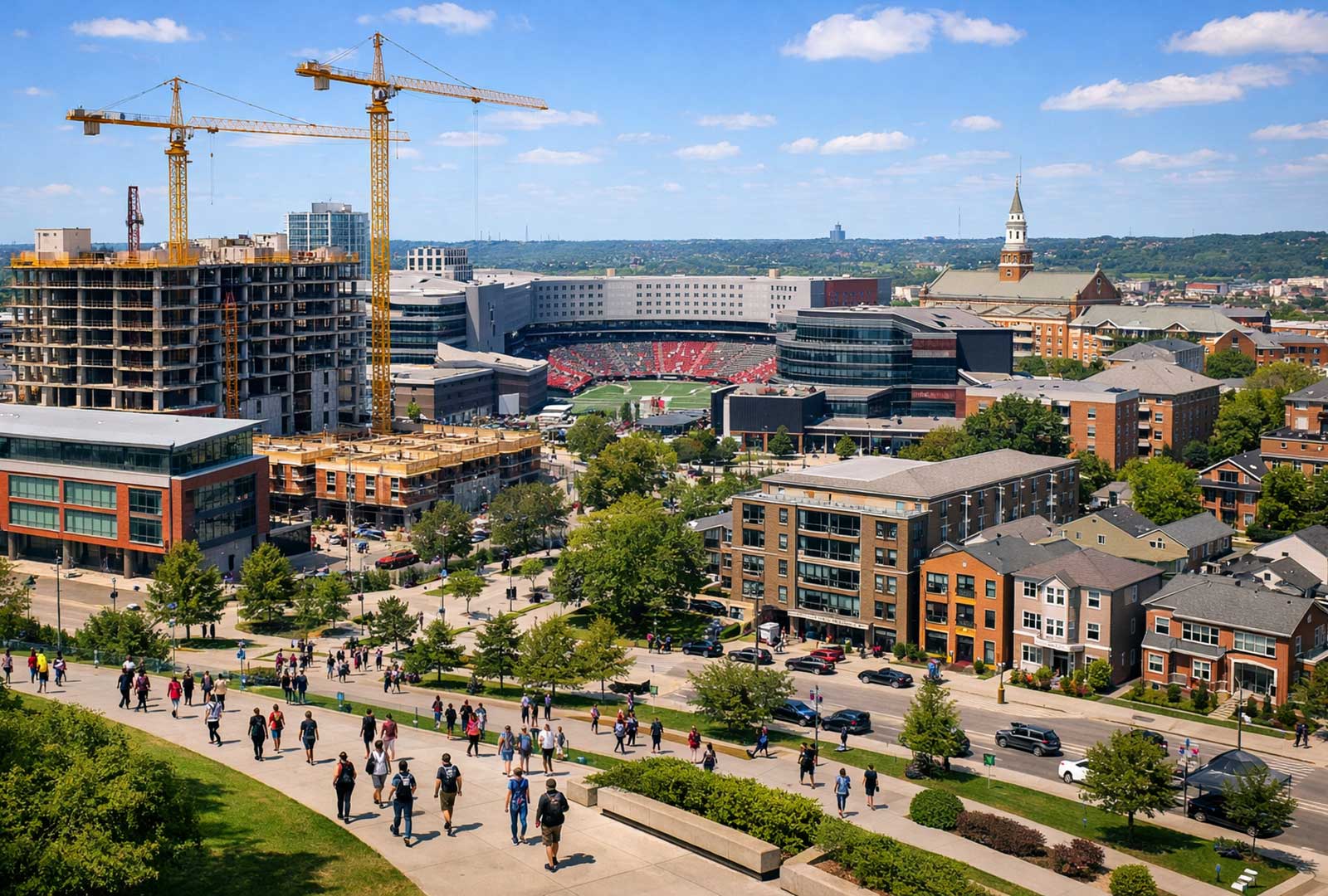
Walk across Uptown this spring, and the scale of UC’s ambition becomes impossible to ignore. The $330 million “Block 1 & 2” housing project topped out in March. This project promises 1,310 new beds across phased openings—converting years of blighted land into student housing. However, what’s less clear is whether the timeline matches actual demand.
Additionally, it is unclear whether UC is building capacity in hopes students will follow. The $190 million Old Chemistry Building renovation modernizes the academic core. Still, it signals a harder truth: UC’s physical plant was aging and undersized for the enrollment it now carries. This is catch-up investment, not luxury expansion. Proposed additions like the Welcome Gateway Building and YMCA conversions suggest UC recognizes its infrastructure is stretched thin.
These projects inject millions into regional construction and create jobs. Nevertheless, they also raise uncomfortable questions about property taxes, land use, and neighborhood character. City planners and advocates are only beginning to grapple with these concerns. Furthermore, these are questions that infrastructure demands of regional growth extend far beyond campus borders.
The Economic Impact Claim: $10.6 Billion Is Real, But Whose Pocket Does It Fill?
The $10.6 billion annual economic impact UC generates across the tri-state region is genuine—equivalent to a Fortune 500 company’s revenue. Yet one in twelve regional jobs depending on UC activity reveals a dangerous concentration. If enrollment or research funding contracts, Cincinnati’s economy absorbs a shock few cities can weather.
Alumni earnings ($6.6 billion) measure past success, not future guarantee. Co-op partnerships with 1,700 employers mean students earn in New York and Chicago as often as in Cincinnati. Construction booms and visitor spending spike and crater with enrollment cycles. Growth is real. Fragility is real, too.
First-Generation and Online Learners: UC’s Actual Mission Shift (Rarely Discussed)
First-generation students are up 10%—a genuine achievement that signals UC is reaching populations whose parents never attended college. Yet simultaneously, online learners now comprise 18% of enrollment (over 9,700 students). That cohort will never walk Upfront’s newly renovated halls or live in the $330 million Block 1 & 2 housing project. UC is building a residential campus for students who are increasingly studying remotely. As a result, this suggests the university’s strategic identity is splintering faster than its marketing can acknowledge.
Cincinnati’s Housing Market and Neighborhood Pressure: The Unpriced Cost of Growth
Student demand has reshaped Cincinnati’s housing market pressures, driving landlords in Corryville, Clifton, and Walnut Hills to convert single-family homes into multi-unit rentals. UC’s $330 million Block 1 & 2 housing project will add 1,310 beds. This can happen only if phased quickly and priced competitively with off-campus alternatives. What remains unclear: whether UC coordinated with city planners on the cumulative impact of 54,000 students on parking, waste, and neighborhood character. Additionally, it is unknown whether the co-op program’s local earning power offsets displacement of non-student businesses and workers.
ANALYSIS: The Sustainability Question No One Is Asking
UC’s enrollment growth masks three uncomfortable assumptions. The first is that the demographic cliff will pause long enough for the university to build its way out of capacity constraints. The second is that online and regional-campus students will generate the same economic return as residential Uptown students. The third is that Cincinnati’s neighborhoods can absorb 54,000 students without fundamental shifts in housing costs, character, and access. None of these is guaranteed. Moreover, these questions intersect with broader economic shifts reshaping Cincinnati. Here, institutional growth can mask deeper structural vulnerabilities in the regional economy.
Local Relevance: Why Cincinnati Should Care (Beyond the PR)
UC’s expansion is reshaping Cincinnati’s tax base, rental market, and job landscape—one in twelve regional jobs now depends on university activity. For a city still rebuilding from decades of industrial decline, that concentration is both opportunity and risk. The university’s growth also intersects with regional education funding challenges and broader sustainability challenges facing the region. In these cases, competing institutional priorities shape resource allocation and long-term planning. Furthermore, if UC stumbles, the fallout ripples across neighborhoods, small businesses, and municipal budgets far beyond campus borders.
Spring 2026 Commencement and the Narrative Turning Point
As doctoral hooding ceremonies unfold April 30 at Fifth Third Arena and undergraduate celebrations fill Nippert Stadium on May 1, UC will graduate roughly 10,000 new Bearcats—many destined to leave Cincinnati, others to stay and anchor the region’s economy. The livestreamed events signal UC’s embrace of distributed engagement. However, they also mask an uncomfortable reality: UC’s $10.6 billion regional impact depends entirely on whether graduates choose to build their careers locally or elsewhere. Expect celebratory messaging about “Next Lives Here” and regional pride. Meanwhile, expect little discussion of retention strategy or whether UC’s infrastructure expansion will actually keep talent in southwest Ohio.
Growth Alone Is Not a Strategy
UC’s enrollment surge reflects real institutional competence—the co-op program works, online access matters, and first-generation recruitment is genuine. But numbers alone do not answer whether UC can sustain this pace without compromising educational quality, straining Cincinnati’s housing and infrastructure, or building unsustainable dependence on a single regional employer. Growth requires management, not celebration.
UC BY THE NUMBERS
Total enrollment: 53,682 (record high); projections exceed 54,000 for current year. Undergraduates: 42,566 (up 3.3%). First-generation students: up 10%. Online learners: 9,700+ (18% of total). Fall 2026 applications: up 15%. Regional economic impact: $10.6 billion annually. Co-op employers: 1,700+. Alumni network: 360,000+.
Read More
Cincinnati Business Closures Signal a Broader Economic Shift
FAQs
How has UC's enrollment growth compared to other major public universities during the same period?
UC’s growth from approximately 43,000 students in 2013 to over 54,000 in 2025 represents a roughly 26% increase over a decade. This trajectory stands out nationally at a time when many universities are experiencing flat or declining enrollment numbers. While specific peer comparisons aren’t detailed in UC’s official reporting, the university’s sustained climb—adding nearly 9,000 students since President Neville Pinto’s ‘Next Lives Here’ strategic plan launched in 2018—positions it as one of the Midwest’s fastest-growing major public universities. This growth is particularly notable given broader higher education enrollment challenges, making UC’s achievement distinct among regional competitors.
What role has the co-op program played in UC's ability to attract and retain students?
UC’s signature cooperative education (co-op) program remains a major enrollment draw and differentiator. The program connects students with more than 1,700 global employers, allowing students to gain real-world experience while earning income during their studies. This model not only enhances student employment prospects and career readiness but also injects millions in annual earnings back into the local economy through co-op spending. As the birthplace of cooperative education and ranked No. 1 among public universities in the field, UC leverages co-op as both a recruitment tool and a competitive advantage that appeals to students seeking practical, career-focused education. The program’s success contributes significantly to graduate outcomes and regional economic activity.
How does UC's online enrollment factor into its overall growth strategy?
Online learners represent a significant and growing portion of UC’s enrollment base, comprising approximately 18% of the total student body—over 9,700 students as of fall 2025. This online expansion has been instrumental in reaching students who might not otherwise attend a traditional campus-based program, including working professionals, non-traditional learners, and individuals from underserved regions. The growth in online enrollment contributes to UC’s overall enrollment targets while allowing the university to expand its geographic reach beyond the immediate Cincinnati region. This diversification of the student population through digital education helps sustain enrollment growth and supports the university’s mission of accessibility and regional relevance without requiring proportional increases in on-campus housing and facilities for all new students.
What specific initiatives has UC implemented to increase first-generation student enrollment?
First-generation student enrollment at UC has grown by 10% in recent counts, representing a deliberate shift toward accessibility and inclusivity. While the article doesn’t detail specific recruitment initiatives, this growth aligns with UC’s broader strategic focus on accessibility and academic excellence under the ‘Next Lives Here’ plan. The university has expanded College Credit Plus opportunities for high school students, which helps first-generation families navigate the college pathway. Additionally, UC’s robust online programs and regional campus offerings at UC Blue Ash and UC Clermont provide alternative entry points for first-generation students who may face geographic or financial barriers to traditional four-year residential enrollment. These combined efforts demonstrate UC’s commitment to democratizing higher education access within its service region.
How is UC managing housing and residential life demands as enrollment continues to climb?
UC is addressing housing demands through significant capital investment, most notably the $330 million ‘Block 1 & 2’ student housing project, which topped out in March 2026 and will eventually add 1,310 new beds when fully completed in phased openings. This ambitious development is being built on land that previously sat blighted for years, revitalizing the Uptown campus area. However, with enrollment exceeding 54,000 students and continuing applications showing a 15% jump for fall 2026, housing capacity remains a critical challenge. The phased opening approach suggests UC is carefully managing construction timelines to match enrollment growth, but the gap between current enrollment and available on-campus housing means many students rely on private off-campus housing, which affects neighborhood dynamics and local rental markets in the Cincinnati area.
What is the projected economic impact of UC's enrollment growth on the Cincinnati region over the next five years?
UC currently generates a $10.6 billion annual economic impact to the regional economy (southwest Ohio, northern Kentucky, and eastern Indiana), supporting more than 125,000 jobs—meaning approximately one out of every 12 jobs in the region is supported by UC’s activities and students. When including statewide effects, UC’s impact rises to $22.7 billion on Ohio’s economy. As enrollment continues to grow and the university adds nearly 1,000 students annually, this economic footprint is expected to expand proportionally. Additional factors driving future economic impact include ongoing construction investments (which inject significant funds into the regional economy), increased research funding, consumer spending by the growing student population, and alumni contributions. However, projections for specific five-year economic growth tied to enrollment increases are not formally published by the university, making precise forecasting difficult.
How do UC's regional campuses (Blue Ash and Clermont) contribute to the overall enrollment growth strategy?
UC Blue Ash College and UC Clermont College have experienced continued expansion and contribute meaningfully to UC’s overall enrollment growth. These regional campuses serve students who may prefer to begin their education closer to home, face commuting constraints, or seek more affordable entry points into UC’s degree programs. The growth at these satellite locations allows UC to expand access across a broader geographic footprint without requiring all new students to relocate to the main Uptown campus. Regional campus enrollment is part of the overall 54,000+ student body and represents an important component of UC’s accessibility mission. By offering pathways through regional campuses, UC can capture students who might otherwise attend competing institutions, while also supporting workforce development and economic impact in areas beyond Cincinnati proper. These campuses also help distribute housing and facilities pressure across the UC system.
This article was created with the support of our proprietary AI-powered newsroom tools and reviewed by our editorial team for accuracy and clarity.