
Share This Article
Article Summary
Cincinnati is actively advancing its Green Cincinnati Plan, aiming for total carbon neutrality by 2050 and currently approaching a 40% reduction in local emissions. The city is driving this progress through initiatives like the Seeds of Change neighborhood grant program, an upcoming $12.1 million solar array at the Center Hill landfill, and expanded community composting efforts. Additionally, local leaders are focusing on green workforce development with a goal to train 4,000 workers by 2028, while utilizing public health research to direct these investments toward vulnerable neighborhoods.
Local leaders say Cincinnati climate initiatives are on track to achieve historic carbon reduction milestones this year.
From new neighborhood grants to massive solar farms, Cincinnati climate initiatives are reshaping the regional economy.
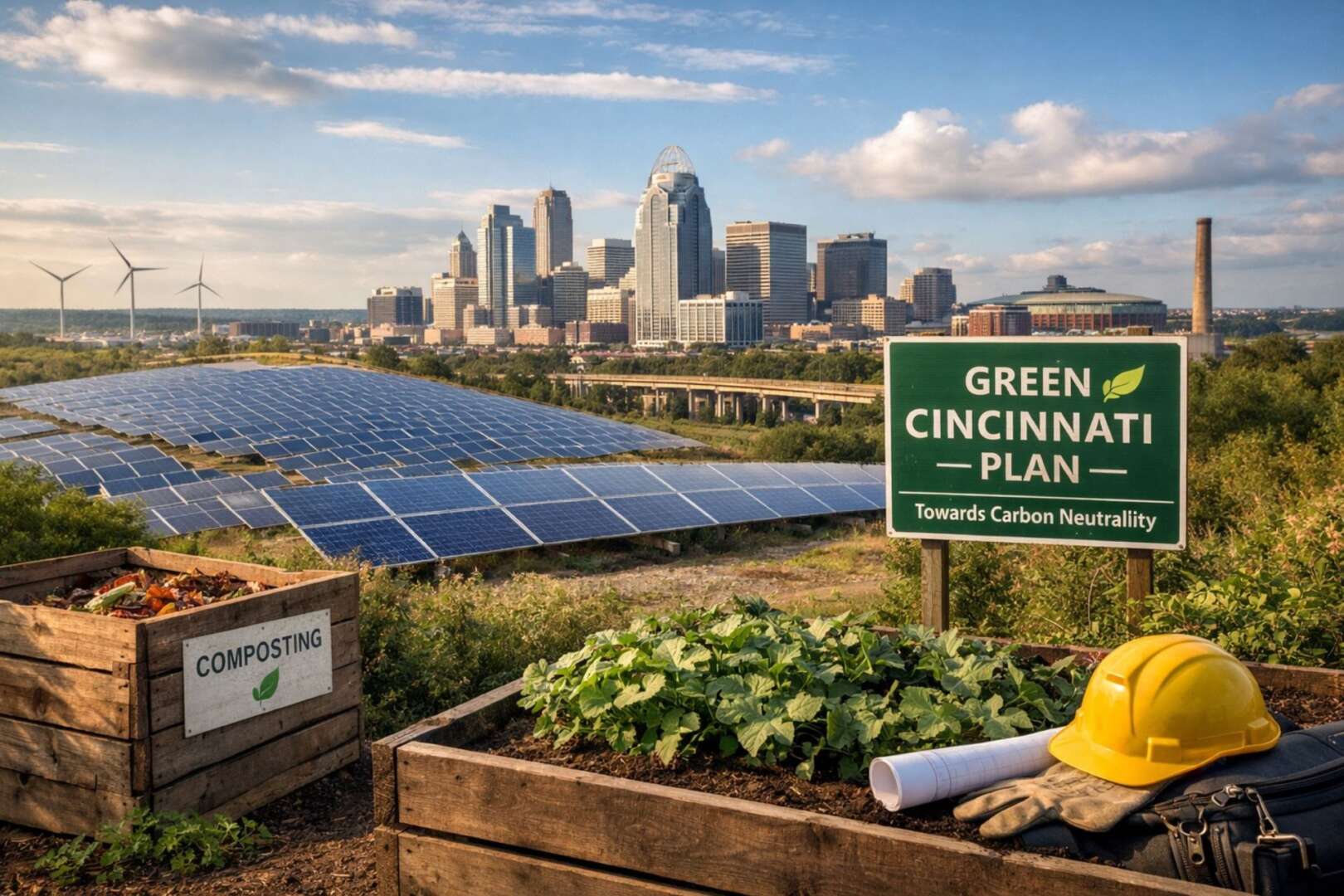
City officials continue pushing the Green Cincinnati Plan forward this year. The comprehensive roadmap aims for total carbon neutrality by 2050. Recent data shows the city is making substantial progress toward this target. Cincinnati is currently approaching a nearly 40-percent reduction in carbon emissions. Officials achieved this despite fluctuating support from federal environmental programs. Local leadership currently prioritizes actionable community projects and large-scale renewable energy.
The city focuses heavily on its successful Seeds of Change grant program. This initiative launched two years ago to fund neighborhood-level environmental projects. It directly supports sustainable, equitable, and resilient local community efforts. The program has funded 159 diverse local projects since 2024. These grassroots efforts span across 47 different city neighborhoods. The city recently announced the spring 2026 open call for new applicants.
How Cincinnati climate initiatives empower local neighborhoods
Funding local sustainability projects
Community empowerment remains central to the city’s broader environmental strategy. The Seeds of Change program gives residents the direct resources to enact local change. According to the Office of Environment and Sustainability, the fund has awarded over $712,000 to date. Eligible proposals include community gardens, energy efficiency upgrades, and waste reduction programs. Local groups can receive development grants ranging from $1,000 to $20,000. Residents strongly support Cincinnati climate initiatives because they yield visible neighborhood improvements.
Combating the urban heat island effect
Many of these local projects target neighborhoods disproportionately impacted by climate change. Extreme heat and heavy rainfall remain primary environmental threats in the region. Community leaders are planting urban forests to combat the dangerous urban heat island effect. Residents have already planted over 2,500 trees and companion plants locally. These small-scale planting projects offer immediate environmental relief to vulnerable communities.
Expanding investment and youth Leadership
City planners intend to expand this successful grassroots funding model soon. They plan to invest $1 million into the Seeds of Change program by 2028. Officials are actively growing their co-investor network to increase available grant funds. More than 500 resident leaders actively manage these vital sustainability projects today. Interestingly, youth activists under the age of 22 lead nearly 30 of these local initiatives.
Expanding renewable energy across the urban landscape
Cincinnati climate initiatives also target the growing demand for reliable renewable energy. Surging regional electricity demand requires new, clean energy generation sources. Cincinnati officials are addressing this hurdle by becoming active energy generators.
The Center Hill solar project
In February 2026, the Cincinnati City Council officially passed an emergency ordinance appropriating $12.1 million to install the solar photovoltaic array, moving it past the evaluation phase. This new commercial solar array would sit atop the Center Hill landfill.
Building on past successes
The Center Hill proposal builds on previous regional renewable energy successes. The city already operates the massive New Market Solar facility in Highland County. This specific facility generated 69.2 gigawatt-hours annually, reported by GridInfo in early 2026. New Market Solar consistently ranks among the top-producing solar farms in Ohio. Cincinnati hopes the new Center Hill project will safely replicate this massive energy success.
Integrating battery storage for grid stability
Solar energy integration drastically lowers regional reliance on traditional fossil fuels. Environmental officials are also exploring commercial battery storage technology. Batteries can store excess solar energy for use during peak grid demand periods. This storage strategy helps stabilize the local grid and lowers overall energy costs. Expanded energy storage remains a primary focus for upcoming regional development phases.
Green workforce development drives Cincinnati climate initiatives
Transitioning to a modern green economy requires highly skilled local labor. City leaders recognize the immediate need for targeted workforce development programs. The city wants to formally train 4,000 individuals for green jobs by 2028.Officials recently awarded $150,000 to six local job-training organizations. These community groups will provide high-quality green job training to 280 local residents.
Job creation serves as a powerful economic engine for these environmental projects. The push toward sustainability creates vast opportunities in construction, agriculture, and engineering.
Regional data shows the green market supported over 1,000 jobs recently. Planners project a $483 million total economic impact through the end of 2026.
Local educational programs are rapidly evolving to meet these new labor demands. The upcoming 2026 Earth Day festival highlights many of these emerging career paths. The April event features a dedicated Green Career Fair in Washington Park. This public fair connects residents directly with living-wage jobs in the sustainable economy. Organizers consider this event a vital step toward long-term economic resilience.
Prioritizing public health in Cincinnati climate initiatives
The changing natural environment directly impacts public health across the region. Local researchers are currently studying how extreme heat affects cardiovascular and immune systems. The University of Cincinnati’s Center for Collaboration on Climate & Community for Health leads this charge. The center recently launched a 2026 seminar series to educate the public. These university experts analyze the specific health challenges facing vulnerable local neighborhoods.
City officials use this crucial health data to direct environmental funding properly. The environment office is currently updating its important Climate Equity Indicators Report. This report analyzes data regarding local demographics, human health, and the built environment. Planners use these detailed metrics to carefully identify the city’s most vulnerable neighborhoods. Planners will use the updated 2026 report to successfully guide the next decade of investments.
Understanding specific neighborhood vulnerability helps the city distribute resources fairly. Neighborhoods suffering from poor air quality or high heat receive priority funding. This data-driven approach ensures equitable distribution of future tree plantings and green infrastructure. Environmental equity remains a core pillar of these broad city environmental programs. Officials want every neighborhood to benefit directly from the ongoing clean energy transition.
Innovative waste reduction and future goals
Expanding zero waste programs
Zero waste policies are gaining incredible momentum across the metropolitan area. The city is aggressively expanding accessibility to its municipal recycling and composting programs. Previously, single-family homes received the bulk of these specific waste services. Now, officials are finding innovative ways to seamlessly include multifamily tenants and apartment complexes. A recent federal USDA grant successfully accelerated these neighborhood food waste pickups.
Over 700 local households have already signed up for the expanded organics diversion program. These diversion efforts successfully keep thousands of tons of material out of growing landfills. According to WVXU, these small behavioral changes drive the city’s broader environmental success. The Cincinnati Recycling and Reuse Hub also crossed a major operational milestone recently. Workers there have completely recycled over one million pounds of materials since 2021.
Strategic goals for 2026 and beyond
Looking forward, Cincinnati is solidifying its strong reputation as a proactive climate leader. The ultimate goal of these Cincinnati climate initiatives is total carbon neutrality by 2050. Here is a brief look at the city’s primary focus areas for the rest of 2026:
- Expanding the New Market Solar facility’s regional grid capacity.
- Approving the $12 million Center Hill landfill solar array project.
- Publishing the fully updated 2026 Climate Equity Indicators Report.
- Distributing new rounds of neighborhood Seeds of Change community grants.
- Expanding zero-waste composting pickups to more downtown apartment complexes.
The ongoing Cincinnati climate initiatives require continuous community engagement to succeed. Residents can eagerly learn more at the upcoming Earth Day celebration on April 19. Planners will totally transform Washington Park into a living model of the green plan. The layout features specific physical zones dedicated to sustainability, resilience, and equity. Event organizers heavily expect to draw 8,000 engaged attendees to the downtown festival.
A greener future within reach
These expansive Cincinnati climate initiatives prove that municipal action can drive global change. The city is successfully navigating international supply chain issues and heavy grid demands. Local leaders are actively building a more inclusive and sustainable regional economy. With continuous financial investments, the 2050 carbon neutrality goal remains firmly within reach. These efforts ensure a healthier, much greener future for all local residents.
FAQs
What is the main goal of the Green Cincinnati Plan?
The primary objective of the plan is to achieve total carbon neutrality by the year 2050. Recent data indicates the city is currently approaching a 40% reduction in carbon emissions.
How does the Seeds of Change program function?
This program provides direct funding for neighborhood-level environmental projects, such as community gardens and energy efficiency upgrades. Local groups and residents can receive grants ranging from $1,000 to $20,000 to implement these sustainable neighborhood improvements.
How is Cincinnati expanding its renewable energy generation?
The city utilizes the existing New Market Solar facility in Highland County, which generates over 69 gigawatt-hours of electricity annually. Furthermore, the city council recently appropriated $12.1 million to build a new commercial solar array atop the Center Hill landfill.
What are the city's green workforce development targets?
Cincinnati aims to formally train 4,000 individuals for jobs in the sustainable economy by 2028. To accelerate this, the city recently awarded $150,000 to six local organizations to provide green job training for 280 residents.