

Share This Article
Article Summary:
Two property managers were indicted within 14 days after allegedly stealing rent payments from Cincinnati-area tenants, raising questions about housing oversight and accountability. The cases reveal how vulnerable residents can face eviction despite paying rent and why gaps in hiring practices, audits, and property management oversight may allow fraud to go undetected for years.
Two Property Managers Indicted in 14 Days: What It Reveals About Cincinnati’s Housing Oversight
Cincinnati’s housing debate usually focuses on supply.
These cases reveal another challenge: whether tenants can trust the systems already in place. This is especially concerning in light of recent rent theft incidents. Bridgette Morris stole roughly $40,000 from Wallick Communities properties between September 2023 and June 2025.
Dion Crockett allegedly took $30,000–$45,000 from The Evanston (CMHA public housing) between January 2024 and April 2026. Tenants discovered the theft only when eviction warnings arrived despite having paid. The real problem is not the individual criminals—it’s that Ohio’s fragmented oversight allowed them to operate undetected for years. As a result, Cincinnati’s most vulnerable residents absorbed all the risk.
How the Housing Fraud Schemes Worked—And Why Nobody Caught Them
Both allegedly followed the same script: collect cash, divert funds, tamper with records, and send false delinquency notices. Morris deposited tenant payments into personal accounts while falsifying records. Crockett cashed money orders that tenants sometimes made payable directly to him. Routine audits, management reviews, and internal oversight failed to detect either scheme for years.
Tenants in affordable housing face a silencing incentive: reporting theft risks eviction or retaliation. Fewer housing options, thinner financial cushions, and limited legal resources discourage many victims from filing complaints. Those barriers also make it harder for law enforcement, regulators, and property owners to identify similar schemes before they grow into larger cases.
The Evanston and Why This Matters Locally
The Evanston sits in Avondale, one of Cincinnati’s historic urban neighborhoods. It is undergoing revitalization pressure from Xavier University’s expansion and rising housing costs in surrounding areas. The Evanston serves residents who often have few housing alternatives if problems arise. When rent theft goes unreported due to eviction fears, vulnerable residents in these communities absorb the cost. Meanwhile, public funds disappear. CMHA serves over 3,000 families citywide. The question is not abstract—it’s about whether people living in some of Cincinnati’s most economically fragile neighborhoods can trust the housing they depend on.
The Crockett Hiring Question
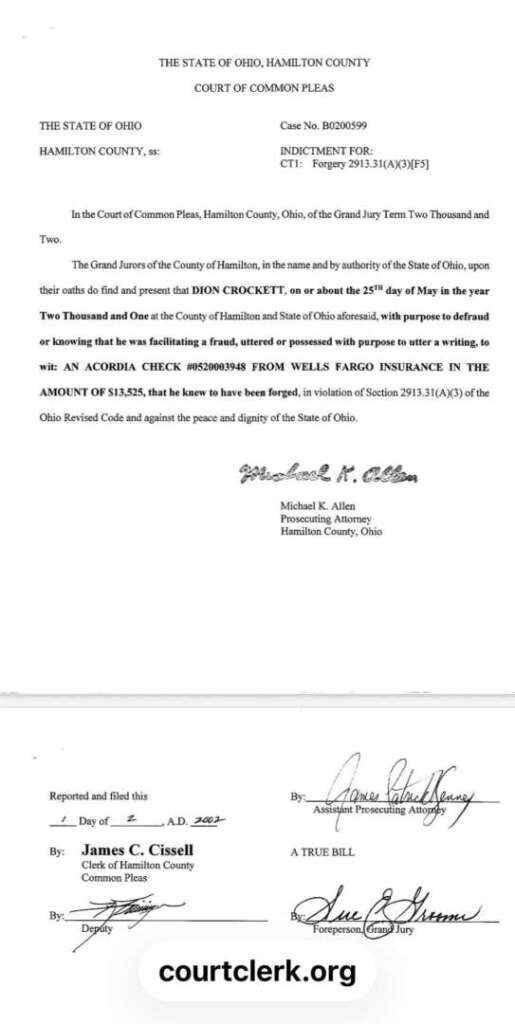
Court records show Crockett’s criminal history stretched back decades. In 2002, a Hamilton County grand jury indictment accused him of knowingly possessing or attempting to use a forged insurance check worth $13,525.
In a separate 2012 court filing, Hamilton County prosecutors opposed Crockett’s request to have records expunged, citing a 1994 larceny conviction and a 1998 domestic violence conviction as reasons he was not eligible.
More recently, Crockett was convicted of menacing in 2023, less than a year before CMHA hired him in 2024 to manage rent payments at The Evanston.
The hiring question is difficult to ignore. Court records documenting forgery, theft-related offenses, and other prior convictions were part of the public record years before Crockett was placed in a position responsible for collecting rent from public housing tenants. However, CMHA has not publicly explained how Crockett cleared its hiring process. It is also unclear whether those records were considered during the vetting process.
When asked about the Crockett case and its hiring practices, CMHA declined to comment. Wallick Communities did not respond to requests for comment regarding Morris’s hiring or the company’s current oversight procedures.
Why Ohio’s System Enables This
Ohio has no standalone property manager license. Oversight is fragmented across real estate licensing, trust account rules, and landlord-tenant law. However, enforcement depends on company audits or tenant complaints, not proactive state supervision. Public housing falls under HUD rules, yet day-to-day oversight relies on internal audits, often infrequent. No state mandate requires digital payments or escrow services; cash and money orders remain legal, creating opacity. Therefore, the result is that a property manager can steal for two years, alter records, and avoid detection until a tenant receives an eviction notice.
This is not unique to housing. Oversight failures that allow financial crimes to slip through the cracks appear across systems where trust substitutes for verification. The difference is that tenants in affordable housing have nowhere else to go.
What Tenants Can Do Now
If you hand cash or a money order directly to your property manager, you have almost no proof that the payment ever happened. Crockett’s victims learned this the hard way.
Pay rent through official portals or checks made payable to the company—never directly to a manager. Photograph money orders, screenshot confirmations, and verify your account monthly by calling the main office (not the on-site manager). If you get a late notice despite paying, gather documentation immediately. Then contact the property owner, CMHA, or Legal Aid Society of Greater Cincinnati. Wrongful eviction based on alleged non-payment is actionable. You have legal recourse, but only if you move fast and document everything.
If you believe you were a victim of rent theft by Crockett or any other property manager, contact the Hamilton County Prosecutor’s office or speak with a tenant rights attorney. The federal lawsuit against CMHA over the Crockett case means affected tenants may be eligible for damages or restitution.
The Accountability Gap & Property Manager Fraud
Before policymakers ask taxpayers for more money or more housing units, they may need to answer a simpler question: Who is watching the people already entrusted with tenant payments?
The alleged schemes involving Morris and Crockett raise another uncomfortable question: How many similar cases never become criminal investigations? Most fraud cases never begin with an indictment. They begin with someone noticing that something doesn’t add up.
Trust Without Verification Creates Opportunity
Cincinnati’s affordable housing system depends on trust. Tenants trust that the person collecting rent will deliver it to the property owner. Housing authorities trust employees to handle payments honestly. Property owners trust internal controls to catch problems before they hurt residents.
But trust without verification creates opportunity.
When oversight breaks down, the people with the fewest resources often absorb the consequences. In these cases, tenants paid their rent, yet some still received delinquency notices and faced the possibility of eviction.
The Rise of a Documentation Culture
In many ways, these cases reflect a broader shift happening across society. People increasingly photograph receipts, save emails, screenshot transactions, and document conversations because trust alone no longer provides sufficient protection.
The systems people rely on work best when accountability accompanies trust, not when it replaces it.
A generation ago, a tenant might hand over a money order and assume the transaction was complete. Today, that assumption can create risk. Documentation has become a form of self-defense.
How Tenants Can Protect Themselves
For tenants, that means treating rent payments like any other important financial transaction.
- Keep copies of money orders.
- Photograph receipts immediately.
- Save confirmation emails and text messages.
- Verify that payments appear in your account ledger.
- Contact the main office if something looks wrong.
- Challenge late notices immediately instead of assuming the issue will resolve itself.
These steps may seem excessive.
In a high-trust environment, they probably would be.
But the residents at The Evanston paid their rent and still faced eviction notices. That reality changes the calculation.
A Bigger Question for Cincinnati Tenants
The larger lesson extends beyond housing. Every system that handles money, benefits, or public resources eventually faces the same question: Does accountability actually match the level of trust being asked of the public?
These cases suggest the answer is not always yes.
Trust flows down.
Accountability flows nowhere.
Read More
Former CMHA manager jailed after rent theft charges in Cincinnati
FAQs
How common is rent theft by property managers, and why are we only hearing about these two cases now?
These two indictments in two weeks are likely just the tip of the iceberg. Rent theft is probably more common than reported because tenants in low-income housing often hesitate to complain — they fear eviction, retaliation, or losing their home. Many don’t know who to report to or assume the system won’t help them. Without mandatory audits or digital payment trails, schemes can run for years before discovery. The Crockett case went on for over two years before tenants’ wrongful eviction notices triggered an investigation. Stronger oversight and tenant education could uncover how widespread this really is.
What specifically should I do if I suspect my rent payment hasn't been credited to my account?
First, don’t panic — document everything immediately. Check your resident portal or call the main office (not the onsite manager) to verify the payment was posted. If it wasn’t, request a written receipt or confirmation in writing. Save all proof: money order receipts, photos of money orders, bank statements, text confirmations — anything that proves you paid. If the property manager pressures you to pay cash or directly to them personally, that’s a red flag. Report the discrepancy in writing to property ownership, CMHA/HUD (if it’s public housing), and keep copies. If you receive a late notice despite having proof of payment, contact Legal Aid or the Hamilton County Prosecutor’s office immediately. The key is creating a paper trail before the situation escalates to eviction.
Why would CMHA hire someone like Dion Crockett with a criminal history involving forgery and theft?
That’s the million-dollar question, and it’s raising serious accountability issues. Crockett had a documented pattern: a 2001/2002 forgery conviction (he forged an insurance check for $13,525), a 1998 domestic violence conviction, 1994 larceny, and a 2023 menacing conviction — just one year before CMHA hired him in 2024. CMHA job postings explicitly require background checks, yet he was placed in a role with direct access to rent payments and tenant records. Either the background check wasn’t thorough enough, red flags were missed, or the hiring process failed to connect the dots. This is especially troubling because CMHA is a public housing authority managing taxpayer funds for Cincinnati’s most vulnerable residents. The federal lawsuit by affected tenants is now exploring exactly how this hiring decision was made and whether proper due diligence occurred.
If I pay my rent online or by ACH transfer, am I completely protected from this kind of theft?
Digital payments are much safer, but not foolproof. When you pay through an official online portal or ACH transfer directly to the company’s account (not an individual), there’s a clear digital trail and the money goes to the organization, not a person’s pocket. This makes it far harder for a manager to intercept. However, even digital systems require verification: check your portal regularly to confirm the payment posted, and if it doesn’t appear within a reasonable timeframe, follow up immediately. The real protection comes from using official channels only — never pay a person directly, even if they claim it’s faster. Money orders should be made payable to the company, not the manager. And always keep records. The cases of Morris and Crockett involved cash and money orders partly because those methods leave less of a paper trail and are harder to track than digital payments.
What are the actual legal consequences if a property manager is convicted of rent theft, and will tenants get their money back?
If convicted, Dion Crockett faces up to 10½ years in prison on multiple charges including theft in office, forgery, and tampering with records. Bridgette Morris faces similar charges. Criminal penalties are one thing, but restitution — paying tenants back — is another. In the Morris case, Wallick Communities credited affected tenants for their stolen payments out of company responsibility, not because Morris personally paid them back. In the Crockett case, tenants are pursuing a federal lawsuit against CMHA for negligent hiring and supervision, hoping to recover damages. However, if Crockett personally has no assets, tenants may never see their money even if he’s convicted. This is why prevention (better hiring, audits, digital payments) matters more than prosecution after the fact. The criminal system punishes the thief, but tenants’ financial recovery depends on the property company or housing authority stepping up — or winning a civil suit.
Are there specific red flags I should watch for that might indicate a property manager is stealing rent?
Yes — watch for these warning signs: (1) A manager pressuring you to pay cash or directly to them personally instead of through official channels; (2) Reluctance to issue official receipts or written confirmation of payment; (3) You receive a late notice or eviction threat despite having proof you paid; (4) The manager discourages you from checking the resident portal or calling the main office; (5) Sudden changes in payment methods or collection practices; (6) The manager seems to have personal financial problems or lifestyle changes that seem inconsistent with their salary. In the Crockett case, he cashed money orders sometimes made payable to him personally — a huge red flag. In the Morris case, tenants received delinquency notices despite having paid, which triggered the investigation. If something feels off, trust your instinct and document it. Report to the property owner, not just the onsite manager, and contact your local prosecutor or tenant rights organization.
What changes should Cincinnati property management companies and housing authorities make right now to prevent this from happening again?
Several critical changes are needed: (1) **Mandatory background checks with teeth** — not just a check-the-box exercise, but thorough vetting that flags financial crimes, forgery convictions, and recent violent offenses. CMHA’s hiring of Crockett shows this isn’t happening; (2) **Digital payment systems only** — eliminate cash and money order collections handled by individual managers; require online portals or ACH transfers to company accounts; (3) **Regular independent audits** — don’t rely on the property manager to audit themselves; third-party audits should compare rent collected to rent posted monthly; (4) **Separation of duties** — whoever collects rent shouldn’t be the same person posting it to accounts or issuing receipts; (5) **Tenant communication channels** — give residents a direct line to report payment issues without fear of retaliation; (6) **Mandatory training** on fraud prevention for all staff handling money. Ohio has no standalone property manager license, which is part of the problem. Stronger state-level oversight and regulations could help enforce these standards across the industry.
This article was created with the support of our proprietary AI-powered newsroom tools and reviewed by our editorial team for accuracy and clarity.