
Share This Article
Article Summary:
This Sunday, Spring Grove Cemetery & Arboretum is offering something increasingly rare in Cincinnati: a completely free spring outing that refuses to optimize itself into irrelevance. Horse-drawn carriage rides, docent-led tours, and thousands of blooming tulips await—but the real story isn’t the flowers. It’s that free spring events in Cincinnati are disappearing, and what remains often feels either sanitized or neglected. Spring Grove proves a different model is possible: a historic cemetery functioning as a living arboretum, where beauty and remembrance coexist without apology, and where slowness still has a place. The question isn’t whether you should go—it’s what we’re collectively saying about ourselves if we don’t.
Horse-Drawn Carriages as the Unexpected Draw
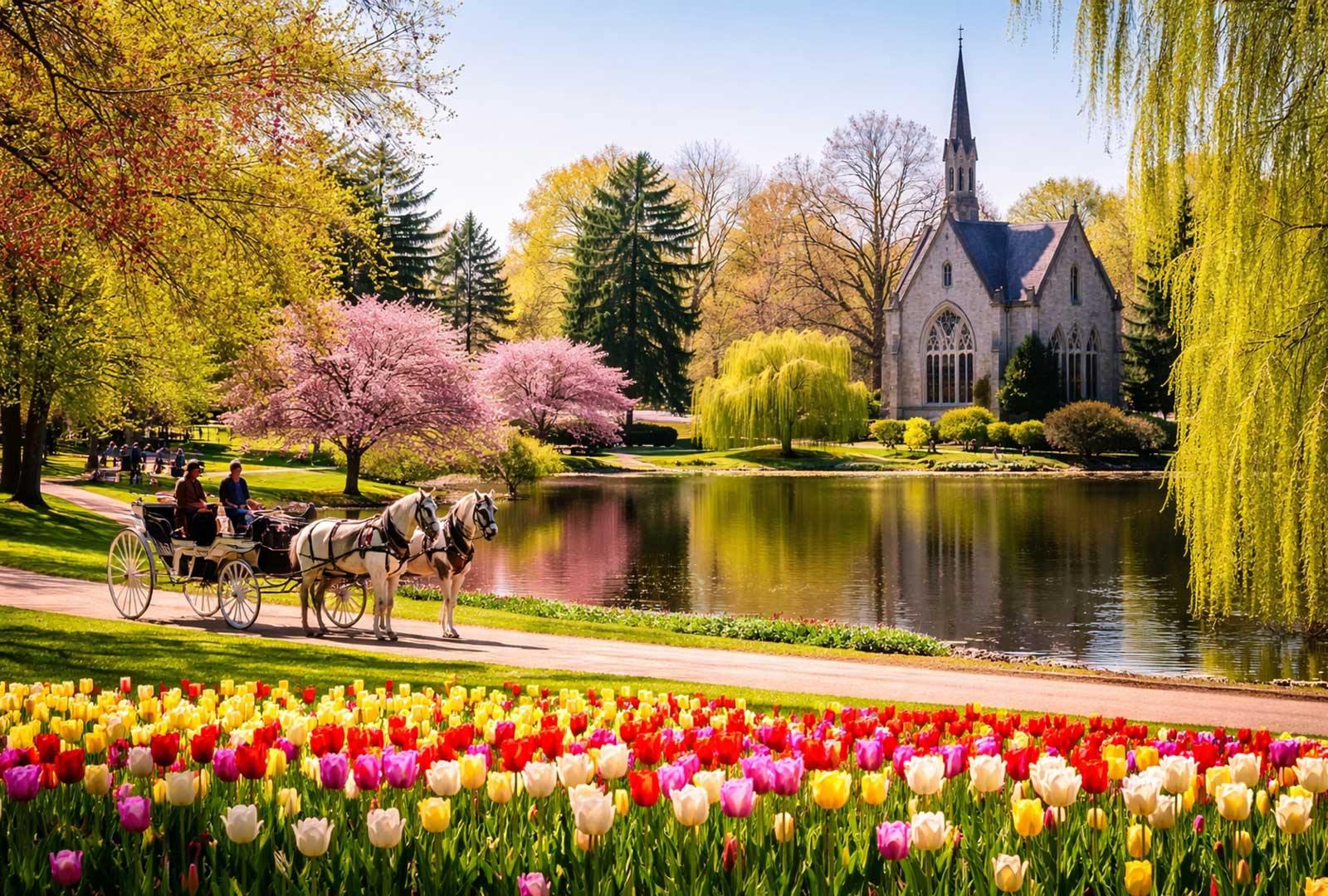
The carriage rides aren’t just the headline draw—they’re the reason this Sunday feels different from scrolling through another spring festival. They run continuously from noon to 3:30 p.m. with no reservations. Instead, they operate on a first-come, first-served basis. That scarcity, modest as it is, transforms the experience. Families wait together, anticipate together, then ride together through blooming grounds. It’s earned, not purchased. The logistics are deliberately low-friction—show up whenever. You don’t have rigid tour groups, or an app to check. You decide when. This is one of the highlights among free spring events in Cincinnati. In addition, it adds a unique charm to the day.
What you notice from a carriage that you’d miss walking alone is harder to name, but real. The elevated vantage point and the pace of hooves, slower than even a stroll, make a difference. The shared quiet with strangers forces your attention outward and upward rather than inward and down. You can’t scroll. You’re held, briefly, in a different kind of time. That’s rarer than it sounds on a Sunday in Cincinnati.
Spring Grove as Cincinnati’s Overlooked Arboretum
Most Cincinnatians have no idea that Spring Grove Cemetery & Arboretum spans 733 acres—larger than many public parks. It functions as a fully curated botanical institution. The grounds hold champion trees recognized nationally for their age and size. There are thousands of planted spring bulbs, and wild forest areas that feel genuinely untamed. It’s a landscape designed with intention, not accident.
April is when that design finally reveals itself. The intentional placement of flowering trees, the layered rhythm of color, and the strategic spacing of species—these become visible only when things bloom. In winter or summer, visitors might wander without grasping the arboretum’s sophistication. But in spring, the grounds stop being a cemetery and become a story. The docent-led tours deepen this: they move beyond flowers to highlight Victorian monuments, chapel architecture, and the craftsmanship of how Cincinnati chose to memorialize its dead. It’s unintentional public art—a museum of memorial culture that most people never notice.
The Specific Names Behind the Landscape: Joseph Earnshaw, Clara Dow, Henry Boyd
Joseph Earnshaw, a surveyor and civil engineer who shaped Cincinnati’s infrastructure in the 1800s, is buried in a landscape built on the same principles he lived by—order, beauty, permanence. There’s a quiet irony in resting in a place you helped design. Henry Boyd, the Black businessman and abolitionist who manufactured bedsteads in a slave state, represents Cincinnati’s contradictory history. His grave at Spring Grove tells a counternarrative to simpler versions of the city’s past.
Clara Dow’s inclusion matters too. Women’s contributions often fade from cemetery records. Yet naming her here is curatorial work—a deliberate choice to ensure certain stories survive the spring blooms and horse hooves.
Why This Feels Different From Other Spring Events
Most Cincinnati spring events sort visitors by wallet. You pay for the botanical garden, the festival entry, the guided tour—and that transaction shapes who shows up and how they move through the space. Spring Grove’s free admission on April 19 means a retired couple on a fixed income, a single parent, and a wealthy family occupy the same grounds on equal terms. That’s rare enough to notice.
But here’s what’s less clear: are visitors drawn to the flowers and horse carriages, or to permission itself—the chance to be in a beautiful, quiet space without commercial pressure? If Spring Grove charged $15 per person, the experience would likely feel different. That gap tells us something about what we’re actually seeking in free spring events in Cincinnati and why these moments feel special.
The real distinction runs deeper. Unlike heritage sites that have been repurposed or sanitized, Spring Grove remains an active burial ground. You’re literally walking past graves while enjoying spring blooms—beauty and mortality occupying the same moment. This simultaneity, the coexistence of joy and remembrance, gives the day its actual weight. It’s not escapism dressed up as history. It’s the honest thing. Additionally, families are often looking for free spring events in Cincinnati. They want both meaning and beauty. Spring Grove is a perfect example.
What Cincinnati Loses by Not Showing Up
Spring Grove represents a vanishing kind of public infrastructure: free, beautiful, accessible space that asks nothing of you except your presence. Most cities have surrendered these to paid admission or corporate sponsorship. Cincinnati still has one—but only if people actually use it. Small crowds don’t mean poor marketing. Instead, they mean we’ve collectively forgotten that slow, unhurried Sundays are still possible.
The horse-drawn carriage rides matter more than they seem. These aren’t optimized tours; they’re a quiet rebellion against speed itself. When carriages disappear—and they are disappearing from American cities—we lose a physical reminder that movement through our streets can be gentle, visible, and shared.
And here’s what’s rarely said aloud: the graves and monuments at Spring Grove aren’t heritage attractions packaged for consumption. Joseph Earnshaw’s grave is simply where he rests. That authenticity, unironic and unfiltered, has become genuinely rare. This Sunday, April 19, 2026, the choice is yours: participate in what’s left, or let it slip away. Above all, free spring events in Cincinnati like this one are opportunities for genuine connection with our city.
Planning Your Visit: The Practical Reality
If you want a horse-drawn carriage ride, arrive before 1:00 p.m.—first-come, first-served means the best window closes fast on a nice Sunday afternoon. The wait itself is worth it, though. You’re not sitting in a queue. You’re part of a small gathering of people who chose to slow down together.
Stack your activities: a docent-led tour (12:00, 1:30, or 3:00 p.m.), a carriage ride, and 20 minutes of wandering adds up to a complete afternoon without feeling rushed. Bring a camera if you want—Spring Grove Arboretum spring blooms Cincinnati are genuinely photogenic. However, don’t let it replace what you’re actually hearing: hooves on gravel, birdsong, the smell of wet earth after rain. Rain or shine, this event happens. Spring mud is just part of the deal. Honestly, it makes everything greener.
Why Spring Grove Matters More Than a Single Sunday Event
This Sunday’s free spring events in Cincinnati lineup is less about a single afternoon and more about a choice. Attendance will reveal what Cincinnati actually wants when given genuine alternatives—not what we say we value, but what we do with our time.
Spring Grove proves that a single 733-acre landscape can serve multiple purposes without conflict: a functioning cemetery, a nationally recognized arboretum, an educational institution, and a free gathering space. Most cities abandoned this model decades ago, sorting land use into single functions and charging for access. Here, remembrance and spring blooms coexist.
The horse-drawn carriage rides are the real tell. They’re slow, inefficient by modern standards, and beautifully resistant to optimization. That Spring Grove still offers them—that someone decided this event should include hoofbeats instead of trolleys—suggests a quiet belief that not everything needs to be faster or more profitable. Whether Cincinnati shows up will say less about Spring Grove’s appeal. Instead, it will say more about whether we’ve lost patience for unhurried, beautiful, free afternoons in our own city.
Read More
Piatt Park upgrade plan advances with $7.2M state funding push
FAQs
Do I need to buy tickets in advance or can I just show up on the day of the event?
You can absolutely just show up! The entire event is completely free with no reservations needed. Everything operates on a first-come, first-served basis, including the horse-drawn carriage rides. Just head to the main entrance at Spring Grove Cemetery & Arboretum (4521 Spring Grove Ave.) anytime between noon and 4:00 p.m. on Sunday, April 19, 2026. The only thing to keep in mind is that carriage rides are popular and run until 3:30 p.m., so arriving earlier in the day gives you a better shot at getting a spot.
How long does a horse-drawn carriage ride actually take, and what will we see?
While the exact duration isn’t specified, carriage rides are designed to be a relaxing journey through the beautiful arboretum grounds, so you can expect anywhere from 20-45 minutes depending on the route. You’ll be riding through the scenic Spring Grove landscape during peak spring bloom season, so you’ll see vibrant tulips, flowering trees, and historic monuments all from the comfort of a classic carriage. It’s perfect for photos and creates that ‘storybook’ feeling visitors rave about. The rides are suitable for all ages, making them great for families, older adults, or anyone who wants to experience the grounds without walking.
Why is Spring Grove Cemetery special compared to other parks or spring events in Cincinnati?
Spring Grove is unique because it’s both a historic landmark and a nationally recognized arboretum all in one. Founded in 1845, it’s not just a cemetery—it’s a living landscape with hundreds of acres, champion trees, extensive gardens, and stunning monuments that tell the stories of remarkable Cincinnatians. Unlike typical spring events focused only on flowers or activities, this event celebrates ‘history, heritage, and horticulture’ together. The atmosphere is peaceful and surprisingly uplifting rather than somber, and visitors often describe it as ‘magical’ or like stepping into a storybook. You’re getting world-class natural beauty, educational history, and architectural interest all for free in one afternoon. Plus, the combination of horse-drawn carriages, guided tours, and thousands of blooming flowers creates an experience that feels genuinely special and different from the usual spring outings.
How much time should I plan to spend there, and can I do multiple activities in one visit?
Plan for at least 1–2 hours, but you can easily spend more if you want to do multiple activities. Many visitors combine a horse-drawn carriage ride (20-45 minutes), a docent-led walking tour (probably 45 minutes to an hour), and self-guided wandering through the blooms and historic grounds. If you’re really into it, you could spend 3+ hours exploring. The beauty is flexibility—there’s no schedule to follow except for the tour start times (12:00 p.m., 1:30 p.m., and 3:00 p.m.) and carriage rides (running until 3:30 p.m.). So you could arrive at noon, grab a carriage ride, stick around for the 1:30 p.m. tour, and then explore on your own. Or keep it simple with just a carriage ride and wandering. Spring Grove is also easy to combine with other spring activities in Cincinnati if you want to make a full day of it.
This article was created with the support of our proprietary AI-powered newsroom tools and reviewed by our editorial team for accuracy and clarity.