



Share This Article
Article Summary:
The Fort Thomas City Council primary on May 19 has become one of the most crowded local races Northern Kentucky has seen in years. Fifteen candidates are competing for six at-large seats in a nonpartisan election where party affiliation will not appear on the ballot, even though most candidates have known political alignments.
The unusually large field reflects growing tension inside Fort Thomas.
Development, residential zoning preservation, infrastructure demands, and the future direction of one of Northern Kentucky’s most sought-after river cities.
For many voters, this election is less about party labels and more about what kind of growth Fort Thomas wants over the next decade. The decisions made by the Fort Thomas City Council will shape the future of the community.
Fort Thomas City Council Election Has Unusually Large Field
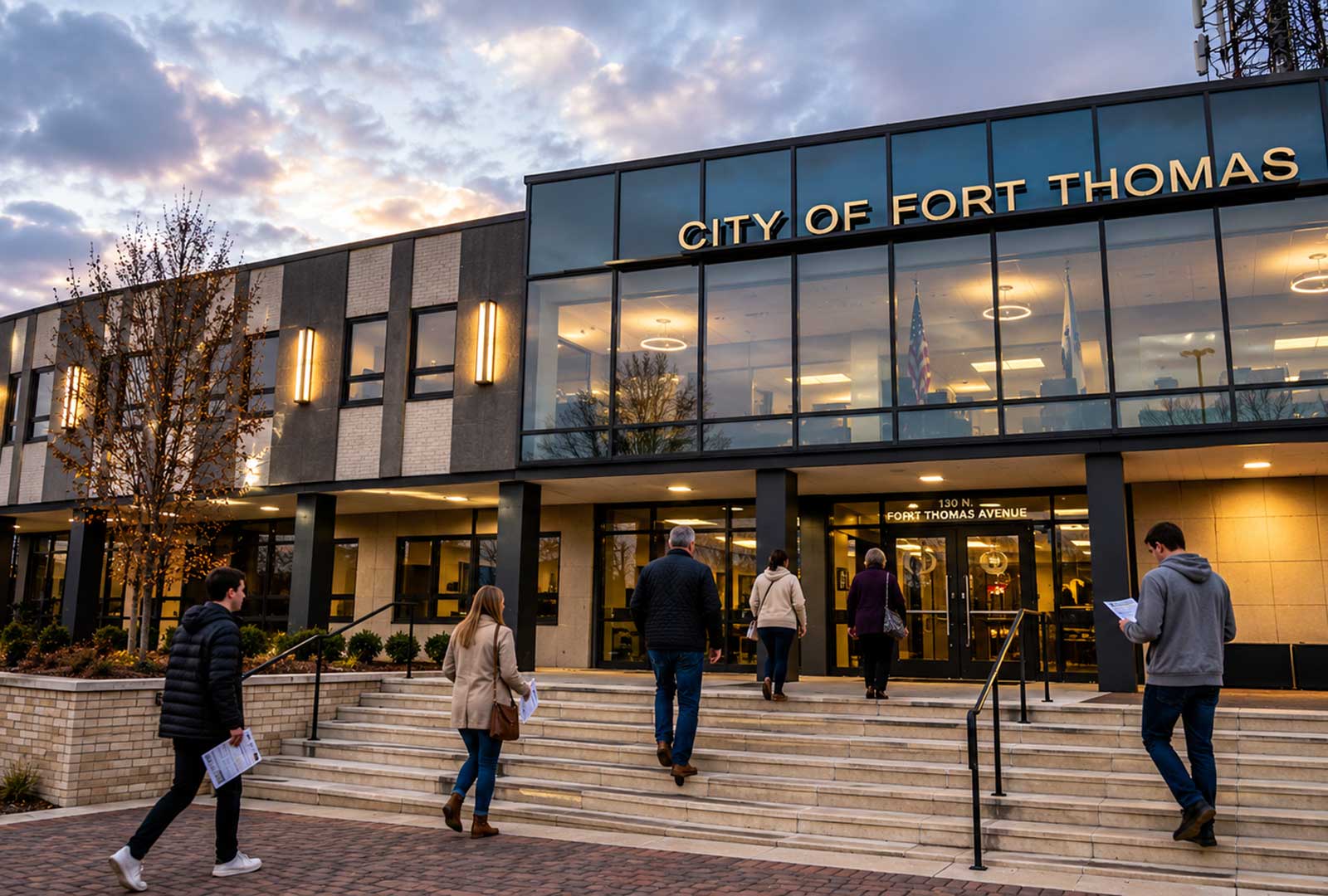
Fort Thomas voters will narrow the field Tuesday in a competitive primary that has drawn 15 candidates for six available city council seats. The top six finishers will move on to the general election later this year.
Unlike partisan races higher up the ballot, the Fort Thomas City Council election is officially nonpartisan. Party affiliation does not appear next to candidate names, even though several candidates are publicly associated with either Republicans or Democrats.
The candidate list includes five incumbents, several newcomers, and a mix of long-time community figures:
- Allison Alessandro (D)
- Steve Arey (R)
- Adam Blau (R, incumbent)
- Ken Bowman (D)
- Mary “Annie” Brown (D)
- Bradley Fennell (R, incumbent)
- Frances Hoffman (R)
- Brandon Long (D)
- Lauren McIntosh (R, incumbent)
- Ben Pendery (R, incumbent)
- Huey Pegram (D)
- Brandon Roller (R)
- Hunter Schlosser (R)
- Eric Strange (R, incumbent)
- Ashley Sullivan (R)
That size alone says something.
Municipal races often struggle to attract candidates, especially in smaller cities. Fort Thomas instead saw a surge of interest, which reflects how much local government decisions now affect housing costs, neighborhood identity, traffic patterns, and property values across Northern Kentucky communities.
Development and Zoning Have Quietly Become the Core Issue
Fort Thomas has spent years balancing growth pressure with its reputation as a stable, residential-focused city known for strong schools, older neighborhoods, and relatively high home values.
Now that balance is getting harder to maintain.
Questions surrounding zoning density, redevelopment, housing inventory, infrastructure strain, and city services have become more visible in local conversations. Residents who moved to Fort Thomas for its neighborhood character often want growth controlled carefully. Others argue the city risks stagnation if it blocks too much new investment or housing flexibility.
That tension is not unique to Fort Thomas.
Communities across the Cincinnati metro area, from Covington to Mason and parts of Cincinnati itself, are wrestling with similar debates about housing development, density, affordability, and preserving existing neighborhood identity while populations and housing costs continue shifting.
But Fort Thomas faces a particularly difficult version of the problem because space is limited and demand remains high.
Every zoning decision now carries bigger consequences than it did 10 or 15 years ago.
Why This Race Matters Beyond Fort Thomas
Local elections like this rarely generate major headlines, but they increasingly shape daily life more directly than national politics.
City councils decide:
- how aggressively development moves forward
- what infrastructure gets prioritized
- how tax dollars are spent
- what neighborhoods look like years from now
They also influence whether younger families can realistically afford to stay in communities like Fort Thomas at all.
One underappreciated dynamic in this race is that nonpartisan ballots can sometimes mask ideological divisions rather than eliminate them. Voters who are less politically engaged may walk into the booth without realizing where candidates generally align on growth, spending, or development philosophy.
Supporters of nonpartisan local elections argue that city governance should stay focused on competence and practical problem-solving rather than national party warfare. Critics counter that removing labels can make elections less transparent for voters trying to understand broader governing philosophies.
Both arguments have merit.
But the size of this field suggests something else too: more people now recognize that local government decisions carry real downstream consequences. That awareness has grown sharply since the pandemic-era housing surge changed pricing and zoning reform debates across much of Greater Cincinnati and Northern Kentucky.
Voters Will Shape the City’s Next Phase
Fort Thomas remains one of Northern Kentucky’s most stable and desirable cities. That stability is exactly why these council races suddenly matter more.
When communities become highly desirable, every decision about zoning, density, traffic flow, and redevelopment becomes more politically sensitive. Residents are no longer just debating policy. They are debating what kind of city they want Fort Thomas to become.
Tuesday’s results will offer an early signal about where voters believe that balance should land.
FAQs
Why is the Fort Thomas City Council race getting attention?
The race has drawn 15 candidates competing for six seats, reflecting growing public interest in local issues like zoning, development, housing, and city services.
Is the Fort Thomas City Council election partisan?
No. The election is officially nonpartisan, and party affiliation does not appear on the ballot, though many candidates have publicly known political alignments.
How many candidates advance from the primary?
The top six vote-getters in the May 19 primary will move on to the general election.
What issues are shaping the Fort Thomas election?
Residential zoning preservation, development pressure, infrastructure, city growth, and maintaining neighborhood character are central issues in the race.
Why do local city council races matter?
City councils directly influence development, taxes, infrastructure, traffic, and housing decisions that shape everyday life for residents.
This article was created with the support of our proprietary AI-powered newsroom tools and reviewed by our editorial team for accuracy and clarity.