
Share This Article
Article Summary:
The Flying Pig Marathon returns Sunday, May 3, 2026, with a 6:30 AM start in downtown Cincinnati and a full 26.2-mile course that stretches across the city and into Northern Kentucky. More than just a race, it’s one of the region’s biggest economic and cultural weekends. But for runners, the reality is straightforward: the course is tough, the time limits are real, and preparation matters more than people expect.
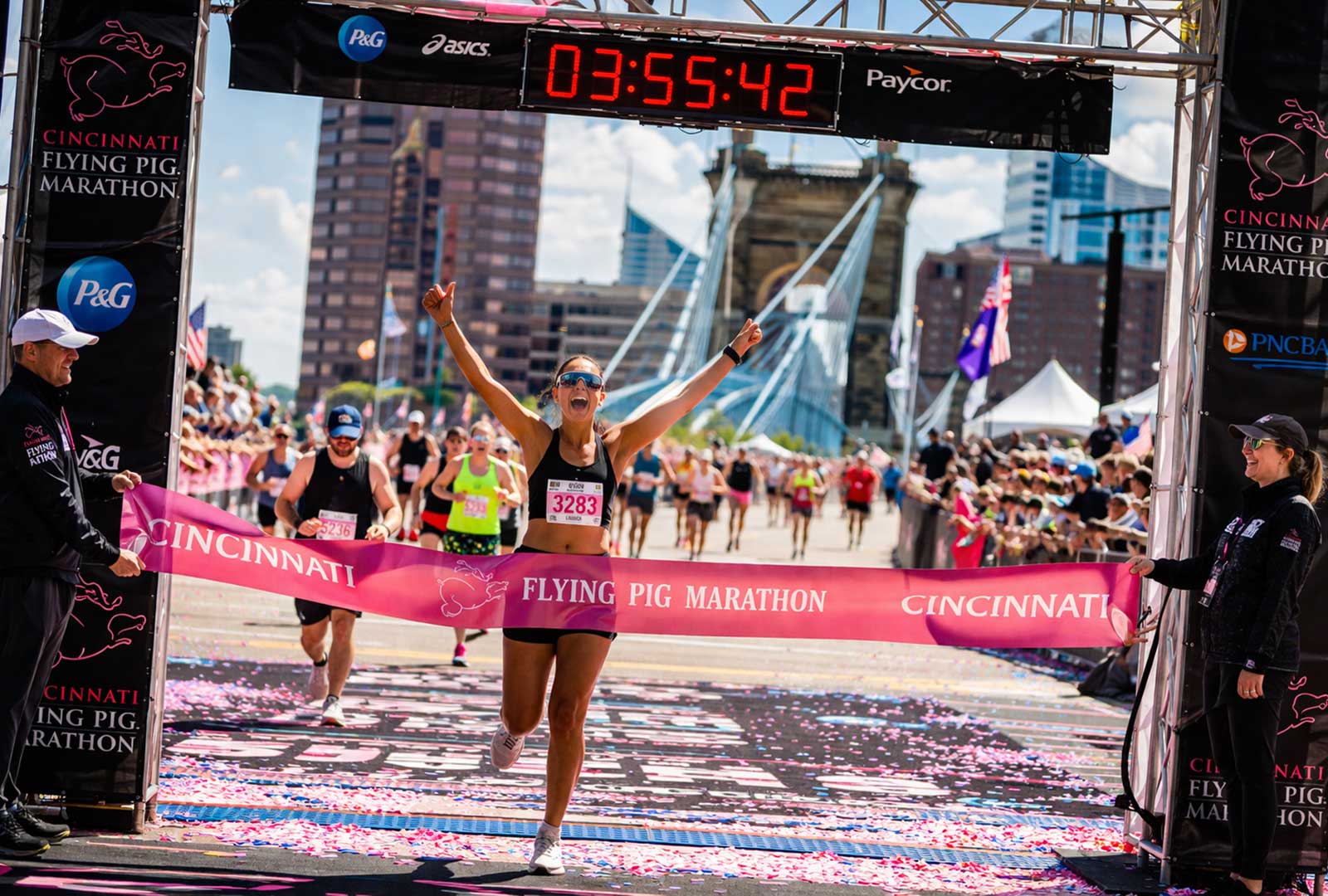
Flying Pig Marathon 2026
The Flying Pig Marathon 2026 starts early Sunday morning on Rosa Parks Street next to the National Underground Railroad Freedom Center.
Thousands of runners will line up across color-coded corrals, known locally as “Pig Pens,” before heading out across a course that has built a reputation for being more demanding than it looks on paper. The Flying Pig Marathon 2026 is expected to attract an even larger and more enthusiastic crowd.
The structure is tight. Runners are expected to arrive at least 30 to 60 minutes before the 6:30 AM start, and once you’re placed in a corral, your only flexibility is moving backward if needed. Bag check runs through designated buses on Elm Street, and missing those logistics can turn the finish line into a frustrating scramble later.
This is a well-organized race, but it assumes participants are paying attention.
The Course Is Where the Race Really Begins
The first few miles can feel manageable, especially with the early energy downtown and the initial river crossings. That changes quickly. Just before mile 9, the half marathon splits off, and full marathon runners continue onto the longer, more demanding route.
From that point on, the Flying Pig Marathon becomes a different kind of race. The climb into Eden Park is the early test that tends to drain more energy than expected. The middle miles through the east side require steady pacing, and the final stretch along Riverside Drive often feels longer than it should, especially for runners already pushing their limits.
There are 25 fluid stations along the course, offering Gatorade first and water second, along with energy gels at miles 18 and 21. Pace teams are available for runners targeting specific finish times, but the course itself dictates how realistic those goals are.
Time Limits Shape the Entire Experience
The seven-hour course limit is not a suggestion. It’s enforced in stages, and it changes how runners need to think about pacing from the start.
Participants must reach mile 17 by 12:15 PM or be transported forward on the course. By mile 20, runners who fall behind pace are directed onto sidewalks, and by mile 24, late runners finish outside the official race route.
For experienced runners, this is manageable. For newer participants, it can come as a surprise. The Flying Pig Marathon is supportive, but it does not allow unlimited flexibility.
Safety, Scale, and What It Takes to Run an Event This Size
The operational side of the Flying Pig Marathon is easy to overlook if you’re just watching from the sidewalk, but it’s the reason the event works at all. Coordinating a race that stretches 26.2 miles across Cincinnati, Northern Kentucky, and multiple major corridors means aligning city departments, emergency services, and logistics teams in a way most weekend events never attempt.
Security is layered and visible for a reason. Local law enforcement, specialized units, and K-9 teams are positioned throughout the course and downtown footprint, not just at the start and finish. That presence isn’t about optics. It’s part of a broader event security plan that has evolved alongside national standards for large public gatherings. Races like this are treated less like casual community events and more like moving, citywide operations.
Medical coverage follows the same logic. There are athletic trainers and medical staff positioned at roughly 15 points along the course, with fully equipped medical facilities staged at the finish line until mid-afternoon. That setup reflects real-world patterns. Most serious issues in endurance races don’t happen at the start. They show up late, when fatigue, dehydration, or underlying conditions catch up with runners. Having distributed coverage reduces response time, which is the difference between routine treatment and something more serious.
Runners are also encouraged to take a more active role in their own safety. The RaceSafe profile system allows participants to preload medical information that can be accessed quickly if they need help on the course. Emergency alert systems, like the county-wide text notifications tied to the event, provide another layer of communication if conditions change or issues arise.
From an experience standpoint, this is where the Flying Pig Marathon separates itself from smaller races. It’s not just about having volunteers and water stations. It’s about building redundancy into the system. Multiple access points, clear cutoff protocols, transportation backups, and coordinated communication channels all exist so the race doesn’t rely on everything going perfectly.
That level of planning is what allows the event to scale to tens of thousands of participants without breaking down. It also explains some of the structure runners feel on race day. The strict timelines, controlled corrals, and enforced cutoffs aren’t just rules for the sake of rules. They’re part of a system designed to keep a large, complex event safe and manageable across an entire city.
The Finish Line and the Weekend Around It
Finishing the race brings runners into the Kroger Recovery Area, where organizers provide food, drinks, and post-race support exclusively for participants. From there, the energy shifts to Smale Riverfront Park, where live music and a steady crowd carry the post-race celebration throughout the day.
Local businesses feel the impact immediately. Restaurants like Cincinnati Lager House open early and stay busy, while spots across downtown and Over-the-Rhine see increased traffic from both runners and spectators. The event consistently draws tens of thousands of participants and visitors, creating one of the strongest tourism weekends Cincinnati sees each year.
What This Race Says About Cincinnati
There’s a broader point here beyond the course itself. The Flying Pig Marathon continues to operate smoothly at a scale where other city efforts often struggle. It coordinates road closures, public safety, transportation, and tourism across downtown, the east side, and Northern Kentucky without major breakdowns.
That’s not small.
The Economic Impact Is Real, Not Theoretical
In 2025, the race generated an estimated $45.9 million in total economic impact across the region. That includes nearly $16 million in spending from out-of-town visitors, plus another $8.2 million from locals moving around the city differently that weekend. More than 670 local jobs were supported, with over $15 million in earnings tied directly to the event.
For Cincinnati, this is one of the most reliable tourism weekends of the year. Hotels fill up. Restaurants at The Banks and Over-the-Rhine run at capacity. Northern Kentucky sees the overflow.
It’s immediate. You can see it happening in real time.
Where the Flying Pig Stands Nationally
The Flying Pig Marathon isn’t in the same tier as races in Boston or New York City, but that’s not really the comparison that matters.
Among mid-sized marathons, it consistently ranks as one of the largest and best-run events in the country. With more than 50,000 participants across race weekend and runners coming from all 50 states and multiple countries, it’s firmly in that top regional tier.
It’s big enough to matter, but still local enough to feel like Cincinnati.
What Runners Actually Say About It
Talk to people who’ve run it, and the feedback is pretty consistent.
The course is tougher than expected. The hills are real. But the crowd support makes up for it.
Local running groups and reviews over the years tend to echo the same themes: strong organization, high energy, and a course that doesn’t hand anything to you.
One Cincinnati-based runner put it simply in a race recap: “It’s not a PR course, but it’s one you remember. The city shows up for you when you need it.”
That reputation matters more than rankings.
The Bigger Question It Raises
Here’s where it gets interesting.
Cincinnati proves, every year, that it can execute something complex, visible, and economically meaningful at a high level. This race requires coordination between city agencies, private partners, volunteers, and tens of thousands of participants moving across the region at the same time.
And it works.
Which makes it fair to ask why that same level of alignment feels harder to achieve in areas that affect residents every day, whether it’s infrastructure, public safety, or long-term development planning.
The Flying Pig Marathon doesn’t answer that question.
But it does make the gap harder to ignore.
What This Does for Cincinnati
For runners, it’s a demanding race that rewards preparation and discipline. For the city, it’s something else entirely. It’s proof that when priorities are clear and execution is tight, Cincinnati can operate at a high level on a national stage.
That’s not theoretical either. It’s happening this weekend.
Read More
Flying Pig route changes announced for 2026 Cincinnati marathon
FAQs
What time does the Flying Pig Marathon 2026 start?
The full marathon begins at 6:30 AM on Sunday, May 3, 2026, in downtown Cincinnati.
Where is the start line for the Flying Pig Marathon?
The race starts on Rosa Parks Street next to the National Underground Railroad Freedom Center.
How long do runners have to finish the race?
There is a strict seven-hour time limit. Runners who fall behind pace may be moved off the official course or transported forward.
Is the Flying Pig Marathon course difficult?
Yes. The course includes notable hills, especially early near Eden Park, and a long final stretch that can be challenging for tired runners.
Where does the half marathon split from the full marathon?
The courses split just before mile 9. Full marathon runners must follow signs for the marathon route.
Can spectators watch the Flying Pig easily?
Yes. There are multiple viewing areas across the course, along with local restaurants and designated party zones that open early for spectators.
This article was created with the support of our proprietary AI-powered newsroom tools and reviewed by our editorial team for accuracy and clarity.