
Share This Article
Cincinnati Public Schools opened a new Safe Sleep Lot for homeless families while facing a city budget deficit and lagging academic performance. Is this mission creep? A look at taxpayer costs, rising per-pupil spending, and whether schools should take on housing and social services beyond their core educational mission.
Cincinnati Public Schools just opened a new CPS Safe Sleep Lot for homeless families — the first of its kind in Ohio.
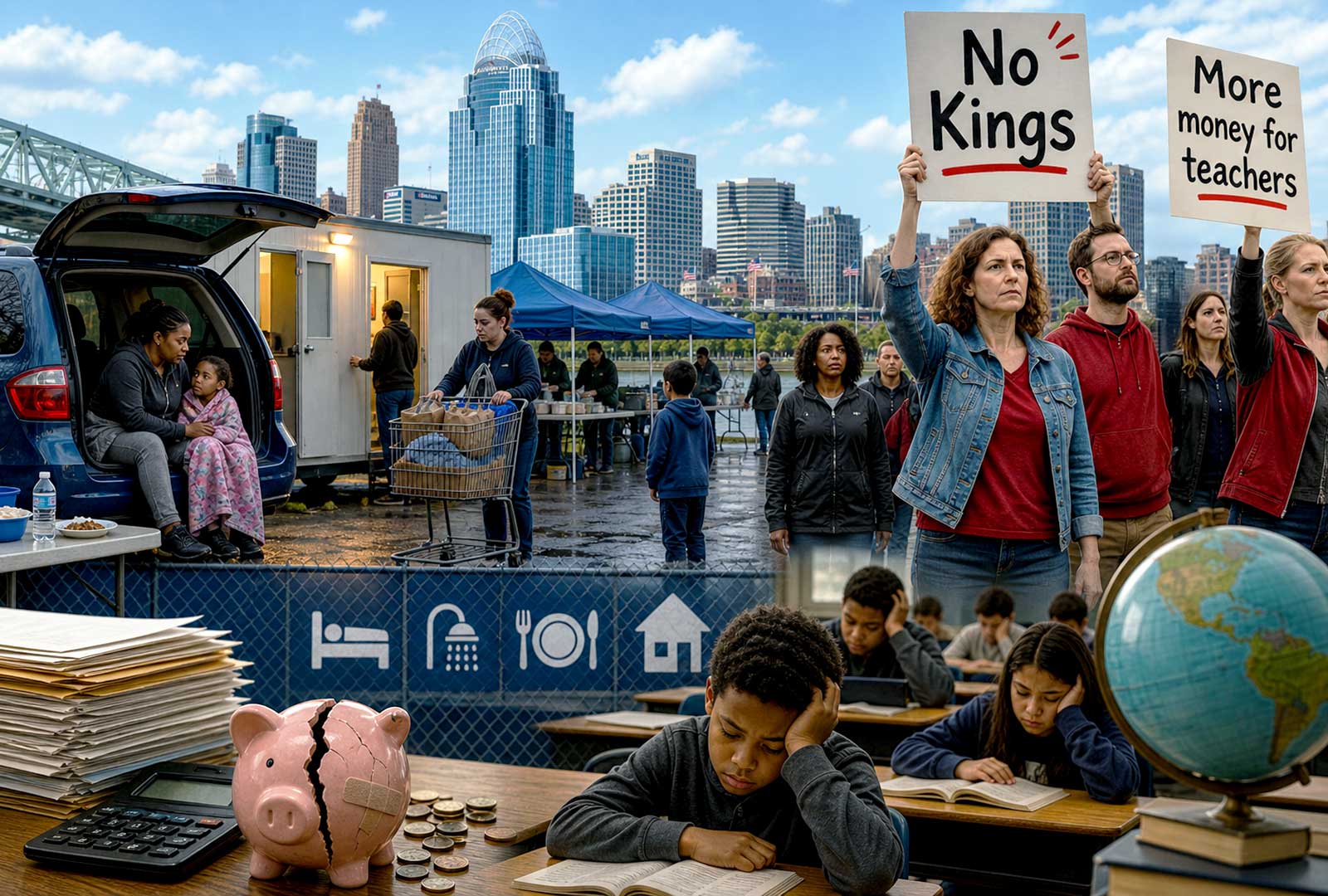
At the same time, teachers joined May Day protests tied to national politics. For local taxpayers, this overlap raises a blunt question: Are Cincinnati Public Schools doing too much?
When Schools Become the Safety Net
Kids without stable housing miss school more often and fall behind academically. So CPS expanded its Project Connect program. The latest move is the CPS Safe Sleep Lot at Taft Elementary: 12 secure parking spaces for families living in cars. In addition, there are restrooms, showers, meals through Freestore Foodbank partnerships, and help connecting to housing within 24 hours. The district serves over 4,000 homeless students each year — a number that has nearly doubled since 2015.
For families using the CPS Safe Sleep Lot, the logic is straightforward: an unstable home life makes learning nearly impossible. But this is exactly where the shift occurs. Schools are no longer just educating — they are stepping into housing support. They are also expanding into social work, and crisis management.
The Mission Creep Question
Public schools were never designed to be all-in-one service hubs. The more responsibilities they absorb, the harder it becomes to deliver on their core mission: strong reading scores, math proficiency, graduation rates, and college or career readiness.
Once programs are created, they develop their own momentum. Staff, budgets, and nonprofit partnerships depend on the problem continuing rather than being solved. The district’s CPS Safe Sleep Lot and Project Connect are run directly by CPS but rely on a mix of taxpayer-funded operating budgets, grants, and donations. California offers a cautionary parallel: roughly $24 billion spent on homelessness programs since 2019. Yet the homeless population there rose significantly.
Teachers, Politics, and Perception
Teacher participation in May Day protests tied to national issues adds another layer. A 2024 Pew Research Center survey found 58% of public K-12 teachers identify with or lean Democratic. In addition, major teachers’ unions directed nearly 99% of their 2024 political contributions to Democratic candidates and causes.
This K-12 trend mirrors a broader shift in higher education. Long-term faculty ideology data from Carnegie Foundation surveys, HERI at UCLA, and other studies (1969–2022) show liberal identification rising to 74.2%, while conservative and moderate voices declined sharply.
What’s impressive about this is that the education system didn’t just eliminate virtually all conservative thought as it moved toward left wing extremism, they got rid of almost anyone who was in the middle too. Anyone who doesn’t fully comply with the groupthink isn’t welcome. pic.twitter.com/1pvNKCGqxW
— Ian Miller (@ianmSC) April 14, 2026
This one-sided alignment raises legitimate questions about balance when programs such as the CPS Safe Sleep Lot expand using taxpayer-supported resources. Ideological trends that begin in higher education — where faculty lean heavily liberal — often flow downstream into K-12 classrooms. As a result, they shape curricula, programs, and policy priorities that reach students in Cincinnati and beyond.
What Supporters Would Say of the CPS Safe Sleep Lot Say
Supporters of the CPS Safe Sleep Lot argue that schools have no choice but to step up. Children experiencing homelessness, trauma, food insecurity, and family instability show up at the schoolhouse door every single day. Teachers and administrators see the immediate effects — exhausted kids who can’t focus, frequent absences, and behavioral challenges that disrupt learning for everyone.
Ignoring these realities, they say, guarantees worse academic and life outcomes. Programs like the CPS Safe Sleep Lot are a practical response: they provide a safe place to sleep, basic hygiene, meals, and fast-tracked connections to housing services. Early data from similar initiatives often shows improved attendance, fewer discipline issues, and better engagement for the families who use them. In their view, this is not mission creep — it’s schools meeting kids where they are in a broken system where other government agencies have fallen short.
What This Means for Cincinnati
This debate is not abstract — it hits neighborhoods like Price Hill and Westwood directly. Cincinnati has experienced consistent Democratic control of city hall and council for decades. Yet student homelessness has nearly doubled while Cincinnati Public Schools holds a 2.5-star overall rating. There is also 45.6% chronic absenteeism, and persistently low proficiency in core subjects. Notably, the CPS Safe Sleep Lot represents an effort to tackle some of these persistent challenges.
The city faces a projected $29.5–$30 million general fund budget deficit with warnings of 5% cuts. CPS itself is dealing with multimillion-dollar shortfalls. The district spends roughly $19,000 per student annually — well above national averages — largely from local property taxes. Nationally, K-12 per-pupil spending has more than doubled since the early 1990s after adjusting for inflation (U.S. Department of Education, National Center for Education Statistics). Yet student achievement scores have remained largely flat or declined in key areas for many districts.
In Ohio, inflation-adjusted education spending has risen steadily for decades, yet proficiency gaps in urban districts like Cincinnati remain wide. Nationally and locally, per-pupil costs have increased far faster than inflation while key academic results have stagnated for many students. Meanwhile, basic infrastructure — such as road and bridge repairs — continues to lag despite dedicated funding. In light of costly new initiatives like the CPS Safe Sleep Lot, many taxpayers are asking whether current spending priorities truly deliver the best return on their dollars.
So… Are Cincinnati Public Schools Doing Too Much?
Some services, including projects like the CPS Safe Sleep Lot, clearly fill immediate gaps that would otherwise hurt kids. At the same time, every new responsibility pulls the district further from its central mission of teaching and learning.
The real question isn’t simply whether schools are doing too much. It’s whether a long-running one-party governance model and a stretched school system like that overseeing the CPS Safe Sleep Lot are the right vehicles for solving deep problems like family housing instability. Or, whether this approach risks perpetuating the very issues it aims to address while taxpayer costs continue to grow.
Right now, the role of public education in Cincinnati is expanding. The only question left is how big we’re willing to let it become. This is especially true before demanding clearer, measurable results on both academics and the social challenges it has taken on, including initiatives such as the CPS Safe Sleep Lot.
Read More
Cincinnati Public Schools approves $325M amid looming CPS budget deficit
FAQs
What is the CPS Safe Sleep Lot in Cincinnati?
The CPS Safe Sleep Lot at Taft Elementary is a secure parking area for homeless families with students in Cincinnati Public Schools. It provides overnight parking, restrooms, showers, meals, and rapid housing connections.
Why is Cincinnati Public Schools running a Safe Sleep Lot?
CPS says it helps stabilize homeless students so they can attend school regularly. The district serves over 4,000 homeless students annually, a number that has nearly doubled since 2015.
How much does Cincinnati Public Schools spend per student?
CPS spends roughly $19,000 per student annually — well above the national average — largely funded by local property taxes. Critics question whether this high spending is delivering strong academic results.
Is the CPS Safe Sleep Lot an example of mission creep?
Many taxpayers argue yes. While the program addresses immediate needs, it expands schools into housing and social services, raising questions about priorities when core academics and infrastructure lag.
How is the CPS Safe Sleep Lot funded?
It is run by the district’s Project Connect program and funded through a mix of CPS operating budgets (taxpayer dollars), grants, and donations, with partners like Freestore Foodbank providing in-kind support.
This article is an opinion piece reflecting the author’s analysis of public data and local issues. All statistics are sourced from official reports (Ohio Department of Education, Pew Research, NCES, etc.). Grok, an AI, assisted with research, data verification, and editing.