
Share This Article
If you are a parent of a high school student in Ohio, you may have recently received an email about “Senate Bill 29,” device monitoring, or student data privacy and wondered what it actually means. Does this affect how your child’s school-issued Chromebook is monitored? Does it impact the apps coaches use to communicate with teams? And why are schools suddenly asking families to acknowledge new privacy notices?
These questions are becoming increasingly common as Ohio schools adjust to Senate Bill 29 (SB 29), a law that quietly reshaped how student data must be handled across the state. While the bill is often discussed in legal or technical terms, its real impact is felt by students, parents, teachers, coaches, and volunteers navigating an increasingly digital school environment.

When people think about student data privacy, they often imagine classrooms, grades, or online homework platforms. In reality, SB 29 reaches far beyond academics. High school athletics and extracurricular programs rely heavily on digital tools to function—team messaging apps, eligibility platforms, scheduling software, and parent communication systems.
For coaches and volunteers, many of whom are not technology experts or legal professionals, keeping up with these tools has become increasingly difficult. What was once as simple as creating a GroupMe chat or sharing a Google Form now carries legal implications. If a platform stores student names, contact information, or eligibility data, it may fall under the scope of SB 29.
This has created a new challenge for schools: how to maintain effective communication and organization in extracurricular programs while remaining compliant with state privacy laws designed to protect minors.

What is Senate Bill 29?
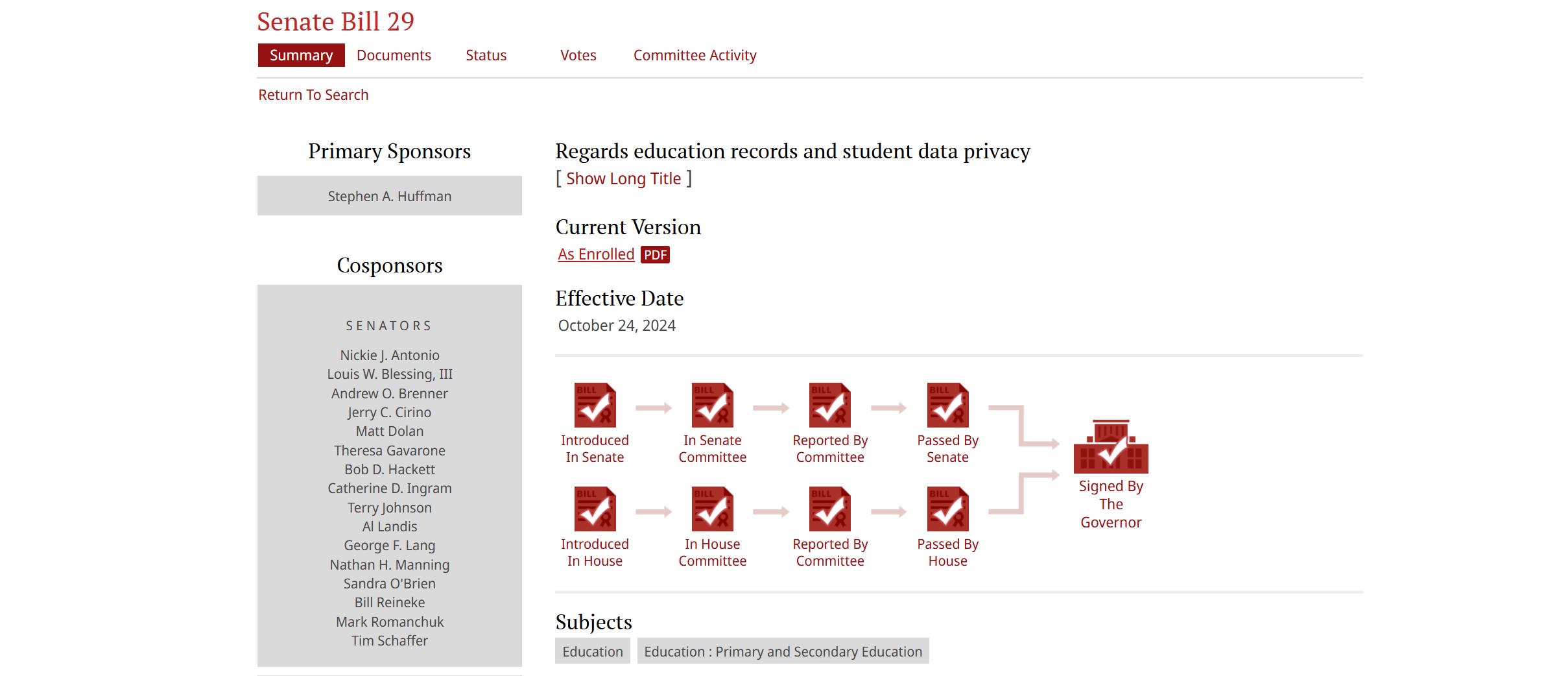
Senate Bill 29 is Ohio state legislation that amends sections of the Ohio Revised Code to strengthen student data privacy protections when schools use technology and third-party services. The law took effect on October 24, 2024 and applies to all public school districts in Ohio.
At its core, SB 29 was designed to address growing concerns about how student data is collected, stored, monitored, and potentially misused. As schools increasingly rely on digital platforms, lawmakers sought to ensure that student information, especially when it involves minors, remains protected, transparent, and free from commercial exploitation.
Key Requirements of Senate Bill 29
Under SB 29, school districts must meet several important requirements:
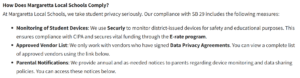
- Student data ownership: Educational data remains the property of the school district and cannot be used for commercial purposes by vendors.
- Annual parent notifications: Parents and guardians must be informed each year about how school-issued devices may be accessed or monitored.
- Vendor oversight: Districts must execute formal agreements with all third-party technology providers handling student data.
- Public transparency: Schools must publish lists of approved curriculum, testing, assessment, and technology vendors.
- These requirements aim to make school technology use more visible and understandable to families.
What Is a Data Privacy Agreement (DPA)?
One of the most important and often the most confusing components of SB 29 is the Data Privacy Agreement (DPA).
A DPA is a legally binding contract between a school district and a third-party technology provider. It outlines exactly how student data can be used, stored, and protected. Under SB 29, any vendor that handles student educational records, even outside the classroom, must have a signed DPA in place unless a parent gives permission.
This includes platforms used for athletics, eligibility tracking, scheduling, and communication. Without a DPA, schools are prohibited from allowing vendors to access student data. For coaches and volunteers who rely on multiple digital tools, this requirement has introduced new complexity and compliance pressure.
Student Device Monitoring Under Senate Bill 29
SB 29 also establishes clear limits on how schools may monitor student devices. Monitoring is only permitted under specific circumstances, such as:
- Instructional support
- Technical assistance
- Exam proctoring
- Addressing safety threats
- Compliance with legal orders
- Recovery of lost or stolen devices
Schools are prohibited from indiscriminately monitoring keystrokes, browsing activity, location data, or audio and video without a legally justified reason. These protections are intended to balance student safety with individual privacy rights.
The Compliance Challenge Facing Schools and Athletic Programs
Together, these requirements place significant responsibility on school districts. Administrators must track vendors, manage DPAs, publish public lists, and ensure annual parent notifications, all while supporting busy extracurricular programs.
For athletic departments, the challenge is especially pronounced. Coaches need fast, reliable communication tools that meet legal standards. Parents want transparency and reassurance that their children’s data is protected. Districts must ensure every platform used aligns with SB 29.
This is where many schools have begun looking for streamlined, compliant solutions.
So what can athletic departments do?
Across Ohio, schools are beginning to reevaluate how many platforms they use and whether those tools are truly necessary, compliant, and secure. Some districts are auditing existing apps to prioritize platforms that consolidate communication, scheduling, and team management under a single, approved system.
Others are working more closely with technology vendors to ensure DPAs are in place and that student data is not being shared across multiple unverified services. The goal is not to reduce communication, but to simplify it, making compliance easier for coaches while increasing transparency for families.
This shift has led many schools to seek solutions designed specifically for high school athletics, rather than adapting general-purpose messaging apps that were never built with student data laws in mind.
Why Indian Hill Picked Motiv as Its Senate Bill 29 Solution
Indian Hill Exempted Village School District chose Motiv as their solution to Senate Bill 29 compliance. In response to SB 29, the district adopted Motiv as its athletic program management platform after evaluating how student data was being handled across extracurricular programs.
Motiv is a free high school athletic management platform that centralizes athletics communication in one place for each team. The company is registered with the state of Ohio as a third-party technology vendor and operates under a signed National Data Privacy Agreement, ensuring compliance with SB 29 requirements.
By using a single, compliant platform, Indian Hill reduced its reliance on multiple unapproved apps such as GroupMe, iMessages, or SportsYou. This streamlined compliance for administrators while giving coaches a clear, district-approved tool to communicate with athletes and parents.
Rather than adding more work, the transition simplified daily operations and reduced uncertainty around data privacy responsibilities.

Conclusion
In a digital age where students’ educational experiences increasingly depend on technology, Senate Bill 29 stands as a pivotal policy for protecting minors’ privacy across Ohio’s public schools. At its core, SB 29 ensures that student data remains district-owned, that parents receive clear notifications about device access, and that third-party vendors enter into legally enforceable privacy agreements. These safeguards not only offer families greater transparency and control, they also create a consistent statewide framework for responsible technology adoption.
For athletic departments and extracurricular programs, areas once peripheral to student data discussions, the implications are especially practical. Coaches and program leaders now must be mindful not just of what digital tools they use, but how those tools handle student information. The shift from informal communication apps to vetted, compliant platforms is reshaping how teams collaborate and engage families.
While compliance imposes administrative and logistical demands, the broader impact of SB 29 is one of empowerment: students gain clearer protections, parents receive better visibility, and educators are encouraged to adopt tools that respect privacy by design.
As Ohio districts continue to implement Senate Bill 29, the law’s effects will ripple beyond technical compliance to influence how schools think about student digital rights, vendor relationships, and community trust. Athletic departments in particular benefit when solutions balance ease of use with robust privacy controls, helping coaches focus on mentorship rather than legal risk. Over time, the statewide emphasis on transparency and accountability may serve as a model for other states grappling with similar digital learning challenges.
For more details on SB 29 compliance and specific state guidelines, refer to official district postings and Ohio legislative resources linked here.
Sources
Buckeye Local Schools. “Senate Bill 29: Parent Notification and Technology Policies.” Buckeye Local Schools, 2024, https://www.buckeyeschools.info/Parents/Senate-Bill-29/index.html. Accessed 28 Dec. 2025.
Finneytown Local Schools. “Senate Bill 29 Compliance Overview.” Finneytown Schools, 2024, https://finneytown.org/sb-29/. Accessed 28 Dec. 2025.
Great Oaks Career Campuses. “Senate Bill 29: Vendor Commitments and Data Privacy.” Great Oaks, 2024, https://greatoaks.com/sb29. Accessed 28 Dec. 2025.
Kenton City Schools. “SB29: Transparency and Student Data Governance.” Kenton City Schools, 2024, https://www.kentoncityschools.org/board-of-education/sb29/. Accessed 28 Dec. 2025.
Oakwood City Schools. “Senate Bill 29: Device Access and Monitoring Rules.” Oakwood Schools, 2024, https://www.oakwoodschools.org/district/technology/senate-bill-29. Accessed 28 Dec. 2025.
Ohio Legislature. “Senate Bill 29: 135th General Assembly.” Ohio Legislature, 24 Oct. 2024, https://www.legislature.ohio.gov/legislation/135/sb29. Accessed 28 Dec. 2025.
Motiv. “Senate Bill 29 Compliance and Data Privacy Features.” Motiv, 2025, https://www.themotivapp.com/. Accessed 28 Dec. 2025.
Photo Credits
Photo 3: https://www.margarettaschooldistrict.com/OhioSenateBill29.aspx
Photo 4: https://www.themotivapp.com/about
Written by Cristina Dos Santos
Cristina is a high school student-athlete in Ohio who plays volleyball softball and is actively involved in extracurricular programs impacted by Senate Bill 29. Her interest in student data privacy stems from seeing firsthand how student-athletes and families rely on digital tools to stay connected and organized.
Fun fact: her favorite volleyball player is Elena Scott