
Share This Article
Article Summary:
Waymo is currently mapping roughly 50 square miles of Cincinnati and Northern Kentucky with human-driven vehicles. The company has not announced autonomous testing or passenger service. The mapping project is an early step that could lead to further testing if Waymo decides to move forward.
Updated Sept. 6, 2026: This article has been substantially expanded with additional reporting on independent safety data, Northern Kentucky’s autonomous-vehicle law and what would have to happen before driverless service could launch in the region. This update also explores the latest developments surrounding Waymo Cincinnati and its potential impact on local transportation.
Waymo Cincinnati Mapping Is Underway, but Driverless Rides Aren’t Here Yet
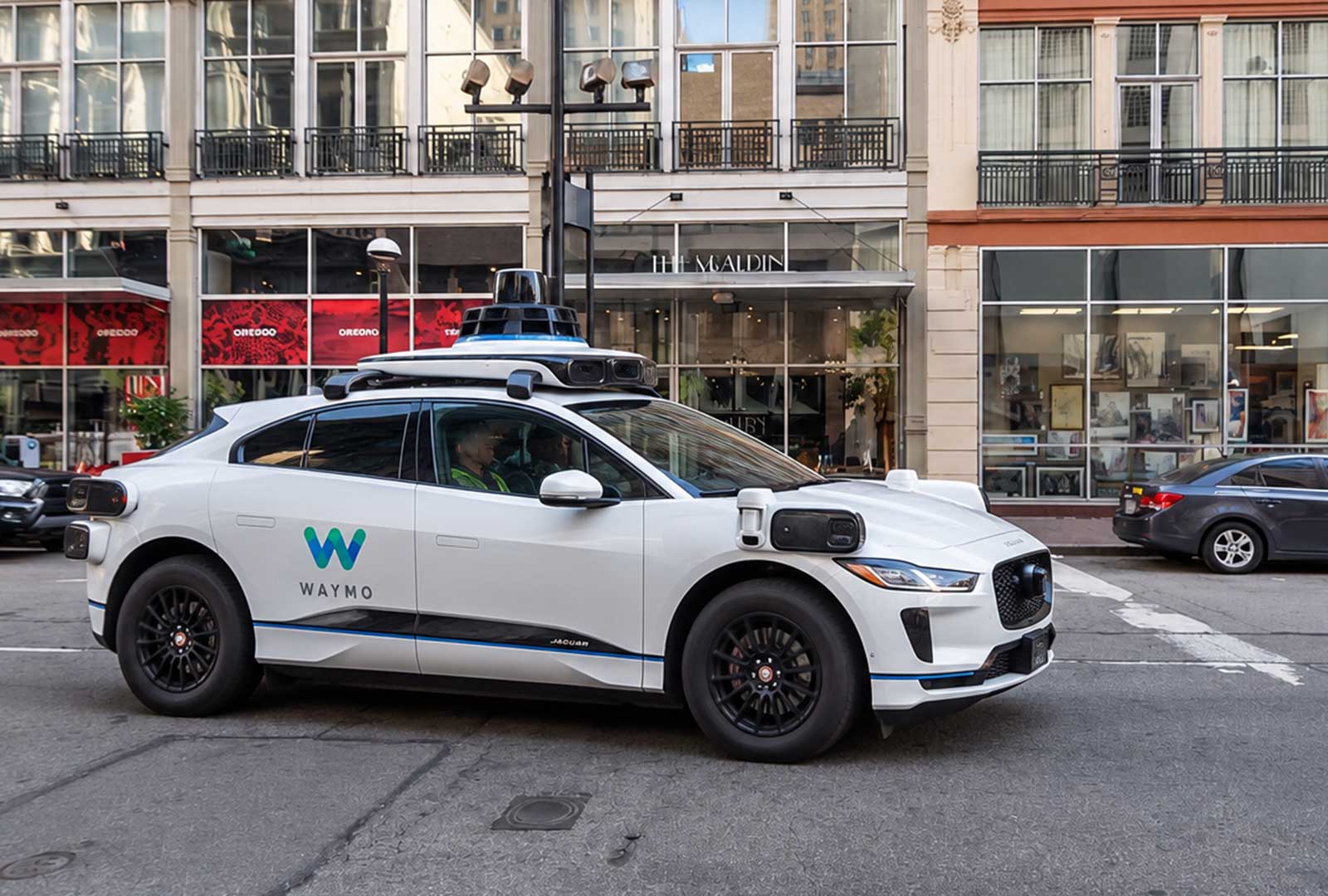
A trained human sits behind the wheel of every Waymo vehicle now on local streets.
Waymo Cincinnati mapping began during the first week of September. It marks the opening step in a process that could eventually lead to a robotaxi launch here. There is no guarantee that it will.
Waymo spokesperson Chris Bonelli confirmed the mapping project to WVXU. The Alphabet-owned company is manually driving Jaguar I-PACE vehicles through downtown, surrounding suburbs and parts of Northern Kentucky. The vehicles carry Waymo’s sensor system and are collecting data for the high-definition map the company says it needs. Waymo will not consider testing cars without a driver here until that map is complete.
“We’ve coordinated with city and state officials ahead of our arrival,” Bonelli said. Mapping, he added, “is a key, first step in validating our technology in a new city.” Waymo says it will leave the region once the roughly two-month mapping project wraps. The company will return only if it decides Cincinnati is worth the next phase.
That distinction is the whole story right now. Waymo has set no date to test its cars without a driver here. It has made no commitment to open the Waymo app to Cincinnati riders, either. Still, some residents are already skeptical of the idea, regardless of timeline.
For example, one Cincinnati resident told FOX19 she felt nervous about handing driving over to “robots.” Others, though, said they would be open to it if the company can show the technology is safe. For now, that debate remains hypothetical in Cincinnati, since no passenger service exists.
Why Mapping Comes First, and What Usually Comes Next
First, Waymo does not run its software in a new city without building a detailed map first. The company records lane markings, curb cuts, signal locations and other fixed details. Its cars rely on that map to navigate later without a human correcting for local quirks.
Waymo has followed a similar sequence in every market it has entered. The process moves through six general steps. First comes human-driven mapping, then additional data collection and simulation. After that, the company runs autonomous testing with a specialist aboard, followed by fully driverless testing. Limited rider access and open commercial service come last.
Cincinnati has only confirmed the first of those steps. Nothing about the mapping project authorizes autonomous operation on Ohio or Kentucky roads. Waymo has not said whether, or when, it would move to step two here.
For now, residents seeing the sensor-covered SUVs downtown or in Northern Kentucky are watching data collection. They are not seeing a preview of a robotaxi fleet. That distinction matters for a region trying to gauge how seriously to take this moment.
Two States, One Metro: Why Northern Kentucky Changes the Calculus
Waymo Cincinnati mapping covers both sides of the Ohio River in the same project. That makes this a genuinely regional story, not a Cincinnati-only one. The metro area’s autonomous-vehicle future, if there is one, will not be decided by a single city government.
Instead, it runs through Cincinnati, Covington, Newport and other Northern Kentucky communities. It also involves two state transportation agencies and at least two major river crossings that carry traffic between them.
The cross-river piece could be especially significant because the region is already undergoing major transportation changes. The Cincinnati Exchange has covered the Brent Spence Bridge Corridor project, which is reshaping I-71/75 between Cincinnati and Covington through 2033. This outlet also reported on a March tanker fire that shut down I-471, another major Cincinnati-Northern Kentucky connection.
Kentucky’s Autonomous-Vehicle Law
Meanwhile, Kentucky sets its autonomous-vehicle framework at the state level. Under KRS 186.763, a fully autonomous vehicle may operate on Kentucky highways without a human driver. However, it must first meet a set of listed safety conditions.
Before operating without a driver, though, the operator must file a law-enforcement interaction plan. That plan goes to the Kentucky Transportation Cabinet and Kentucky State Police. Specifically, it must describe how officers should approach the vehicle. It also has to explain how officers would remove the vehicle from the road if necessary. Motor carriers running fully autonomous vehicles must additionally carry at least $1 million in liability coverage.
Kentucky law gives the Transportation Cabinet primary regulatory authority over autonomous vehicles. It also limits how much individual cities and counties can independently regulate them. Ohio’s framework, by contrast, leaves more room for local involvement.
That difference matters for Waymo Cincinnati mapping specifically, since the project spans both states. In practice, Waymo vehicles crossing the Ohio River during any future service could operate under two different layers of government oversight within the same ride.
The Provision That Just Expired, and What the 2026 Bill Actually Does
One piece of Kentucky’s law changed on its own this summer. No legislative action was required. Specifically, the original 2024 law required a licensed human driver aboard any fully autonomous vehicle weighing more than 62,000 pounds, mostly heavy trucks. That requirement applied from July 15, 2024 through July 31, 2026. That date has now passed, and the requirement expired as written.
A 2026 bill is sometimes discussed alongside that expiration. However, House Bill 223 does not extend or restore the 62,000-pound threshold. Lawmakers introduced HB 223 on Jan. 7, 2026. The House referred it to the Transportation Committee on Jan. 14, but the bill advanced no further during the session.
The bill would instead prohibit school districts from operating a fully autonomous vehicle as a school bus. It would also bar autonomous operation of any vehicle that otherwise requires a commercial driver’s license. None of this directly regulates Waymo’s passenger cars. Still, it shows Kentucky lawmakers are actively working through how far the state’s 2024 framework should extend.
The Questions Nobody Has Answered Yet
However, Waymo has not published a boundary map for the Waymo Cincinnati mapping zone, which covers roughly 50 square miles. Several of the most consequential regional questions remain genuinely open. The Cincinnati Exchange could not confirm answers to any of the following. Instead of guessing, this outlet states that directly:
- Does the mapping zone include CVG? Unconfirmed. Waymo has not said whether Cincinnati/Northern Kentucky International Airport falls inside its current boundary.
- Does it include the Brent Spence Bridge, I-71/75 or I-471? Unconfirmed. Waymo describes the zone only as downtown Cincinnati, surrounding suburbs and parts of Northern Kentucky. The company has named no specific highways or river crossings.
- Which Northern Kentucky communities are actually included? Unconfirmed. Covington and Newport come up most often in local coverage. However, Waymo has not published a list. This outlet also could not verify whether Bellevue, Fort Thomas, Erlanger or Florence are part of the project.
- Has Waymo signed any written agreement with a local or state agency? Unconfirmed. So far, no memorandum, data-sharing agreement or other written arrangement between Waymo and Cincinnati, Covington, ODOT or the Kentucky Transportation Cabinet has surfaced publicly. Bonelli’s statement that the company “coordinated with city and state officials” does not, on its own, confirm a written agreement exists.
- What additional approvals would autonomous testing or commercial service require? Unconfirmed in detail. Kentucky’s law-enforcement interaction plan requirement would apply before any driverless operation on the Kentucky side. Waymo has not specified Ohio’s approval process for this project.
Each of those questions is answerable, in principle. Waymo, Cincinnati’s Department of Transportation and Engineering, KYTC or ODOT could all provide answers. None of them has done so publicly yet.
Is Waymo Actually Safer? Independent Data First, Then the Company’s Own Numbers
The safety case for autonomous vehicles now rests on more than company talking points. Because Waymo Cincinnati mapping could eventually lead to driverless service here, it’s worth being precise about which numbers come from where.
An IIHS study published July 23, 2026, is the only independent analysis in this discussion. It found Waymo’s driverless vehicles involved in 68% fewer police-reportable crashes per mile than human drivers. Researchers drew on crash data collected in San Francisco, Phoenix, Los Angeles and Austin between 2021 and 2024.
The reduction varied sharply by city. Phoenix saw a 76% drop, while Austin actually showed a 4% higher crash rate. IIHS said Austin’s sample size was too small for a firm conclusion. The organization also cautioned that current federal crash-reporting rules aren’t built to monitor a rapidly scaling driverless fleet.
By comparison, Waymo’s own safety reporting tells a different, larger story. The company claims a 94% reduction in crashes causing serious or fatal injury. It also reports an 82% drop in crashes causing any reported injury. Both figures compare against an “adjusted human benchmark” the company built for the same cities. That Waymo safety data covers more than 220 million fully autonomous miles logged through March 2026.
Those numbers come from Waymo’s own analysis of its own data, not an outside audit. As a result, they should be read as company reporting rather than treated as equivalent to the independent IIHS findings.
What Tampa Shows, and What It Doesn’t Prove About Cincinnati
For example, Waymo followed a similar sequence in Tampa before opening service there. Mapping and specialist-driven testing began in December 2025. The company opened public rides on Sept. 1, 2026, covering roughly 50 square miles of the city.
That footprint is similar in size to the current Waymo Cincinnati mapping zone. However, the similarity is coincidental, not a signal. Tampa’s driverless rides arrived nine months after mapping began, but Waymo has offered no comparable timeline for Cincinnati.
The company’s own public statements say only that it will leave the region once mapping is complete. Waymo will return “when we’re ready,” with no stated schedule.
What This Could Mean for Rideshare Drivers and Local Transportation
If Waymo Cincinnati mapping eventually leads to passenger service, transportation economics will matter as much as the technology. Cincinnati City Council Member Mark Jeffreys has ridden in a Waymo before. He told Axios he doesn’t expect city action unless Waymo actually moves toward launching in Cincinnati.
Still, Jeffreys said the city should start studying how other cities have handled the congestion and regulatory questions autonomous vehicles raise. Waymo could bring “disruptions” that affect rideshare drivers’ livelihoods, he said. He added: “It’s really important that we get ahead of this.”
That concern isn’t unique to Cincinnati. Rideshare and taxi drivers in other Waymo cities have organized against the company already. As a result, any future Cincinnati launch would raise the same basic question locally: what happens to Uber and Lyft drivers’ income if rides shift toward a fleet that doesn’t need a paid driver at all.
Robotaxis that stall or hesitate around unusual situations can also create their own congestion. Construction zones and emergency scenes are common examples. Cincinnati Police, Covington Police and Kentucky State Police have not publicly detailed what protocol they would use to interact with a stopped or disabled autonomous vehicle. Because Waymo has not announced driverless testing here, those procedures remain largely hypothetical for now.
Not Cincinnati’s First Encounter With Autonomous Technology
In addition, the region has some history with automation already. CVG tested an autonomous baggage tractor through a 2024 partnership with Aurrigo. The University of Cincinnati has researched autonomous-vehicle technology for years, and Ohio has funded similar research through DriveOhio.
Waymo Cincinnati mapping extends that regional history. It does not start one from nothing.
Nationally, Waymo is racing against other companies moving in the same direction. Amazon-backed Zoox is expanding its own robotaxi testing into more U.S. cities. Tesla, meanwhile, opened its steering-wheel-free Cybercab to public riders in Austin the same week Waymo’s mapping cars appeared in Cincinnati. Still, this region’s project is a small, early piece of that larger push. It is not a story about Tesla or Zoox themselves.
What Happens Next
Ultimately, what comes next in Cincinnati depends entirely on what Waymo decides once its roughly two months of mapping wrap up. The company hasn’t said what that decision will look like. It also hasn’t said when residents might hear about it.
Until then, Waymo Cincinnati mapping remains at step one of the six-step process the company has run in more than a dozen other American cities. Steps two through six, autonomous testing, driverless testing, limited rider access and full commercial service, all remain unconfirmed here. For now, the sensor-covered Jaguars on local streets are gathering data, not passengers.
FAQs
Is Waymo available to ride in Cincinnati right now?
No. So far, Waymo Cincinnati mapping is the only confirmed phase. The company has not announced passenger service or a launch date.
Why are Waymo cars driving around Cincinnati and Northern Kentucky?
They’re collecting data for the high-definition map the company needs before it will consider testing autonomous driving here. Waymo has run this same step in every market it has entered.
Are the Cincinnati Waymo vehicles driving themselves?
Not yet. Trained specialists are manually driving every vehicle in the mapping project.
Does the mapping project cover Northern Kentucky, including Covington and Newport?
Waymo says the project includes Northern Kentucky broadly. However, the company has not published a list of specific communities. It also has not confirmed whether CVG, the Brent Spence Bridge or specific interstates fall inside the roughly 50-square-mile zone.
Has Waymo signed a formal agreement with Cincinnati or Kentucky officials?
No written agreement, memorandum or data-sharing arrangement has surfaced publicly. Waymo says it “coordinated with city and state officials,” but that statement alone doesn’t confirm a formal agreement exists.
What would have to happen before Cincinnati got driverless Waymo rides?
Waymo would need to complete mapping, decide to move forward, and run autonomous and driverless testing locally. In addition, the company would need whatever approvals Ohio and Kentucky regulators require. That includes Kentucky’s law-enforcement interaction plan for any driverless operation on the Kentucky side. None of those steps has been confirmed or scheduled.
This article was reported, fact-checked and edited using The Cincinnati Exchange’s proprietary AI article system as part of our editorial process.