



Share This Article
Article Summary: Covington, Kentucky’s Board of Commissioners votes Tuesday, Sept. 8, on a 10-year, $6 million contract with Axon Enterprise covering body cameras, Tasers, mobile license-plate readers, an autonomous drone system, and AI-assisted report-writing software. The proposal stalled once already, on Aug. 25, after residents and commissioners raised questions about surveillance, data retention, and the contract’s decade-long term.
Covington commissioners face a vote on Tuesday on a $6 million Axon Enterprise contract.
The ten-year deal already stalled once after residents and commissioners raised pointed questions.
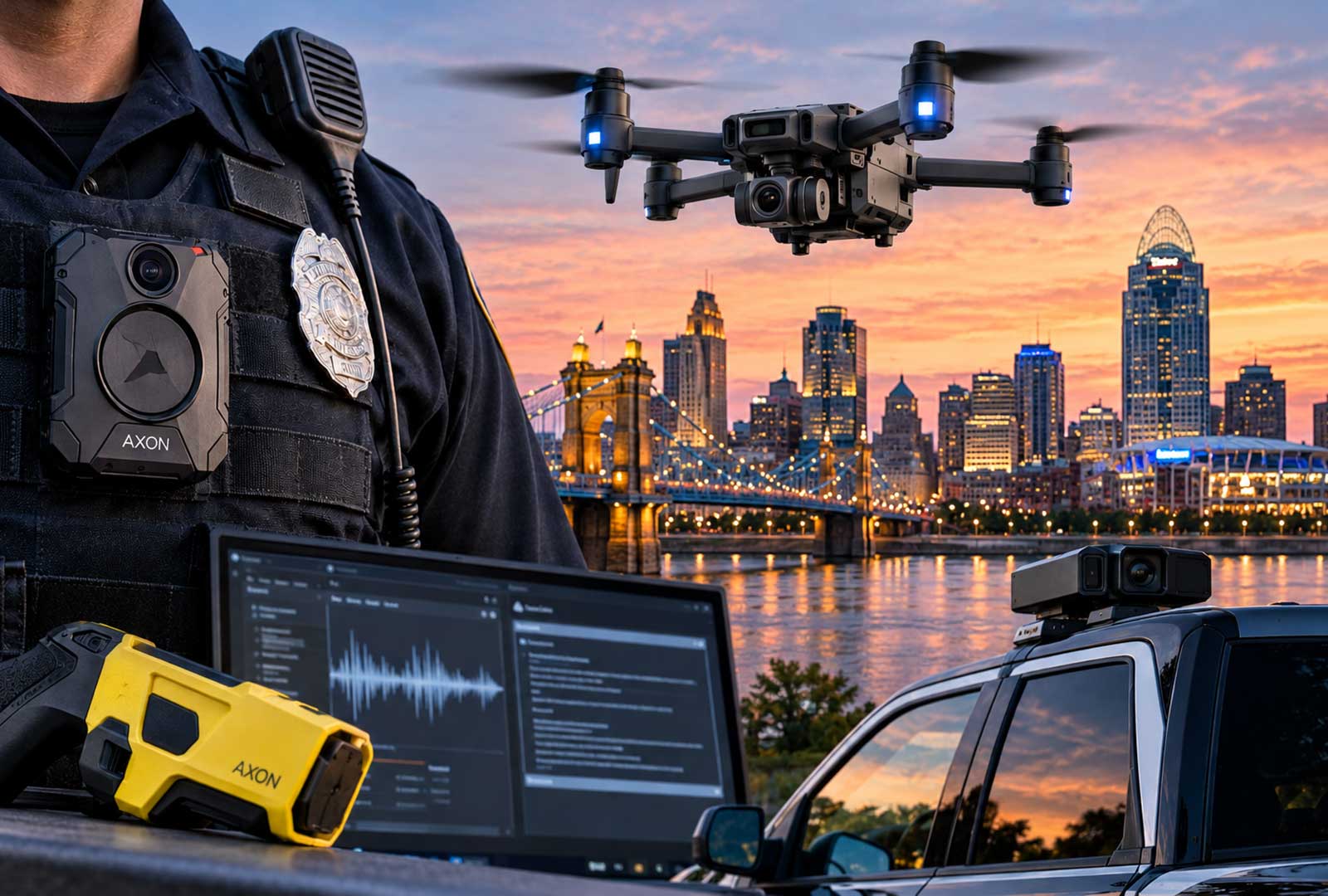
The Covington Axon contract bundles body cameras, Tasers, and mobile license plate readers. It also adds a dock-based Drone as First Responder system and AI report-writing software. All of it falls under a single 10-year commitment. Commissioners vote on the agreement Tuesday, Sept. 8, at 6 p.m. at Covington City Hall. A city staff presentation on the Axon proposal comes first, followed by extended public comment. The vote follows an Aug. 25 stall on the same proposal. Residents and commissioners had raised questions then about privacy, data retention, and the decade-long commitment.
Read the signed Axon quote (PDF) · Tuesday’s draft agenda · Aug. 25 meeting minutes
What commissioners are voting on
The Covington Axon contract would replace the Covington Police Department’s current five-year Axon agreement, which expires Sept. 30. Chief Justin Wietholter took over the department in August 2025. He’ll present the agreement alongside city staff before public comment opens Tuesday. Each speaker gets five minutes. The order now sits on the regular agenda as a standalone item, not the consent agenda where it started.
That placement matters because of what happened the first time. On Aug. 25, commissioners pulled the contract off consent. Residents had raised concerns about privacy, data security, and the length of the deal. Public comment ran from 6:17 to 6:40 p.m., for a total of 23 minutes. Mayor Ron Washington then offered a nine-point motion adding safeguards regarding license plate data and drone use. Commissioners tabled that motion 3-2. Tim Acri, Shannon Smith and James Toebbe voted to delay; Tim Downing and Washington voted no. A separate motion to simply approve the contract died minutes later for lack of a second. Nobody voted on the actual agreement that night.
What the Covington Axon contract buys
The signed Axon quote puts the total contract value at $6,025,083.04 over 120 months. It covers 117 body cameras, 117 Tasers, mobile license plate readers for four patrol vehicles, a single drone system, and a suite of AI-assisted software subscriptions. Wietholter’s written statement to the Board frames most of that spending as continuation rather than expansion. “The bulk of the contract relates to the continued expansion and improvement of the city’s body-worn camera and evidence-management systems,” he wrote. He added that “ever-increasing technology costs” account for a large share even without new capability.
The dollar breakdown
An Exchange review of the itemized quote shows three of the largest existing or upgraded core systems: the body-camera bundle, Taser package, and Fleet 3 system that includes four mobile ALPR licenses, totaling about $2.61 million.
The quote separately lists roughly $3.09 million in identifiable drone and AI-related products and services. That figure includes the Axon Air DFR system, Draft One report-writing software, AI Assistant, automatic transcription, redaction and tagging tools, and the initial AI Era package. The remaining balance of the $6.025 million covers interview-room systems, evidence storage, licenses, training, warranties and other services that don’t fit neatly into either category. These groupings reflect the Exchange’s analysis of the vendor’s quote, not an official city breakdown; the city has not provided its own accounting.
Funded partly through asset forfeiture
Wietholter’s written statement also discloses that asset forfeiture proceeds will fund part of the Covington Axon contract. Those proceeds come, in his words, “primarily in connection with drug-related cases,” not general fund dollars alone. That’s not a new arrangement for Covington’s relationship with Axon. A 2021 agenda request for the department’s prior $955,707.90 Axon renewal shows the city funded $250,000 of that contract from forfeiture proceeds and the remaining $705,707.90 from maintenance agreement funds. Neither the current statement nor the 2021 request specifies what share of the new $6 million agreement will be drawn from forfeiture funds, and that remains an open question.
The push for updated technology isn’t unique to Covington. Departments across the region are weighing similar upgrades against tighter budgets. Cincinnati police staffing coverage from the Exchange found the department roughly 15 percent below authorized strength, a separate but related pressure on how public safety dollars get prioritized on both sides of the river.
License plate readers, and why officials say these aren’t Flock
Covington’s proposed system mounts license-plate cameras on four marked patrol vehicles rather than fixed roadside poles, the kind of network that has drawn national backlash under vendors like Flock Safety. Wietholter’s statement calls the department’s setup “significantly different from a broad, fixed network designed to continuously collect vehicle-location information.” He says the department, not an outside network, owns and controls the resulting data.
How long Covington has run that system depends on which of the chief’s own accounts you use. He told commissioners on Aug. 25, according to LINK nky’s reporting, that the technology dates back “about a decade.” His written follow-up statement says the department has used the same four units “for over 15 years.” Both statements come from the same official within two weeks of each other. The department hasn’t corrected either account on the record.
Wietholter wrote that department policy, consistent with Kentucky law, limits retention to 90 days for reads not tied to an active case. He wrote that searches require documentation and are “regularly subject to audit by the commander of the Investigations Bureau.” LINK nky’s earlier reporting notes one exception to that 90-day window: the communications dispatch system retains its own category of data for a year. The mayor’s motion tabled on Aug. 25 would have gone further. It would have required Chief-level sign-off for any search of historical data outside that window, plus a formal report on every such search. The draft agenda doesn’t say whether those specific conditions return in some form Tuesday.
What “AI” actually means in this contract
The quote includes several distinct AI products, not one generic “AI policing” package. Axon’s Draft One tool drafts incident reports from body-camera audio. An AI Assistant provides real-time features, including a translation function for non-English-speaking residents. Separate line items cover automatic transcription, evidence redaction, and evidence tagging. Wietholter’s statement frames the translation capability as a customer-service improvement. He wrote that it will let officers “effectively communicate with non-English-speaking residents and visitors during calls for service.”
A data-sharing question the city hasn’t addressed
A separate contract provision raises another data-use issue that neither city document addresses. The signed quote incorporates Axon’s Customer Experience Improvement Program, or ACEIP, by reference. Covington accepts those terms by signing the agreement. Neither Wietholter’s statement nor the mayor’s motion mentions the provision by name.
Axon’s own public documentation on ACEIP describes ACEIP Basic as a program that uses only “transformed or de-identified data via Privacy-Preserving Techniques.” Axon retains no customer name, customer ID, or other direct identifier under that program. Agencies can withdraw at any time by contacting the company, and Axon will complete the withdrawal within 30 days. Departure also occurs automatically within 90 days of a customer ending its Axon agreement. Axon describes the program’s purpose as accelerating its own technology development, including “building and supporting automated features.” What remains unclear, specific to Covington, isn’t whether withdrawal is possible; Axon says plainly that it is. The real question is what categories of Covington’s own data would qualify for the program while enrolled, and whether the city intends to stay enrolled at all. The Exchange has asked Axon and the city directly and will note any response it gets before Tuesday’s vote.
The Covington Axon contract also includes an autonomous drone
The drone in this contract isn’t simply equipment an officer carries into the field. The quote includes an “Axon Air DFR Dock Plan.” It pairs a dock-based Skydio X10 with software built for Drone as First Responder DFR operations.
Axon markets the system as capable of launching in under 20 seconds. Skydio’s own materials describe a remote operator dispatching the aircraft from its dock with a single click. The drone then autonomously flies its route to the incident, typically arriving before an officer does.
The mayor’s tabled motion devoted several of its nine safeguards specifically to drone deployment, surveillance limits, reporting, data retention, and oversight. It would have barred “routine, random, or indiscriminate surveillance” outright and restricted deployment to defined active criminal incidents, missing-person cases, disaster response, and narrow economic-development uses such as site inspections. It also would have required a public deployment report within five days of every flight. The department would have had to delete retained footage after 90 days absent an ongoing investigation, and report to the Board every six months. The same motion included a standing exception letting the chief personally authorize departures from those rules in an emergency, with a written report required afterward. Commissioners haven’t adopted any of that language. They tabled it along with the rest of the contract on Aug. 25, and Tuesday’s agenda gives no indication whether they’ll revisit it in the same form.
Why the Covington Axon contract runs ten years
The current five-year Axon agreement expires Sept. 30, while the proposed replacement runs 120 months. Axon’s quote lists an unbundled price of about $7.22 million, a list price of about $6.10 million, and a final quote subtotal of $6.025 million. The vendor estimates approximately $1.94 million in savings relative to the unbundled price. That doesn’t answer what a five-year alternative would cost. Neither city document the Exchange reviewed explains why officials chose a decade-long commitment.
Why the Covington Axon contract vote stalled in August
The Aug. 25 meeting became tangled in a parliamentary back-and-forth over how to handle the Axon proposal. Commissioner Tim Acri summed up the confusion partway through the debate over how to properly table the item. He told colleagues, “I still don’t know exactly what we’re doing here,” according to LINK nky’s on-the-scene reporting. City Solicitor Frank Schultz eventually suggested voting on the base contract that night and amending it later through separate action. That motion died for lack of a second. Washington closed the meeting by directing the city manager to look into scheduling a public forum in roughly 30 days. The city separately announced on Sept. 2 that it would instead extend public comment at the Sept. 8 legislative meeting. Nothing in the public record explicitly ties the two announcements together.
What we still don’t know heading into Tuesday
Several questions about the Covington Axon contract remain open as of this writing. The city hasn’t said what portion of the $6 million will come from asset forfeiture funds versus general revenue. Axon hasn’t responded to questions about what categories of Covington data could qualify under its Customer Experience Improvement Program while the city participates, or whether Covington intends to stay enrolled. It’s not yet public whether Mayor Washington will reintroduce his nine safeguard conditions, tabled on Tuesday, Aug. 25, in the same form, in a revised form, or not at all. And the department hasn’t publicly addressed the two-week gap between the chief’s “about a decade” and “over 15 years” description of its license-plate reader history.
FAQs
What is Covington voting on Sept. 8?
A 10-year, roughly $6 million contract with Axon Enterprise covering body cameras, Tasers, mobile license-plate readers, a drone system, and AI software for the police department.
Why did the contract fail to pass on Aug. 25?
Commissioners pulled it from the consent agenda after public and commissioner questions, then tabled a compromise motion 3-2, and a separate motion to approve the base contract died for lack of a second.
Does this contract include the same technology as Flock Safety cameras?
No. The proposed contract uses Axon Fleet 3 mobile license-plate readers mounted on four patrol vehicles rather than a fixed roadside Flock camera network. Mayor Washington’s tabled Aug. 25 safeguards would also require separate Board authorization before Flock cameras could be purchased, installed, or deployed under this contract.
What does the AI software in this contract actually do?
It includes tools that draft incident reports from body-camera audio, transcribe recordings, redact evidence, and provide real-time translation for officers speaking with non-English-speaking residents.
How is the drone system different from a typical police drone?
The contract includes a dock-based Drone as a first-responder system. A remote operator can dispatch the Skydio X10 from its dock, after which the aircraft can autonomously fly the calculated route to the incident, eliminating the need for an officer to carry and deploy it manually.
This article was produced using The Cincinnati Exchange’s proprietary AI article system, with reporting verified against primary source documents including the signed Axon Enterprise quote, official Covington Board of Commissioners meeting minutes, and written statements from Covington Police Chief Justin Wietholter and Mayor Ron Washington.