
Share This Article
Article Summary:
Teen takeovers are disrupting cities across America, prompting Cincinnati to prepare before facing the problem at the same scale. The city has expanded curfews, increased police visibility, funded youth programs, and built new support services in an effort to prevent the kinds of incidents that have recently made headlines in Washington, Chicago, Orlando, and other cities.
While teen takeovers sweep across large cities, Cincinnati has spent the past year building an infrastructure to respond
Could this help before a major incident forces its hand?
Cincinnati has spent the past year building a response to a problem it has not yet fully experienced.
The city expanded its juvenile curfew, created dedicated youth holding centers, funded a Saturday night recreation program timed to the hours when teenagers are most likely to get into trouble, and deepened partnerships among Cincinnati Police, the Hamilton County Sheriff’s Office, and the Ohio State Highway Patrol. City leaders have named Fountain Square, The Banks, and Over-the-Rhine as areas requiring heightened attention. The mayor said in May that “it is a sad but real historical pattern that the summer months bring new challenges.”
What Cincinnati has been preparing for is known in other cities: a teen takeover.
If Cincinnati readers haven’t heard much about this trend yet, that may be part of the point. The city is trying to get ahead of something that has already overwhelmed Chicago, Washington, Tampa, Orlando, and a growing list of American cities — before it arrives here at the scale those cities experienced.
What Is Happening Elsewhere
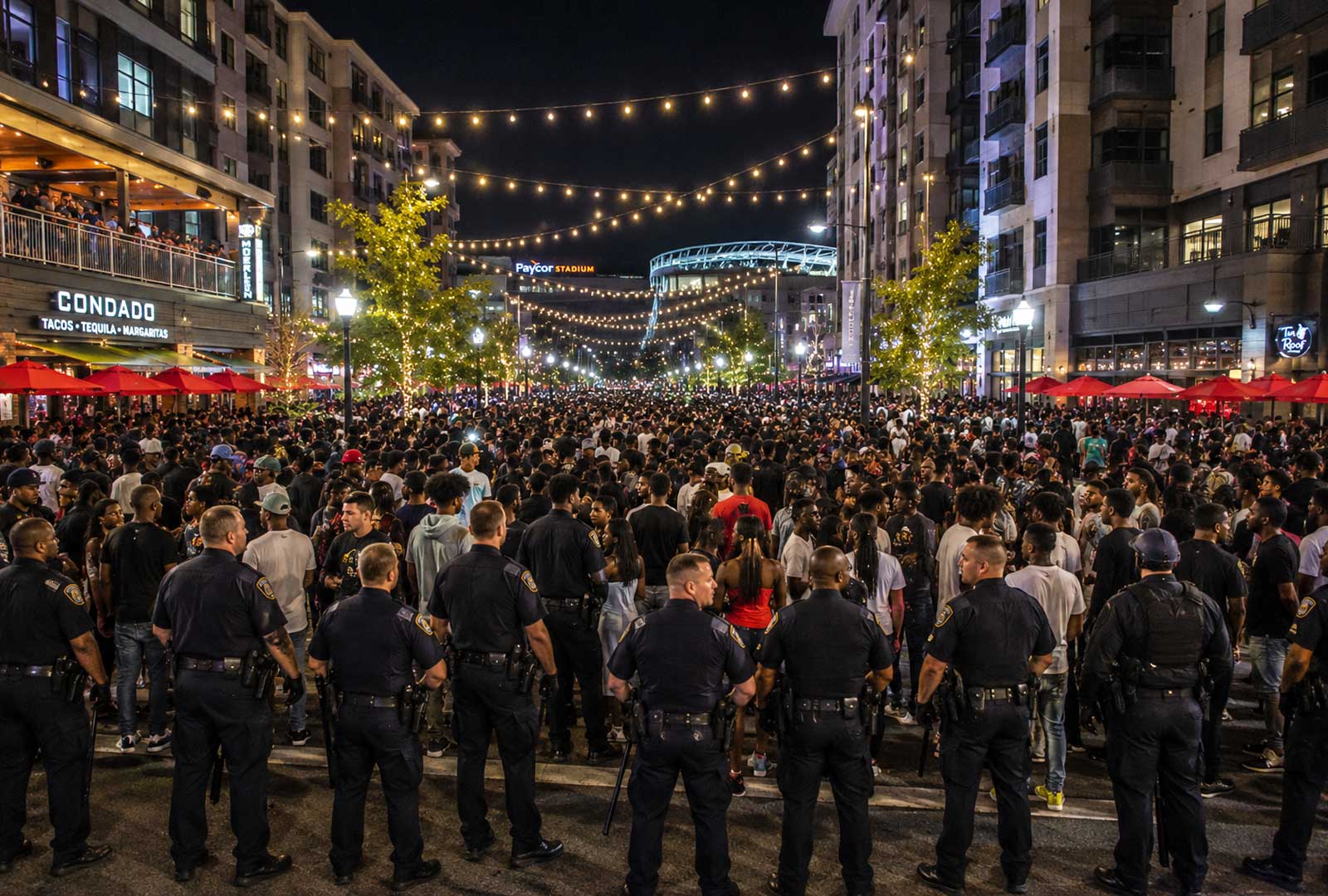
A teen takeover involves a large, loosely organized gathering of teenagers and young adults that descends on a public space—such as a mall, park, beach, restaurant, or downtown entertainment district—and is organized almost entirely through social media. It can grow from a small plan into a crowd of hundreds or thousands within hours.
Organizers produce polished digital flyers using free AI image generators, post them to Instagram, TikTok, and Snapchat, sometimes withhold the exact location until the last minute to stay ahead of police, and watch the event unfold. Baltimore Police Col. Ryan Lee told the Police Executive Research Forum,
We see very sophisticated, fancy-looking, AI-generated flyers that are clearly engineered to market excitement to the juvenile mind. This is really an evolution of what we saw maybe ten years ago with the flash-mob challenges.
Participants bring their phones to film the scene in real time and post it, which draws more people and creates what Col. Lee called
something akin to guerrilla advertising for the next takeover.
- Washington, D.C. (Spring 2026) — ~200 teens at Navy Yard sparked gunfire, disorderly conduct, and robbery; a later Chipotle brawl circulated widely on video.
- Chicago, Memorial Day 2026 — An 18-year-old driver struck five officers with a vehicle; driver charged with five counts of attempted murder.
- Orlando, April 2026 — ~1,000 teenagers at Icon Park resulted in nine arrests including battery on a police officer.
- Clearwater, Florida, May 2026 — A beach gathering of 500+ teens ended with a 17-year-old shot.
- Edmond, Oklahoma, May 2026 — A shooting at an unsanctioned teen gathering left one person dead and more than 20 wounded.
- Tampa, May 2026 — 22 arrested ages 12–21 at Curtis Hixon Park on charges including weapons violations.
Experts have debated what drives the trend. Researchers point to a post-pandemic generation hungry for in-person connection, a shortage of affordable and supervised evening activities, the neurological reality that adolescent brains are wired to prioritize peer excitement over consequence, and the viral feedback loop that makes each incident advertise the next. Georgetown Law professor Kristin Henning, who studies juvenile justice, has argued that most teens who show up to these events are not looking for trouble — they want somewhere to be on a weekend night. In testimony before the D.C. City Council: young people who attended the takeovers gave the same answer: there was nothing else to do.
That detail is worth holding onto as Cincinnati’s summer begins.
The Ohio Footprint
The trend has already touched Ohio. In Pickerington, outside Columbus, a coordinated teen gathering this spring drew an estimated crowd of mostly Columbus-area teenagers after a flyer circulated on Instagram. Cleveland has dealt with its own version of the problem — illegal street takeovers that shut down intersections and, in one documented case, stopped traffic on I-90.
Cincinnati experienced a direct version in March. On March 15, police arrested 39 people and towed 65 vehicles after tracking a large group of drivers who had traveled south from Columbus on Interstate 75 specifically to conduct a planned street takeover. Officers first encountered the group near Paddock Road and I-75, where a firearm was recovered. The group fled, regrouped near Kellogg Avenue, fled again, and was ultimately dispersed in the parking lot of Woodward High School in Clifton.
It was all over social media that there was an intent — primarily, folks from Columbus were going to come to Cincinnati and do a street takeover.
— Ken Kober, Cincinnati FOP President
That the city was ready that morning — tracking the group on I-75 before it could establish itself — showed how much effort Cincinnati has already invested in getting ahead of these events. It also illustrated something important about the geography of the problem: these gatherings travel. Columbus teens came to Cincinnati. The reverse is equally possible. And the social media posts that organize them do not stop at city limits.
The Cincinnati Geography
Look at where other cities have experienced teen takeovers, and the pattern starts to look familiar.
Downtown entertainment districts with open plazas and heavy weekend foot traffic are common targets. Waterfront gathering spaces create natural meeting points. Regional malls often draw teenagers from multiple neighborhoods and suburbs into a single location.
Cincinnati offers each of those environments. Fountain Square sits in the middle of the Central Business District, surrounded by restaurants, retail, and multiple transit connections. The Banks stretches along the riverfront between two stadiums, with open public spaces that can fill quickly during major events. Across the Ohio River, Newport on the Levee attracts visitors from both states while operating under an entirely different law-enforcement jurisdiction from Cincinnati.
Fountain Square in particular has already been the site of serious incidents. A double shooting there in October 2025 prompted Mayor Aftab Pureval to announce that “everything is on the table” and set into motion much of the curfew and enforcement infrastructure now in place. What happened at Fountain Square last fall was not a teen takeover in the formal sense — but it demonstrated the city’s vulnerability to sudden, serious violence in its most public gathering space, and it accelerated the policy response.
The broader downtown public safety picture heading into 2026 has left many residents asking the same question: Is the city ready? The teen takeover trend gives that question a sharper edge.
What Cincinnati Has Built
The policy response Cincinnati has assembled over the past year is more layered than most residents may realize. Taken together, it represents an attempt to address the problem from multiple angles simultaneously.
Juvenile curfew zones. Following a summer of downtown incidents and the October shooting at Fountain Square, the City Council passed a tiered curfew ordinance. There is now a citywide curfew of 11 p.m. to 5 a.m. for all unaccompanied minors under 18. In the Central Business District, Over-the-Rhine, and surrounding areas, the curfew tightens to 9 p.m. The council subsequently extended the same 9 p.m. special curfew to Short Vine near the University of Cincinnati, after police reported seeing teenagers as young as 14 and 15 in that area’s nighttime crowds.
Curfew centers. Cincinnati’s approach diverges from a simple enforcement model in one notable way: rather than relying primarily on arrests, the city built a parallel infrastructure for youth detained for curfew violations. The city signed contracts with Seven Hills Neighborhood Houses (up to $182,000) and Lighthouse Youth and Family Services (up to $192,772) to operate curfew holding centers where officers can bring minors, staff attempt to reach parents or guardians, and — if a child has nowhere safe to go — overnight placement can be arranged. “The point of this is to save kids,” Mayor Pureval said.
Rec @ Nite: The Cincinnati Recreation Commission launched the expanded summer version of its Rec @ Nite program this month. The program runs on Saturdays from 5 to 10 p.m. through August, deliberately covering the evening hours when youth face the greatest risk. It operates at four sites: Hirsch, Lincoln, Winton, and Evanston. The program is free for youth ages 12 to 17, with the city allocating $650,000 for its funding. Cincinnati Police officers station themselves at each site, alongside private security, while Metro provides transportation. The evening hours are a core part of the program’s mission.
“Ultimately, the city cannot parent. This is a collaboration. We are going to do what we need to do, but we need parents and caretakers.”
— Anna Albi, Cincinnati City Council Member
That framing echoes what cities experiencing the worst of the teen takeover trend have concluded at some cost. Washington, D.C. U.S. Attorney Jeanine Pirro announced in May that her office would begin pursuing enforcement actions against parents whose children violate curfew — “Law-abiding taxpayers should no longer have to pay for parental neglect,” she said. In Chicago, aldermen drafted legislation that would hold parents liable when their children are arrested at takeover events. Cincinnati has not moved to that level of enforcement, but the direction of thinking in cities ahead of Cincinnati on this trend is clear.
The Question the Reporting Raises
The honest question at the center of Cincinnati’s summer preparation is whether the infrastructure being built is sized appropriately for what could arrive.
Cincinnati’s Rec @ Nite program serves youth on Saturday nights at four sites. That reflects a real commitment. It is also four sites in a city whose teenagers, on any given Saturday, move through dozens of neighborhoods and gather at a handful of central locations that a single social media post can mobilize in minutes.
The city establishes curfew centers, joint patrols, an expanded bike unit, and social-service partnerships — these are genuine tools. They reflect a city that studied what happened elsewhere and took it seriously. But curfew zones in Washington worked well until the legislation expired, after which the gatherings returned within weeks. Enforcement without sustained investment in alternatives tends to create a cycle rather than a resolution.
What Cincinnati does — perhaps most importantly — is enter the summer with both kinds of tools already in place. The city built the enforcement side and the alternatives side simultaneously, funding them in the same planning cycle, designing them to operate on the same evenings.
Since the case for investing early in Cincinnati’s youth rather than paying for the consequences later has been made here before, you either invest early or pay dearly later.
In this case, the city appears to have chosen early.
This article was created with assistance from The Cincinnati Exchange’s proprietary AI editorial tools and reviewed by a human editor prior to publication. All facts, sources, editorial decisions, and final content were verified and approved by The Cincinnati Exchange.