



Share This Article
Article Summary
Kenton County’s fiscal court held off on a vote on automated license plate readers for the second straight meeting, as Ohio cities, including Cleveland and Dayton, wrestle with the same technology. With Ohio lacking a statewide framework for police use of the devices — unlike Kentucky, which passed its first regulatory law this year — the debate keeps landing on the same question: whether cities should ban the technology outright or regulate it, pointing to crime-solving outcomes, a civil rights endorsement, and Kentucky’s own reversal from a ban proposal to a regulatory law, while acknowledging that efficacy claims and misuse risks both deserve scrutiny.
For the second time in as many meetings, Kenton County leaders declined to vote this week on automated license plate cameras
The same technology now fueling Ohio license plate reader debates just across the river.
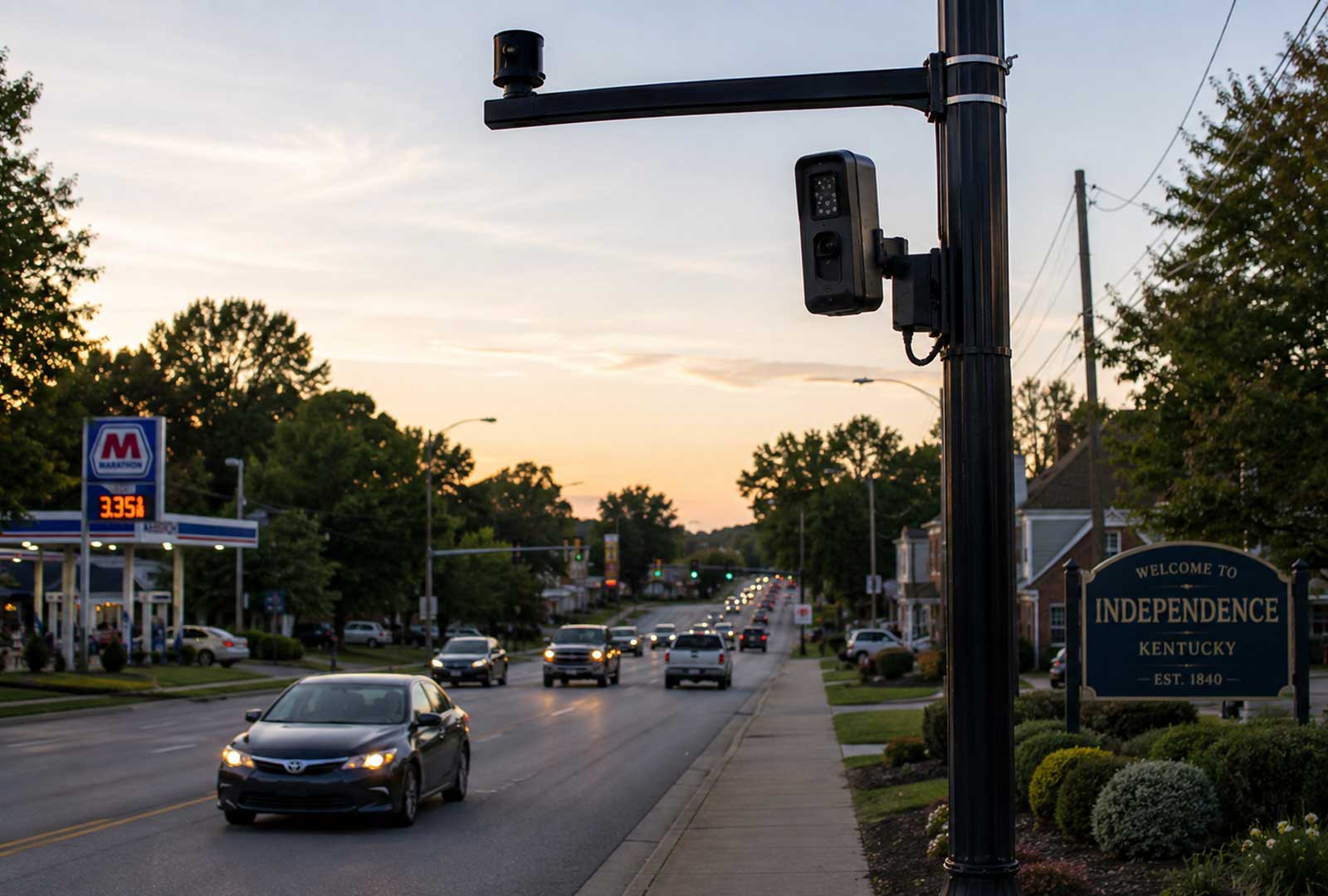
Kenton County Judge/Executive Kris Knochelmann made the announcement before public comment even began Tuesday. The fiscal court would not act on Kenton County Police Chief Spike Jones’s request to begin soliciting bids for the cameras, which are part of the ongoing debate over Ohio license plate readers. That held true even though the item sat on the agenda. Residents packed the Kenton County Historic Courthouse in Independence anyway. Most came to oppose the cameras.
Kenton County is now the third Northern Kentucky community to wrestle publicly with the technology this summer. Newport just wrapped a three-month pilot of 17 cameras amid a packed, contentious town hall. Independence, Bellevue, Villa Hills, Fort Mitchell and Wilder already have contracts in place, according to LINK nky’s tracking. Just across the river, Cincinnati and Hamilton County have more than 400 of the devices between them, according to the open-source mapping project Deflock — part of the same push shaping Cincinnati’s broader public safety strategy.
Ohio License Plate Readers Face the Same Fight as Kentucky’s
This isn’t only a Kentucky story. Ohio cities are having the same argument right now. Cleveland City Council took its own contentious vote this week on whether to continue its Flock camera contract. A survey commissioned by Flock found that 55% of Cleveland residents support police use of the cameras. Support ran even higher among Black and Latino residents, according to the poll.
Dayton went the opposite direction. The city suspended its program indefinitely this spring, pending an independent review. Questions had surfaced about how officers were accessing the data. Closer to home, Colerain Township is paying nearly $150,000 over two years to run 22 cameras. Those cameras have logged 40 million plate scans and led to 44 arrests so far.
Ohio, notably, doesn’t yet have a statewide framework for how police departments use the technology. The only ALPR-related bill moving through the legislature this session, House Bill 725, addresses commercial use of license plate data. It says nothing about how law enforcement agencies deploy or access it. Kentucky, by contrast, passed its first law regulating police use of the devices this year.
Ban or Regulate? Ohio License Plate Readers Face the Same Choice
That regulatory gap is the real question underneath every one of these local fights: not whether license plate readers exist, but whether cities write rules for them before or after installing them.
At Tuesday’s Kenton County meeting, Jones told commissioners he wants six cameras total: one at the county jail, and five at park entrances. None, he said, would monitor public roads. “We see this as a way of preventing potential predators from coming into our parks,” he told the fiscal court, “and preying on our children.” Commissioners weren’t fully convinced. “I struggle with it,” said Commissioner Joe Nienaber. He said he wants children safe at county parks, but he also has real concerns about privacy.
Opposition in the room went further still. Libertarian congressional candidate Jeremy Todd called the cameras “tools of mass compliance.” Independence resident Tim Grothaus put it more simply: “I want humans watching over us, not AI.”
What License Plate Readers Have Helped Solve
Departments across the region point to concrete outcomes when they make the case for the technology. Independence police logged 28 arrests and recovered 12 stolen vehicles from Flock hits over the past two years, according to department data. Colerain Township’s arrest numbers tell a similar story a few miles away on the Ohio side, tied to the 44 arrests from its 22-camera network — evidence that matters at a moment when Cincinnati is grappling with its own violent crime and staffing questions.
Nationally, police departments have credited the cameras with helping locate missing children, recover trafficking victims, solve hit-and-run crashes and identify suspects in violent crimes — the track record supporters cite most often when arguing that an outright ban discards a working investigative tool rather than fixing how it’s used.
The Bias Argument for License Plate Reader Oversight
Not every civil rights concern about the technology runs the same direction. The Oakland, California, chapter of the NAACP formally endorsed the expanded use of license plate readers in that city, arguing the cameras flag vehicles already linked to a crime rather than relying on an officer’s in-the-moment judgment about who looks suspicious. That argument has become a recurring talking point for departments defending camera programs elsewhere, including in Northern Kentucky and Ohio.
Weighing the Evidence Behind Claims
Cities that have adopted the technology point to real numbers. San Francisco has credited its camera network with reducing auto theft while increasing arrests. San Diego’s police department has reported a 20% drop in vehicle theft in the technology’s first year of use there.
Both claims deserve some scrutiny, though. One San Diego councilmember has publicly noted that the 20% figure roughly tracks the national decline in car theft over the same period, independent of the cameras. Meanwhile, Dayton’s suspension is a reminder that oversight failures aren’t hypothetical. They’re the reason cities pause programs in the first place.
Kentucky’s Law Could Be a Model for Ohio License Plate Reader Rules
That’s the tension Kentucky lawmakers tried to resolve with House Bill 58, the state’s first law regulating the devices. Gov. Andy Beshear signed the bill in April. It set data retention limits, restricted what information the cameras can capture, and made camera locations subject to open-records requests.
Three Northern Kentucky Republicans supported the bill, including state Rep. TJ Roberts. Months earlier, Roberts had introduced a separate bill that would have banned automated license plate readers outright statewide. He called the technology a mass-surveillance threat “just as much” to Americans as to undocumented immigrants. That a onetime ban sponsor ultimately backed a regulatory framework instead says something about where this debate tends to land once lawmakers work through it in detail: not at prohibition, and not at unregulated deployment, but somewhere in between.
What Comes Next for Reader Policy
Whether Ohio lawmakers pick up that model remains an open question. So does Kenton County’s next move. Commissioners gave no indication of when they’ll revisit Jones’ request. Opposition at Tuesday’s meeting was, by LINK nky’s account, universal among speakers.
From Independence to Cleveland to Dayton, the same debate keeps resurfacing in different forms. The question isn’t whether license plate readers belong on either side of the Ohio River. It’s who watches the watchers once cities install them — and whether the rules get written before that happens, or only after something goes wrong.
FAQs
Architected formatted FAQ responses for user accessibilityWhy did Kenton County delay its vote on license plate readers?
Commissioners said they weren’t ready to act on Police Chief Spike Jones’ request to solicit bids, even though it was on the agenda. It’s the second consecutive meeting where they’ve held off, following a public comment period packed with opposition.
What does Kenton County's proposed camera plan actually include?
Jones requested six cameras total — one at the county jail and five at park entrances — with none monitoring public roads. He’s framed it as a tool to help prevent predators from entering county parks.
Is this only happening in Kentucky?
No. Cleveland City Council took its own contentious vote to continue its Flock camera contract the same week, and Dayton suspended its license plate reader program indefinitely this spring, pending an independent review. Colerain Township in Ohio already runs 22 cameras.
Does Ohio have a law regulating how police use license plate readers?
Not yet. The only ALPR-related bill moving through the Ohio legislature this session, House Bill 725, addresses commercial use of the data — not how police departments deploy or access it.
How does Kentucky's law differ from Ohio's approach?
Kentucky passed House Bill 58 this year, its first law regulating police use of the devices. Signed by Gov. Andy Beshear in April, it sets data retention limits, restricts what the cameras can capture, and makes camera locations subject to open-records requests.
Do civil rights groups support license plate readers?
Some do. The Oakland, California, chapter of the NAACP formally endorsed expanded use of the cameras, arguing they reduce bias by flagging vehicles linked to specific crimes rather than relying on an officer’s subjective judgment.
This article was researched, reported, and edited by humans. Artificial intelligence was used as an editorial tool to assist with research, organization, grammar, and readability. All facts, quotes, analysis, and editorial judgments were reviewed and verified by The Cincinnati Exchange prior to publication. The Cincinnati Exchange does not publish AI-generated content without human oversight, verification, and editorial approval.