



Share This Article
Key Points
- Cincinnati’s Oct. 13 presentation blames the July 17 floodgate failure on the railroad arms.
- On July 23, City Manager Sheryl Long called the issue “not related to the arms.”
- A 2020 city-commissioned engineering study documented recurring failures of the same arms.
Cincinnati officials now attribute the Duck Creek floodgate’s July 17 failure to the railroad arms, the problem The Cincinnati Exchange reported on July 22. A city-commissioned 2020 engineering study had documented recurring failures of the same arms nearly six years earlier.
Cincinnati now says a failure of the railroad arms kept the Duck Creek floodgate from closing on July 17.
The Cincinnati Exchange reported the crossing-arm problem on July 22, five days after the storm.
The city’s finding on the Duck Creek railroad arms appears in a presentation the administration gave a council committee Tuesday. Page 8 of the packet, which the agenda lists as document 202602884, gives one cause for the Oakley failure. It reads: “A failure in the operation of the traffic control railroad arms resulting in a failure of the floodgate to close.”
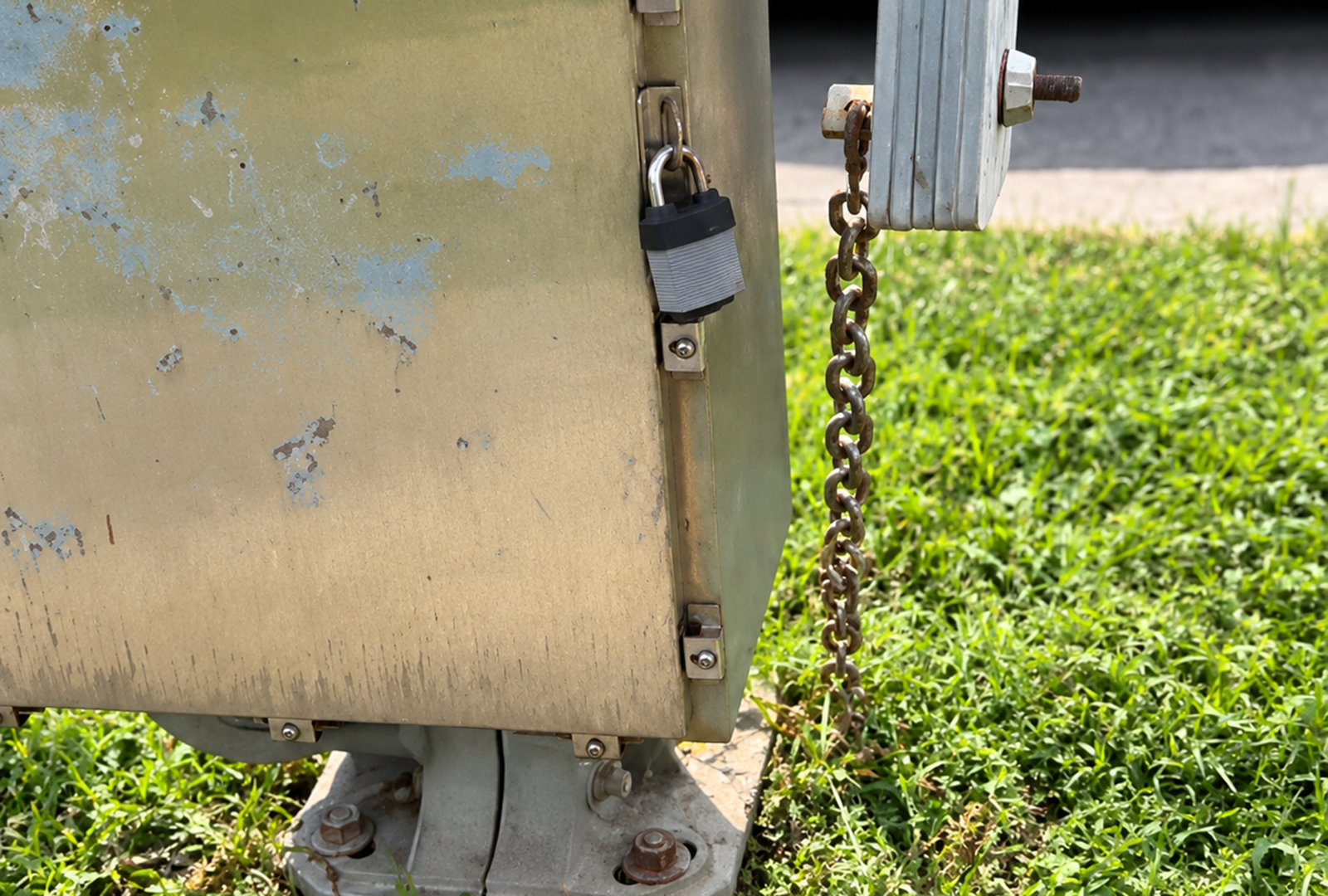
That sentence matches part of the account a source gave the Exchange in July. The Exchange’s July 22 investigation reported the source’s account that the crossing arms had deteriorated and had started dropping on their own. It photographed chains holding both arms upright. The source also said the floodgate could not close until the arms lowered. At the time, the Exchange said it had not verified that sequence through engineering documents.
The October slide states the city’s own conclusion that the arms failed and that the failure kept the gate from closing. It does not document the electrical or mechanical link between the two. It does not say the chains caused the failure, and the Exchange has not established that they did. Nor does it address the source’s claim that the arms had received no preventive maintenance since 2018, which remains unverified.
What the city said about the Duck Creek railroad arms in July
City Manager Sheryl Long made two separate statements about the arms at a July 23 press conference. The October slide treats them differently.
First, she addressed the chains. “SMU explained to me that they chained the arms in October,” she said, according to WVXU’s report. “The arms being chained was not the cause of the malfunction.”
Second, she relayed a broader finding. “Water Works confirmed yesterday it is a larger mechanical issue not related to the arms,” Long said, according to FOX19’s report. Yesterday was July 22, the day the Exchange published its photographs.
The October slide leaves the first statement alone. It says nothing about chains. It contradicts the second. A failure in the operation of the arms is, by definition, related to the arms.
Jason Fleming, then identified as a Greater Cincinnati Water Works deputy director, pointed somewhere else again. Spectrum News 1 reported on July 23 that the malfunction sat in the sensor system that signals a flash flood. FOX19 described the problem as a sensor malfunction when Councilmember Mark Jeffreys filed his flood-review motion on July 27.
The sensor explanation held through August. WVXU reported on Aug. 4 that Fleming said the sensor system had malfunctioned and that crews had since fixed it. The city returned the gate to automatic mode, he said, and added new testing and staffing. WVXU’s account of those August statements does not mention the railroad arms.
What the October presentation says about the Duck Creek floodgate
Ten weeks later, the Duck Creek railroad arms are the only cause the administration has put on paper for the gate’s failure. The packet, which Local 12 posted after the meeting, devotes two bullets to the Madison Road floodgate itself. Page 8 names the arms. Page 25 lists the fix as replacing the barrier arm and evaluating better flood warning and alerting technology.
Neither page says when the arm failed, who decided to leave it chained, what the replacement costs, or when it arrives. Neither mentions the sensor the city blamed in July and August.
The rest of the deck shows what the administration can count when it chooses to. It reports $773,200 in flood relief paid to 675 recipients as of Oct. 9, from 970 applications received and 835 approved. Direct payments from the Stormwater Management Utility to Madison Road property owners stand at roughly $290,000. A third-party claims administrator is still reviewing most claims. The floodgate associated with those claims gets no date, no dollar figure and no schedule.
Fleming, now listed as the utility’s interim director, declined on-camera questions after the meeting, Local 12 reported. So did Metropolitan Sewer District Director Diana Christy. A city statement said the administration expects to return to a future committee meeting with more detail on initiatives, priorities and timelines.
2020 engineering study documented recurring arm failures
The city has had the arms’ failure mode on paper since December 2020. That month, The Kleingers Group delivered its flood gate study on the Madison Road gate to the Stormwater Management Utility. The utility had commissioned it in 2019. WVXU posted the full 174-page report in July.
The report says the city had never had notable trouble deploying the gate itself. The arms were another matter. A small transformer in the cross-arm motor box fails periodically, and the arms’ default condition is to drop when it does. When that happens, the report says, city personnel “raise the cross arm manually and secure it until the transformer is replaced.”
Kleingers put the repair at about $145 for the transformer plus roughly four hours of labor. The firm said the swap typically takes one to two working days. Its no-action cost estimate assumed six such failures a year at $545 each. That figure describes the firm’s expectation of the system’s reliability, not a maintenance history. The city has not released a failure log.
The report also priced a permanent fix for the Duck Creek railroad arms. Replacing all four cross-arm closure mechanisms would cost about $60,000, Kleingers estimated, with a caveat. The original manufacturer, Safetran Systems, had become part of Siemens in 2013, and Siemens never answered the firm’s requests for replacement information. Long said in July that some parts might have to come from outside the country. The city had that supply problem on paper nearly six years ago.
Kleingers recommended neither the $145 patch nor the $60,000 mechanism swap. Citing the system’s low reliability, it recommended replacing the Madison Road bridge so the gate and arms could come out entirely. The firm estimated that job at $2.372 million, or $2.621 million with a small levee. Fleming said in July the city judged that option infeasible because of cost and the property it would have required.
Two limits on the $145 figure belong next to it. The transformer is the only arm failure mode the report documents, and Long did not say what failed in October. A new transformer would also not, by itself, have guaranteed closure on July 17. The work orders would show whether the October problem matched the one the report described.
Chained in October, still chained in July
What the city did in October is a matter of its own statements. SMU crews chained the Duck Creek railroad arms because the arms kept lowering and blocking traffic, Long said on July 23. The Exchange photographed chains on both arms the week after the storm. On one, the chain attached to the moving assembly with a metal quick link.
The 2020 report describes securing the arms as an interim step between a failure and an electrician’s visit, measured in working days. The city’s statement and the Exchange’s photographs establish the endpoints: chained in October, chained in late July. They do not establish that the chains stayed on without interruption in between. Whether anyone ordered a repair in that time, or whether crews attempted one, is not in the public record. Nor is whether the parts problem the city described in 2020 stalled it.
October was also the month of the gate’s last annual test. Fleming said in July that the test covered manual operation only. The city has not said whether the test and the chaining happened on the same visit. Nor has it said whether anyone asked what a chained arm does to the automatic sequence.
The city knew the Duck Creek railroad arms needed replacing before the storm, and the record shows it. In April, the city sought bids to replace the four crossing gates and flashers at Madison Road, WVXU reported. The Office of Procurement later canceled the solicitation. It said it would republish the bid with updated specifications in July, once the city’s financial system opened for fiscal year 2027. Whether it did so remains unestablished. No republished bid surfaced in the Exchange’s search of public procurement listings as of Tuesday.
Then came July 17. Duck Creek rose past the gate’s trigger level, Long said, and the gate stayed open. A city spokesperson told WVXU the water had never reached that level before. The East Side flooding killed one person, the Exchange reported at the time. About 40 properties sit inside the footprint the gate protects, according to Long and Assistant Fire Chief Matt Flagler.
How the Madison Road floodgate sequence works
The 2020 report describes the automatic sequence in detail. Three sensors read the creek: a radar unit, a backup pressure transducer and a float switch. At 539.5 feet of elevation, the Duck Creek railroad arms drop and an alarm sounds. At 540.0 feet, the gate deploys. A traffic loop holds the gate open while a vehicle sits in the way, and an auto dialer alerts the city.
The report lists those as sequential steps. It does not say in plain terms whether the gate’s controller waits for the arms to confirm they are down before it moves. That detail lives in the operations and maintenance manual the report cites, which the city has not released.
The city’s October presentation says a crossing-arm malfunction kept the floodgate from closing. That supports the central concern the Exchange’s source raised in July. The presentation does not say how. It leaves open whether the controller required an arm-position confirmation, whether the arm malfunction interrupted another component, or whether a separate interlock blocked deployment. The controller records would settle it.
Three kinds of tests at the Madison Road floodgate
The gate’s history involves three different tests, and the distinction matters for the city’s July explanation.
A manual test has an operator start the closure from the site. It proves the gate can move. SMU ran one each year, most recently in October, and the gate passed, Fleming said in July.
A simulated trigger feeds the controller a false high-water reading to see whether the automatic sequence starts on its own. On July 23, Fleming told reporters the automatic sequencing was not something the city could test without the creek at flood level. The same week, by his own account, the city brought in additional resources and mimicked a high water level. The gate did not deploy on its own. He said that kind of test had not been part of annual testing in the past.
A full automatic closure runs the whole chain, from the water reading through the Duck Creek railroad arms to the gate across the road. Since August, Fleming said, crews run trigger tests three times a week and a complete closure every two weeks. Staff also sit at the gate in person when rain is in the forecast. Whether the three-times-weekly tests exercise the arms, or only the controller, is not in the public record.
The city showed the week after the storm that it could simulate high water and test the automatic sequence. By Fleming’s account, it had not included that procedure in its annual testing before July 17. Whether earlier testing would have caught the crossing-arm malfunction remains an open question. SMU took over operation and maintenance of the gate in 2012, four years after the Army Corps of Engineers installed it. A city spokesperson told WVXU in July that no record exists of the gate ever deploying automatically in that time.
Where the administration’s case is strongest
Its defense rests on three points.
First, the storm. Five inches of rain fell in three hours, according to the deck. Fleming said the creek went from normal to flooding in under 45 minutes, too fast for a crew to reach the gate.
Second, the footprint. The gate protects about 40 properties around the Madison Road bridge, Long said. Even with the gate closed, she said, the volume of water would have caused serious damage.
Third, the response. The city restored automatic mode and now tests the trigger three times a week. It closes the gate fully every two weeks, staffs it during rain and plans to replace the arm. Equipment fails, and a 2008 Army Corps installation was always going to need upkeep.
Those points explain why the damage was severe. They do not explain why the chains crews put on in October were still there in July. A report the city commissioned documented the arm failure mode in 2020 and priced two fixes. By the city’s own account, crews put a chain on the Duck Creek railroad arms in October. Its procurement record shows it planned to replace the arms before the storm and then pulled the bid. And its July statement, that the problem had nothing to do with the arms, now sits against its October slide.
What the record still does not show
The October finding raises questions the presentation did not answer. These records would answer them:
- Work orders and incident reports for the Duck Creek railroad arms since the Kleingers report, including the October 2025 chaining and any repair ordered afterward.
- Who performed the October 2025 annual test, and what it recorded.
- Any control logic or operations manual passage that ties gate closure to arm position.
- What Water Works found on July 22 that led Long to say the problem had nothing to do with the arms, and what changed by October.
- Whether the city republished the crossing-gate replacement bid it canceled this summer.
- Attachment A-16 of the 2020 report, the Motz Engineering controller investigation, which the Exchange could not retrieve from WVXU’s copy.
One question sits above the rest. Cincinnati officials say crews chained the Duck Creek railroad arms in October 2025. When The Cincinnati Exchange photographed the equipment in July 2026, the arms had chains attached. The city has not released records showing what repairs anyone attempted between those dates or who authorized them. Nor has it shown whether anyone evaluated how the malfunction might affect automatic floodgate closure.
FAQs
Why didn't the Duck Creek floodgate close on July 17, 2026?
The city’s Oct. 13 presentation to a council committee attributes the failure to the operation of the traffic control railroad arms, which lower before the gate deploys. In July, officials called it a mechanical malfunction not related to the arms and later blamed the sensor system. The city has not publicly reconciled the explanations.
Did the chains on the crossing arms cause the floodgate failure?
That remains unestablished. City Manager Sheryl Long said on July 23 that the chained arms were not the cause. The city’s October slide names a failure in the operation of the arms and does not mention chains. Work orders and the control logic, which the city has not released, would show what actually failed.
What did the 2020 Kleingers report say about the railroad arms?
The December 2020 Kleingers Group study, commissioned by the Stormwater Management Utility, found the arms periodically dropped when a small transformer in the motor box failed. It said crews manually raised and secured the arms until an electrician replaced the part, typically within one to two working days at about $145 plus labor.
How does the Madison Road floodgate's automatic sequence work?
According to the 2020 report, three sensors read Duck Creek’s level. At 539.5 feet, the railroad arms drop and an alarm sounds; at 540.0 feet, the gate deploys. A traffic loop holds the gate open while a vehicle is present. The city’s October presentation says an arm malfunction kept the gate from closing but does not document the control logic.
What has the city changed since the floodgate failed?
Officials said in August that crews fixed the sensor system, returned the gate to automatic mode, run trigger tests three times a week, perform a full closure every two weeks and staff the gate during rain. The Oct. 13 presentation adds that the city is replacing the barrier arm, without a date or cost.
This article was reported, fact-checked and edited using The Cincinnati Exchange’s proprietary AI article system as part of our editorial process. It includes analysis of public records and official statements. Claims attributed to a confidential source in our July 22 reporting remain unconfirmed except where city statements or documents now corroborate them.