
Share This Article
Article Summary:
Cincinnati officials say they don’t yet know why the Duck Creek floodgate failed to close during the July 17 flooding that killed one person and devastated Oakley. A source with direct knowledge of the system tells The Cincinnati Exchange the crossing arms hadn’t received preventive maintenance since 2018, and were later immobilized after they began lowering unpredictably. Photos taken at the site show hardware consistent with that account, though neither claim has been independently confirmed.
A source says the floodgate’s warning arms were intentionally restrained after years without preventive maintenance.
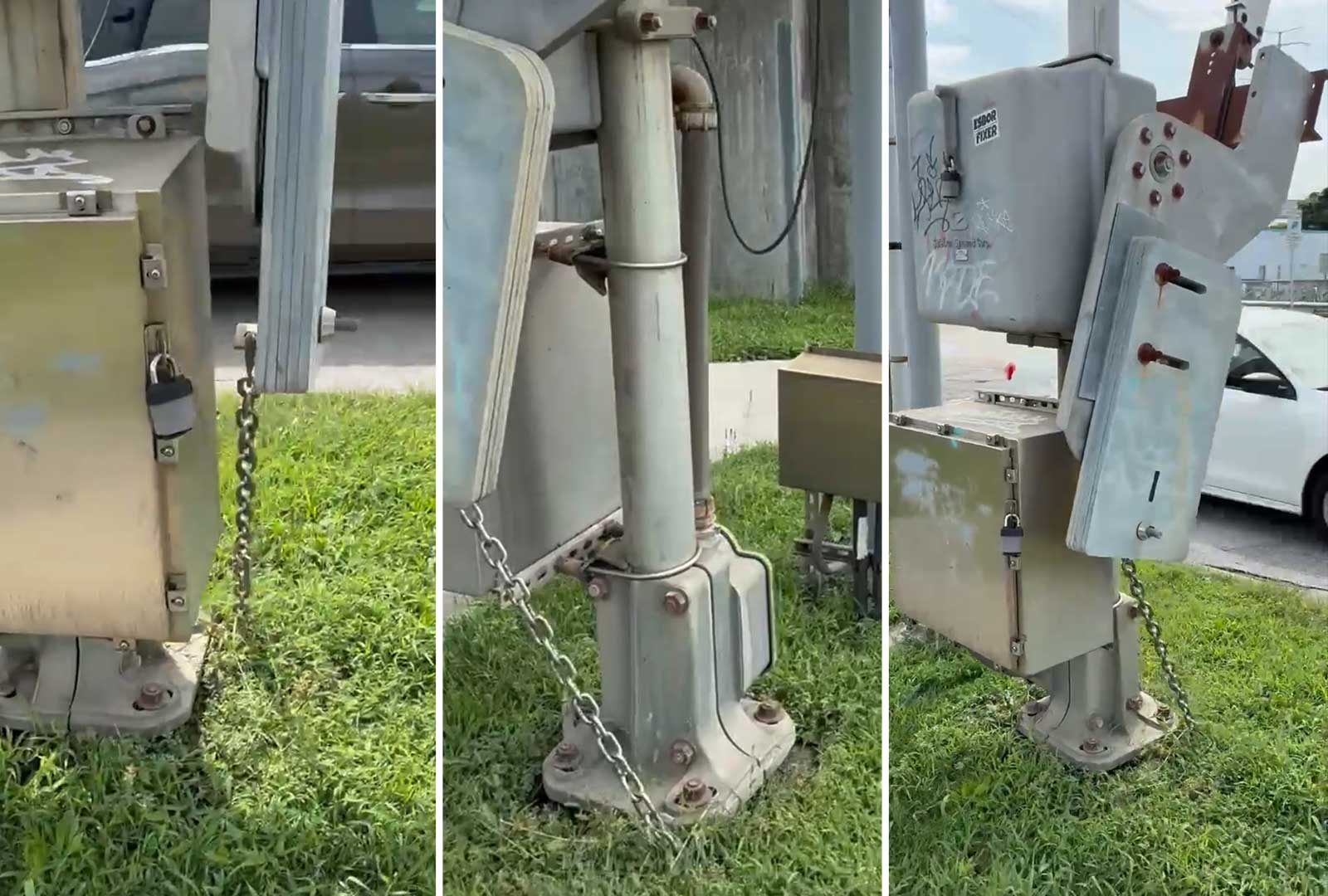
Photographs obtained by The Cincinnati Exchange show the crossing arms physically chained in the raised position.
Whether that chain prevented the flood wall from deploying remains under investigation. The Duck Creek floodgate is a key component of the system under investigation in this ongoing inquiry.
When Assistant Fire Chief Matt Flagler stood before reporters after the July 17 flooding, he made one fact unmistakably clear: the Duck Creek floodgate never closed.
That failure had real consequences. Water surged across Madison Road, businesses in Oakley flooded, vehicles became trapped, and firefighters carried out dozens of water rescues. For many residents, the obvious question wasn’t how much rain fell. It was why the city’s flood-protection system didn’t do the one thing it was built to do.
Nearly a week later, Cincinnati officials say they still don’t know. The city, the U.S. Army Corps of Engineers and Cincinnati’s Stormwater Management Utility have all said they are reviewing video, sensor data and the system’s operation before reaching any conclusions.
But The Cincinnati Exchange has uncovered information that points investigators in a very specific direction.
A source with direct knowledge of the Duck Creek floodgate told The Cincinnati Exchange that the crossing arms—the striped railroad-style barriers that block Madison Road before the flood wall rises—had not received preventive maintenance since 2018. According to the source, the arms eventually deteriorated to the point that they began lowering unexpectedly on their own. Rather than repairing the problem immediately, the source says, the arms were physically chained in the raised position to prevent them from dropping into traffic.
If accurate, that detail changes the entire story.
According to the source, the crossing arms are not simply warning devices. They are part of the floodgate’s operating sequence. Before the flood gate can close, the crossing arms must first lower and secure the roadway. If the arms are physically prevented from moving, the flood wall cannot be deployed.
That explanation has not been confirmed by the city, and The Cincinnati Exchange has not yet independently verified the system’s operating sequence through engineering documents. But the photographs taken at the site raise questions the city will now need to answer.
What the photographs show
After receiving the source’s account, The Cincinnati Exchange visited the Duck Creek floodgate and documented the crossing-arm equipment.
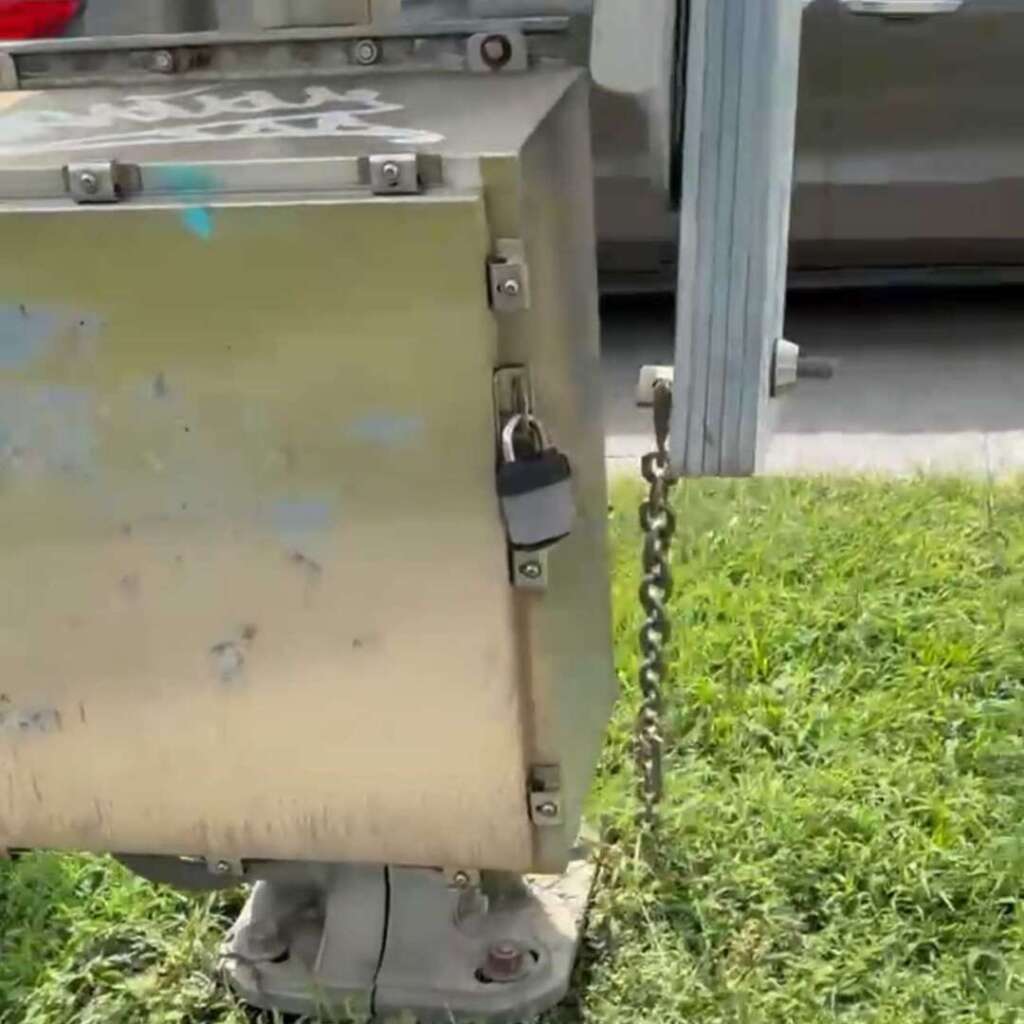
The photographs show a heavy chain attached directly to the lower portion of one crossing-arm assembly. Rather than hanging loose or securing the nearby electrical cabinet, the chain is connected to the moving arm mechanism itself with a metal quick link and runs downward to a fixed anchoring point near the base of the equipment.
The arm is standing in its fully raised position while the chain remains attached.
Based on the visible configuration, the chain appears capable of limiting the arm’s downward movement once it becomes taut. That is consistent with the source’s description of an arm restrained in the upright position.
The photographs do not establish when the chain was installed, who installed it, or whether it remained attached during the July 17 storm. They also do not establish why the chain was there. Those are questions that can only be answered through maintenance records, city documentation and the ongoing investigation.
Still, the photographs confirm one important fact: both crossing arms were physically connected to a fixed point by an external chain.
If the source is correct
The distinction matters because this would not simply be a case of equipment failing unexpectedly.
It would suggest a sequence of decisions.
First, preventive maintenance was allegedly allowed to lapse. Then the crossing arms allegedly began malfunctioning by lowering unexpectedly. Instead of immediately restoring the system to normal operation, the source says the arms were restrained to keep them upright. If those restraints remained in place during the July 17 storm—and if the flood wall truly cannot deploy until the arms complete their lowering sequence—the flood-protection system may have been physically incapable of operating as designed.
That remains a hypothesis, not a conclusion.
It is also a testable hypothesis.
Maintenance records would show whether the system received regular service after 2018. Work orders could reveal whether the crossing arms experienced repeated failures. Engineering documents should explain the sequence required to deploy the flood wall. Surveillance video from July 17 may show whether the chain was attached as the storm unfolded.
Those records exist.
The public has not yet seen them.
A history of warning signs
The Duck Creek floodgate has drawn attention before.
In 2016, the system also failed to close during a flooding event that stranded vehicles on Madison Road. At the time, city officials said there was no evidence the creek had reached the activation threshold and advanced a planned inspection.
The city later commissioned an engineering review of the floodgate system. That report has not yet been released publicly, despite renewed questions about the infrastructure following the July flooding.
There are additional signs that officials already knew the crossing-arm equipment needed attention. Earlier this year, Cincinnati issued a solicitation to replace the warning gates and flashers associated with the Duck Creek floodgate. The procurement was later canceled and postponed, with the city indicating it would be republished after the start of the new fiscal year.
That fact does not prove the source’s allegation. It does, however, establish that the warning-arm equipment was already the subject of a planned replacement before the July 17 storm.
Questions that deserve answers
The city’s investigation will ultimately determine why the floodgate failed to close. But based on the information available today, several questions deserve immediate answers:
- Has the Duck Creek floodgate received preventive maintenance since 2018?
- Why was a chain attached to the crossing-arm assembly?
- Was that chain attached during the July 17 storm?
- Can the flood wall deploy if the crossing arms remain in the raised position?
- Did city officials know the crossing arms had been restrained?
- Did the 2020 engineering study identify deficiencies involving the crossing-arm mechanism?
- If so, what corrective action was taken?
These questions are not political. They go directly to the maintenance and operation of critical public infrastructure.
If the source’s account is incorrect, the city can resolve the issue by releasing the maintenance records, engineering reports and operational data that explain exactly what happened.
If the source is correct, the implications are far more serious.
The story would no longer be about an unpredictable mechanical failure during an extraordinary storm. It would be about whether a known problem with a critical flood-protection system went unresolved until the day the system was needed most.
Until those records are released, one fact remains beyond dispute.
The Duck Creek floodgate did not close.
The city says it is still trying to determine why.
The public deserves an answer grounded in evidence, not speculation—and the records to support it.
FAQs
Did the Duck Creek floodgate fail during the July 17, 2026 flooding?
City officials have acknowledged that the Duck Creek floodgate did not fully protect the area during the July 17 flooding and have said the system’s performance is under investigation. Officials have not yet released a complete explanation of what prevented the system from functioning as intended.
Why didn't the Madison Road floodgate stop the flooding?
That question remains unanswered. Officials have cited multiple contributing factors, but the city has not publicly explained the exact sequence of events or why the flood protection system did not prevent widespread flooding around Madison Road and Duck Creek.
Why were the warning lights flashing if the crossing arms were still up?
Photos and video reviewed by The Cincinnati Exchange appear to show the warning lights activated while at least one crossing arm remained upright. The city has not publicly explained whether that was normal operation, the result of a mechanical problem, a manual override, or another circumstance related to the emergency response.
What is the chain attached to the crossing arm?
Photographs show a chain connected to the crossing-arm assembly. Its purpose has not been publicly explained. The Cincinnati Exchange has asked officials whether the chain is part of the normal operating configuration, a maintenance restraint, or another component of the system.
Was Cincinnati warned about problems with the Duck Creek flood protection system?
Public reporting indicates that engineering studies years before the July 2026 flooding recommended improvements to flood infrastructure in the area. One of the central questions now is which recommendations were completed, which were deferred, and whether those decisions affected the system’s performance during the storm.
This article was reported, sourced, written and edited by a human journalist. Artificial intelligence was used only as an editorial assistant to help improve grammar, clarity and organization. AI was not used as a source of facts or to verify information. Any information attributed to confidential sources is identified as such, and any claims not yet independently confirmed are clearly labeled. As with all developing investigations, this article will be updated as new records, evidence, and official responses become available.