




Share This Article
Article Summary
A new independent report on Police Chief Teresa Theetge paints a sharply divided picture between her own assessment of leadership and that of department insiders. Investigators found consistent concerns around communication, collaboration, and internal culture within the Cincinnati Police Department. What’s less clear is whether these issues reflect one leader or deeper structural problems inside city government.
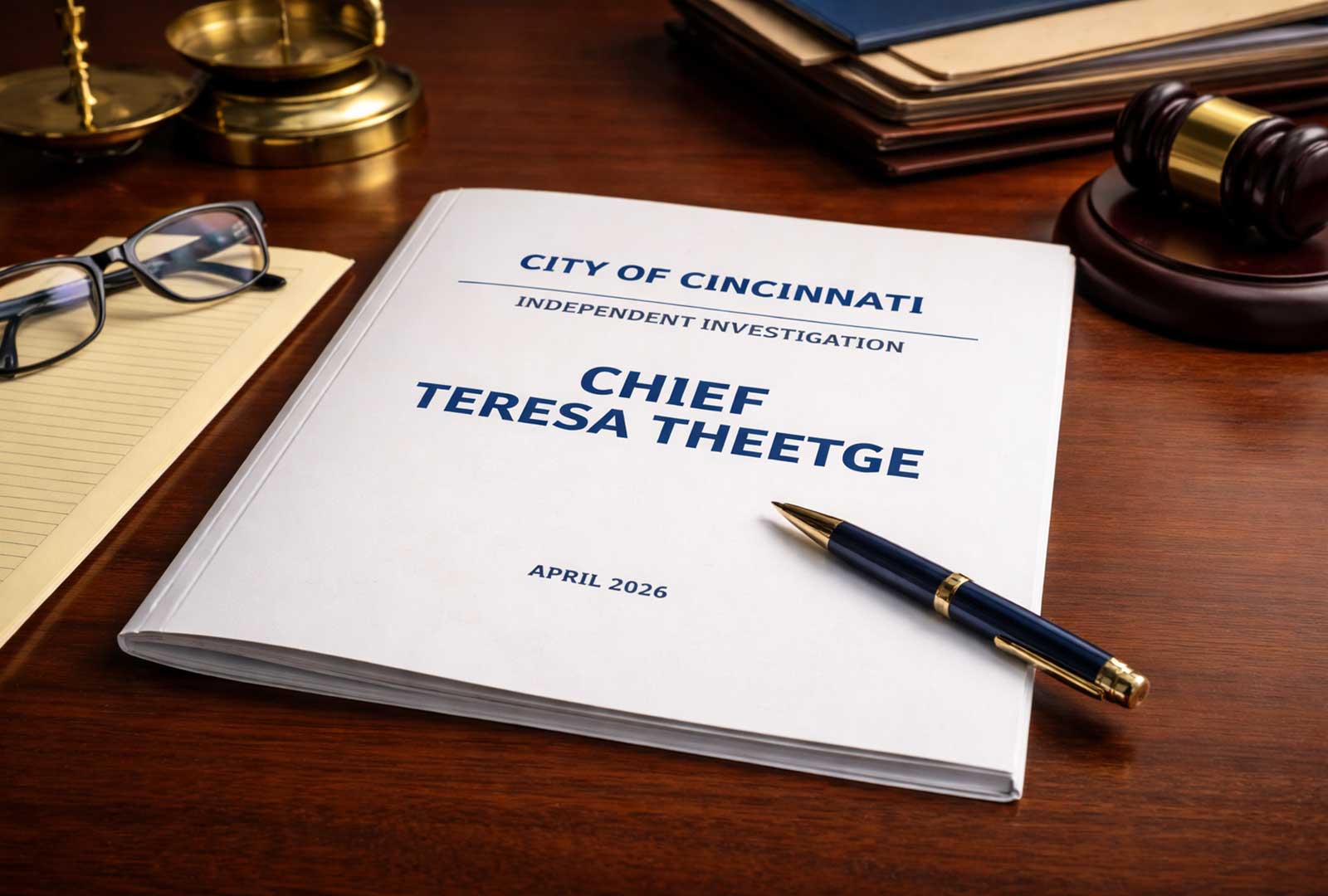
The Theetge report does more than evaluate a police chief.
It exposes how leadership, politics, and internal systems collide inside the Cincinnati Police Department.
The findings are direct, but the implications are harder to pin down. The Theetge report brings new context to these discussions.
For readers who want to compare perspectives directly, my original analysis on Cincinnati Watchdog offers a more critical read of the same material, while the full independent Theetge report commissioned by the City of Cincinnati provides the primary source behind both interpretations.
Context Behind the Theetge Report
The City of Cincinnati commissioned an outside investigation into Chief Teresa Theetge’s performance, focusing on leadership effectiveness, communication, collaboration, and whether her approach harmed public safety or department operations. On paper, that sounds straightforward. In practice, it produced a report that says as much about how City Hall and CPD interact as it does about Theetge herself.
That matters because the Theetge report arrives at a time when Cincinnati is already arguing about public safety, crowd control, and leadership visibility. The city has spent months dealing with broader questions around disorder, including Opening Day chaos at The Banks and the larger debate over violent crime accountability in Cincinnati. As a result, this report does not land in a vacuum.
Theetge Report Findings on CPD Leadership
At the center of the Theetge report is a simple contradiction. Chief Theetge believes she has been highly effective. Most of the people interviewed for the report do not.
Witnesses described a leadership style that concentrated decision-making within a small inner circle while limiting collaboration across the department. That kind of structure can keep control tight for a while. However, it can also create blind spots, especially in a department that depends on information moving quickly and trust moving even faster.
The report says departments became siloed, morale suffered, and many officers saw her as inaccessible, intimidating, and resistant to feedback. Most notably, the investigators wrote that the vast majority of witnesses believed it would not be in CPD’s best interest for Theetge to return as chief.
That level of agreement raises a question. When nearly everyone agrees on the problem, is it still just a leadership issue?
A Breakdown in CPD Communication
Communication is where the Theetge report becomes more revealing. The Chief pointed to emails, weekly notes, and formal channels as proof that information was being shared. Yet many witnesses said they learned about key developments through the media, or at the same time as rank-and-file officers, without any real opportunity to prepare, respond, or shape the decision.
That gap matters because communication is not just about sending information. It is about whether people feel included in how decisions are made.
The report also describes a perceived culture of retaliation, where some officers believed speaking openly could affect their careers. Readers can review those claims directly in the full Theetge investigation report, which outlines how those perceptions developed across multiple interviews.
Even if every claim is not provable in a strict sense, perception still shapes behavior. Over time, that limits feedback, narrows decision-making, and reduces trust across the organization.
Theetge Report vs. City Hall Pressure and Public Safety Politics
Another major theme in the Theetge report is the gap between data-driven policing and political pressure. Theetge argued that resources were pushed into areas based on perception rather than crime data, while witnesses described incomplete execution of agreed-upon plans.
At the same time, there were claims that communication between CPD leadership and City Hall was restricted, which may have slowed coordination during key moments.
Both explanations point in different directions. However, they may describe the same underlying issue: a system where decision-making authority is unclear and incentives are not aligned.
Police Chief Review Raises Questions About Favoritism and Accountability
The Theetge report also highlights concerns around favoritism, nepotism, and accountability. The Chief rejected those claims, but investigators emphasized that widespread perception alone can affect how an organization functions.
When enough people believe decisions are not neutral, trust erodes quickly. Once that happens, even legitimate decisions are questioned.
Witnesses also described a pattern of shifting responsibility for problems. Whether those claims are fully accurate or not, they reinforce a broader issue: accountability becomes harder to define in a system where multiple actors share authority but not responsibility.
Why the Theetge Report Matters in Cincinnati
For Cincinnati residents, the Theetge report is not just about leadership style. It directly affects how the police department operates in practice.
If communication breaks down internally, coordination suffers externally. If morale drops, performance follows. And if City Hall and CPD leadership are not aligned, policy execution becomes inconsistent.
Those effects do not stay inside the department. They show up in how the city responds to real-world situations.
One Chief or a Structural Problem?
This is where the debate becomes more complicated. Zinser’s original post argues that the report relies heavily on perception rather than measurable outcomes. That critique deserves attention, especially given the report’s strong conclusions.
At the same time, perception is not irrelevant in a police department. A leader who is not trusted internally may struggle to lead effectively regardless of formal performance metrics.
That tension sits at the center of the Theetge report. It may be identifying a real leadership failure. It may also be revealing deeper structural issues inside Cincinnati’s public safety system.
If those structural issues remain, replacing leadership may change the tone without changing the outcome.
Takeaway from the Cincinnati Police Investigation
The Theetge report documents consistent concerns about leadership, communication, and internal culture inside CPD. Those findings are significant.
But the larger question remains unresolved. If authority, incentives, and accountability are not clearly aligned, then leadership alone may not be enough to fix the system.
That is the issue Cincinnati may ultimately have to confront.
Read More
City Fire Department faces $8M in cuts amid nearly $30M Cincinnati budget deficit
FAQs
What is the Theetge report?
An independent investigation into Cincinnati Police Chief Teresa Theetge’s leadership, commissioned by the city.
What did the report conclude?
It found she was not an effective leader, citing issues with communication, collaboration, and department culture.
Was misconduct found?
The report focused more on leadership effectiveness and organizational impact than specific policy violations.
Will this lead to leadership changes?
That decision rests with city leadership, but the report’s conclusions create significant pressure for action.
This article is an opinion and analysis piece based on publicly available information, including the independent Theetge report. Any conclusions or interpretations are those of the author.