



Share This Article
Article Summary
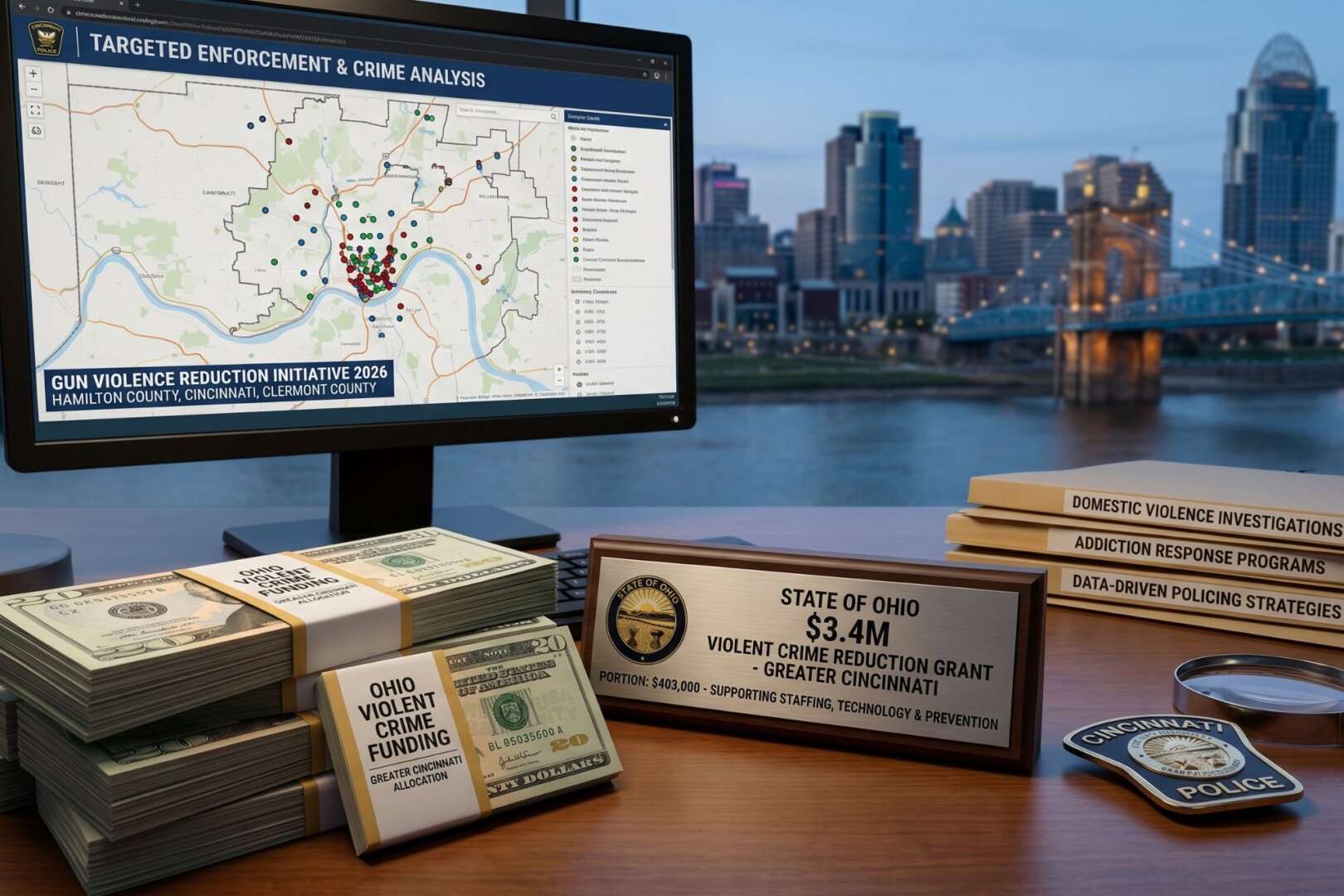
Ohio violent crime funding will distribute $3.4 million statewide, with more than $403,000 allocated to Greater Cincinnati agencies. The funding will support staffing, technology, and prevention programs across multiple jurisdictions. Local recipients include the Hamilton County Prosecutor’s Office, Cincinnati Police Department, and Clermont County Prosecutor’s Office. State officials say the grants are part of a broader effort that has awarded over $87 million since 2021.
Ohio violent crime funding will distribute $3.4 million to law enforcement agencies across the state.
Ohio officials announced a new round of grants aimed at reducing violent crime through targeted enforcement and prevention strategies.
Governor Mike DeWine said the funding supports local agencies working to address crime trends and improve public safety outcomes. The grants come from the state’s operating budget and continue a multi-year initiative that has expanded since 2021.
State leaders say the funding allows local jurisdictions to tailor solutions based on community needs. Agencies receiving funds will use the money for staffing, technology, and specialized programs. According to reports from WLWT, several Greater Cincinnati agencies are among this year’s recipients.
Ohio violent crime funding targets local enforcement needs
More than $403,000 from the Ohio violent crime funding package will go to agencies across the Greater Cincinnati region. Local officials say the funding will support both immediate enforcement efforts and longer-term prevention programs.
Among the recipients:
- Hamilton County Prosecutor’s Office — approximately $116,000
- Hamilton County Office of Addiction Response — $120,000
- Cincinnati Police Department — about $30,000
- Clermont County Prosecutor’s Office — roughly $87,700
- Hamilton Police Department — about $49,500
The Hamilton County Prosecutor’s Office plans to use its allocation to hire additional detectives and expand domestic violence investigations. Officials say this approach aims to improve response times and strengthen case development. The Office of Addiction Response will focus on programs that address substance use and its link to violent crime. Local leaders say prevention efforts play a key role in reducing repeat offenses.
The Cincinnati Police Department will use its portion for targeted enforcement and operational support. Smaller allocations still provide flexibility for departments to address specific local concerns. According to WLWT, agencies can direct funds toward equipment, overtime, and data-driven policing strategies.
How Ohio violent crime funding will be used
The violent crime funding supports a range of strategies designed to reduce crime rates and improve public safety. State officials emphasize that local agencies have flexibility in how they apply the funds.
Common uses include:
- Hiring investigators, analysts, and support staff
- Expanding domestic violence and victim support programs
- Investing in surveillance and data analysis tools
- Increasing patrols in high-crime areas
- Supporting task forces focused on repeat offenders
Governor DeWine said local agencies continue to develop innovative approaches to crime reduction. He noted that the state’s role is to provide resources that help scale those efforts. According to reporting by The Cincinnati Enquirer, the funding reflects a broader strategy that combines enforcement with prevention and intervention.
State leaders also point to the importance of collaboration between agencies. Many programs funded through these grants involve partnerships between police departments, prosecutors, and community organizations. Officials say this coordinated approach helps address the root causes of violent crime rather than focusing solely on arrests.
Statewide impact of Ohio violent crime funding
The funding for violent crime has expanded significantly over the past several years. Since 2021, the state has awarded more than $87 million to over 200 law enforcement agencies. Officials say the program has supported a wide range of initiatives, from technology upgrades to specialized enforcement units.
State data shows that agencies have used previous funding rounds to:
- Launch gun violence reduction programs
- Expand crime analysis capabilities
- Increase officer staffing levels
- Improve coordination across jurisdictions
According to the Office of the Governor of Ohio, these investments aim to create long-term improvements in public safety. Officials say consistent funding allows agencies to build sustainable programs rather than relying on short-term solutions.
Some law enforcement leaders report that previous grants helped reduce response times and improve case clearance rates. Others highlight the role of data-driven policing in identifying crime patterns. While outcomes vary by region, the state continues to expand funding based on local needs and proposals.
The recent violent crime status in Greater Cincinnati presents a nuanced picture: while certain issues like aggravated assaults remain stubborn, the city has made significant strides in reducing severe gun violence over the last year.
Gun violence reductions
The most promising development in Cincinnati’s crime statistics is a drastic reduction in shootings.
- Significant Drops: According to an end-of-year 2025 report by WKRC, overall shootings in the city dropped by 20 percent compared to the previous two years.
- Victim Count: The same WKRC report noted that the number of shooting victims steadily decreased from 377 in 2023, to 353 in 2024, and fell sharply to 283 by the end of 2025.
Overall violent crime trends
While gun violence has plummeted, the broader category of violent crime (which includes homicide, rape, robbery, and aggravated assault) has fluctuated.
- Aggravated Assaults: Data from the Major Cities Chiefs Association (MCCA) and CincyInsights (the city’s open data portal) indicates that while homicides have trended downward from their pandemic-era peaks, other violent crimes like aggravated assault remain points of focus.
- Long-Term Improvement: Despite year-to-year fluctuations, public reports and historical tracking by the Cincinnati Police Department (CPD) indicate that violent crime in the city generally remains lower than the record highs seen in 2020 and 2021.
The property-to-violent crime connection
Law enforcement has repeatedly highlighted a direct link between property crime and violent crime in the Greater Cincinnati area.
- Stolen Firearms: The Cincinnati Police Department has consistently reported that a major driver of the remaining gun crime is firearms stolen from unlocked vehicles. Auto thefts and break-ins continue to fuel the cycle of illegal firearms entering the streets.
Recent 2026 law enforcement actions
Local and state authorities are maintaining pressure on repeat offenders to continue the downward trend in 2026.
- Targeted Operations: According to the Office of Ohio Governor Mike DeWine, a multi-agency task force—part of the state’s Violent Crime Reduction Initiative—launched its first major operations of 2026 in January.
- Focus on Warrants and Firearms: The Governor’s Office reported that this ongoing partnership between the Cincinnati Police Department, the Ohio State Highway Patrol, and the Hamilton County Sheriff’s Office specifically targets individuals with outstanding felony warrants and a history of violent crime to confiscate illegally possessed firearms.
- Targeting Domestic Violence: In April 2026, Governor DeWine’s office announced additional funding for the Hamilton County Prosecutor’s Office to create dedicated law enforcement units and perform lethality assessments aimed directly at reducing repeat offenses in domestic violence cases.
Neighborhood disparities
The statistical likelihood of encountering violent crime heavily depends on your specific location within the city.
- Crime Hotspots vs. Safe Zones: Preliminary 2026 neighborhood reports generated by CPD’s Crime Analysis and Problem Solving unit show varying statistics by district. Vibrant nightlife hubs continue to deal with higher densities of property and nuisance crimes, while severe violent crime historically remains concentrated in specific zones, with many residential neighborhoods reporting crime rates well below the city averages.
Local response in Greater Cincinnati
Local officials in the Cincinnati region say the latest round of Ohio violent crime funding will help address ongoing public safety challenges. Agencies continue to focus on both enforcement and prevention strategies as crime patterns evolve.
Prosecutors and police leaders emphasize the importance of addressing domestic violence, gun-related offenses, and repeat offenders. They say additional staffing and resources will improve their ability to investigate complex cases. Community-based programs funded through these grants also aim to reduce the likelihood of future crimes.
The Hamilton County Office of Addiction Response highlighted the connection between substance use and violent crime. Officials say targeted intervention programs can reduce both addiction and crime rates. By combining enforcement with treatment and prevention, agencies hope to achieve more sustainable results.
The funding also aligns with broader efforts to improve coordination across jurisdictions in Southwest Ohio. Agencies often collaborate on investigations and share intelligence to address regional crime trends. Officials say the state funding supports these partnerships and strengthens overall response capabilities.
Also read:
After an 11-Year-Old Is Killed, Cincinnati Must Confront Violent Crime and Accountability
FAQs
What is Ohio violent crime funding?
Ohio violent crime funding is a state grant program that provides financial support to law enforcement agencies. It focuses on reducing violent crime through targeted enforcement and prevention strategies.
How much funding is going to Greater Cincinnati?
More than $403,000 from the latest round will go to agencies in the Greater Cincinnati region. The funds are distributed among multiple departments and offices.
What will the funding be used for?
Agencies will use the funding for hiring staff, expanding investigations, and investing in technology. Some programs also focus on domestic violence response and addiction-related crime prevention.
Who decides how the funds are spent?
Local agencies determine how to use their allocated funds based on community needs. The state provides guidelines but allows flexibility in implementation.


