
Share This Article
Article Summary
A tanker truck crash triggered a massive fire and explosion on Interstate 471 in Newport, Kentucky late Friday night, forcing the highway to shut down in both directions. Emergency crews responded after a passenger vehicle struck a gasoline tanker carrying thousands of gallons of fuel near the Memorial Parkway exit. Several people were taken to the hospital with minor injuries, and transportation officials are inspecting class=”BZ_Pyq_fadeIn”>the roadway and nearby structures for possible heat damage.
I-471 Fire Triggers Massive Emergency Response
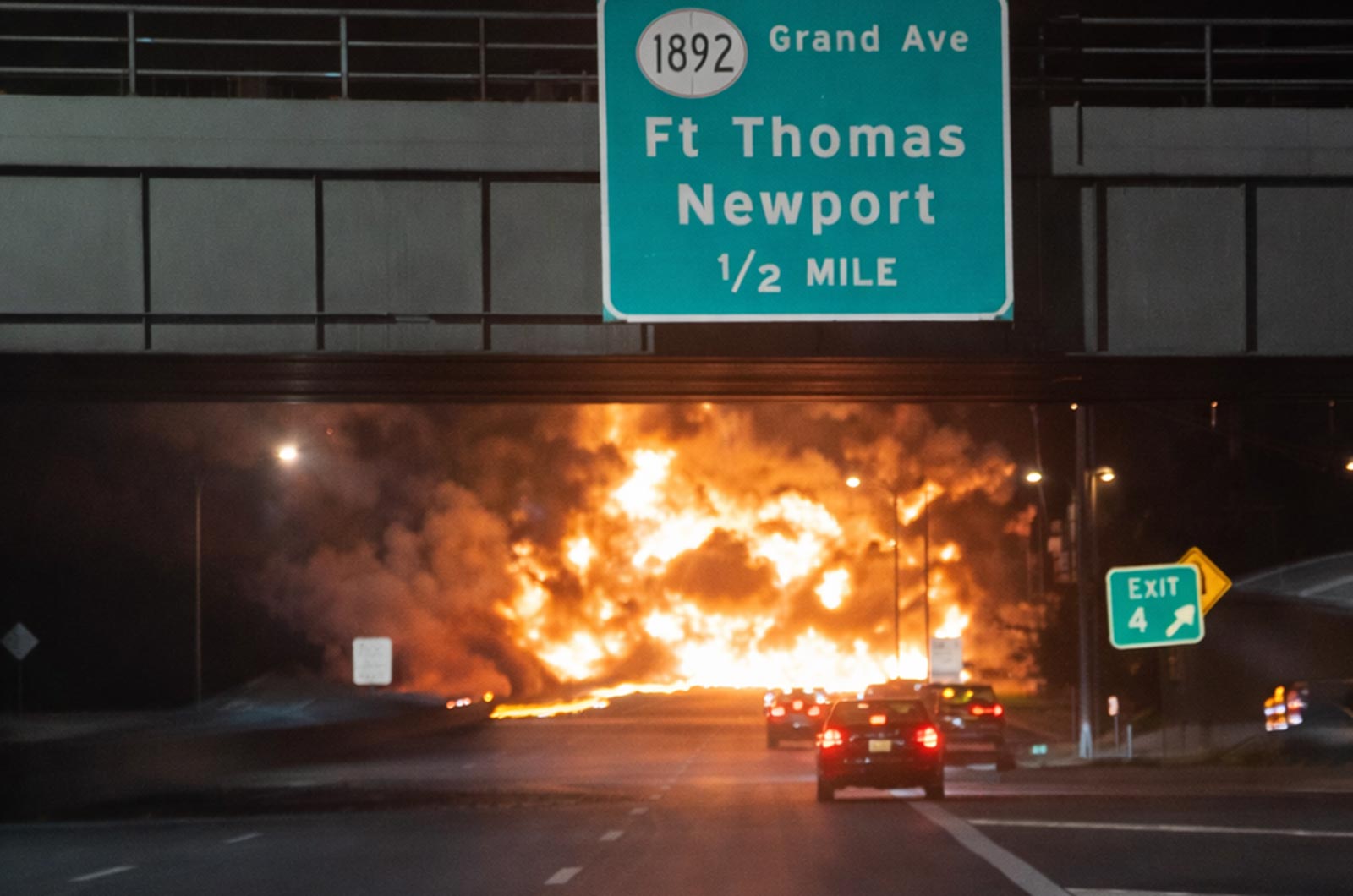
The I-471 fire began around 10:10 p.m. on March 13, 2026, when a passenger vehicle crashed into a gasoline tanker truck traveling southbound on Interstate 471 near the Memorial Parkway exit in Newport, Kentucky.
Authorities say the impact caused the tanker to overturn and ignite, producing a large fireball and multiple explosions visible from surrounding neighborhoods in Northern Kentucky and downtown Cincinnati. The I-471 fire drew attention and concern throughout the area.
Emergency dispatch calls described the incident as a tanker fire requiring a multi-agency response. Fire departments from Newport and nearby communities quickly responded to contain the blaze.
Witnesses reported hearing several loud explosions as flames and smoke rose high above the interstate.
Crash Sends Three to the Hospital
According to officials, the passenger vehicle involved in the crash carried a woman and two children.
All three were transported to the hospital with minor injuries, while the tanker truck driver was treated at the scene and later released. Authorities confirmed that no fatalities were reported.
The tanker truck was carrying approximately 8,300 gallons of gasoline, which fueled the intense fire after the crash.
Because of the danger posed by the fuel fire and repeated explosions, authorities immediately shut down both northbound and southbound lanes of Interstate 471 while crews worked to control the blaze.
Highway and Infrastructure Inspections Underway
Transportation officials closed the interstate while engineers inspect the roadway and nearby structures for possible damage caused by the intense heat.
Crews from the Kentucky Transportation Cabinet began assessment, cleanup, and initial repair work Saturday while bridge inspectors evaluated nearby overpasses and highway infrastructure.
Officials have not reported major structural damage, but inspections are continuing before any lanes are reopened.
The interstate will remain closed until engineers confirm that the roadway is safe for traffic.
Traffic Disruptions Across Northern Kentucky
The closure quickly created traffic disruptions across Newport and surrounding communities.
Drivers traveling between Cincinnati and Northern Kentucky were forced to use alternate routes while the interstate remained shut down.
Detours and alternate routes included:
-
Alexandria Pike (U.S. 27) through Newport
-
KY-8 along the Ohio River
-
Dave Cowens Drive and other local connectors
The disruption also comes less than two years after a major fire shut down part of the same corridor.
On November 1, 2024, an arson fire started at the Sawyer Point playground beneath the southbound approach of the Daniel Carter Beard Bridge, commonly known as the Big Mac Bridge. The fire spread upward and damaged steel beams supporting the roadway.
The southbound side of I-471 remained closed for about 100 days, reopening on February 9, 2025, after major structural repairs.
Transportation officials reported the repairs required replacing seven bridge girders and about 7,600 square feet of concrete deck, with total repair costs reaching roughly $10.5 million.
Prosecutors later said Terry Stiles deliberately set the fire and he pleaded guilty to aggravated arson and arson. Three others — Zachary Stumpf, Kaitlen Hall, and James Hamilton — were convicted or pleaded guilty to obstruction-related charges tied to the investigation.
The earlier closure also created widespread traffic disruptions. Regional planners reported that roughly 33,000 vehicles per day were diverted to other Ohio River crossings, including the Brent Spence Bridge and the Taylor-Southgate Bridge.
Transportation officials urged drivers to avoid the area and expect delays while inspections and cleanup continue.
What the I-471 Closure Could Cost the Region
While officials have not released a formal estimate of the economic impact from the current shutdown, transportation data provides a way to approximate the scale of disruption.
Traffic counts show that roughly 100,000 vehicles travel I-471 each day in both directions combined. If drivers are forced to detour and lose an average of about 20 minutes per trip, the regional impact adds up quickly.
Using a common transportation economics measure — the value of travel time, typically estimated around $20 per hour for personal travel — the added delay can be translated into an approximate economic cost.
Under that model:
-
Daily traffic affected: about 100,000 vehicles
-
Average extra travel time: ~20 minutes (0.33 hours)
-
Estimated daily cost of lost time: roughly $660,000 per day
If the interstate reopens quickly, the total impact may remain limited. But if repairs take longer, the economic effects grow rapidly.
Estimated regional impacts could include:
-
7–14 day closure: roughly $4.7 million to $9.3 million in lost travel time
-
30–100 day closure: roughly $20 million to $66 million in regional delay costs
Those figures do not include repair costs, fuel consumption, freight delays, or lost business activity along affected corridors.
For comparison, the 2020 Brent Spence Bridge fire — which closed that crossing for about six weeks — was estimated to cost the regional economy between $500,000 and $1 million per day, largely due to freight disruptions.
Why I-471 Is a Critical Regional Corridor
Interstate 471 is a short but important connector between downtown Cincinnati and Northern Kentucky.
The highway runs approximately 5.7 miles from Interstate 71 in Cincinnati to Interstate 275 in Campbell County, serving tens of thousands of commuters each day.
It also crosses the Ohio River via the Daniel Carter Beard Bridge, a prominent Cincinnati landmark often called the “Big Mac Bridge” because of its distinctive yellow arches.
Because the route connects downtown Cincinnati with major Northern Kentucky suburbs, closures on I-471 can quickly ripple through traffic patterns across the entire metro area.
What Happens Next With the I-471 tanker explosion?
Transportation officials are continuing to inspect the roadway and surrounding infrastructure to determine whether the heat from the tanker fire caused any structural damage.
Cleanup crews must also remove damaged vehicles, clear debris, and repair any sections of pavement affected by the blaze.
If inspectors confirm that the roadway is safe, parts of the interstate could reopen relatively quickly. However, any structural repairs could extend the closure.
For commuters across Greater Cincinnati and Northern Kentucky, the incident is likely to cause traffic disruptions until the interstate fully reopens.
Read More
C-STARS simulation center opens in Cincinnati to train U.S. military medical teams
Editorial Note on Economic Estimates
The economic impact figures in this article are modeled estimates, not official government totals.
The calculations are based on publicly available transportation data, including estimated daily traffic volumes on Interstate 471 and widely used federal transportation guidance on the value of travel time for passenger vehicles.
Sources informing these estimates include:
-
Ohio Department of Transportation traffic volume data
-
U.S. Department of Transportation guidance on travel time valuation
-
Regional traffic diversion data reported by the Ohio-Kentucky-Indiana Regional Council of Governments (OKI) following the 2024 Daniel Carter Beard Bridge fire
-
Reporting on the 2020 Brent Spence Bridge closure, which provides a regional comparison for economic disruption caused by major bridge shutdowns
Using those inputs, the article estimates the potential regional cost of travel delays based on average detour time and daily vehicle counts. The figures should be interpreted as illustrative estimates of economic impact, not official totals released by transportation agencies.