
Share This Article
The announcement is $115 million.
The story is decades of accumulated expertise that no competitor can easily recreate.
Drive north out of Cincinnati on I-75, and you pass through Evendale without much ceremony. There are no signs announcing it as the home of one of the world’s most consequential aerospace companies. The GE Aerospace campus sits behind a security fence — sprawling, utilitarian, and largely invisible to the commuters rushing past it twice a day.
That invisibility is part of what makes this story easy to miss.
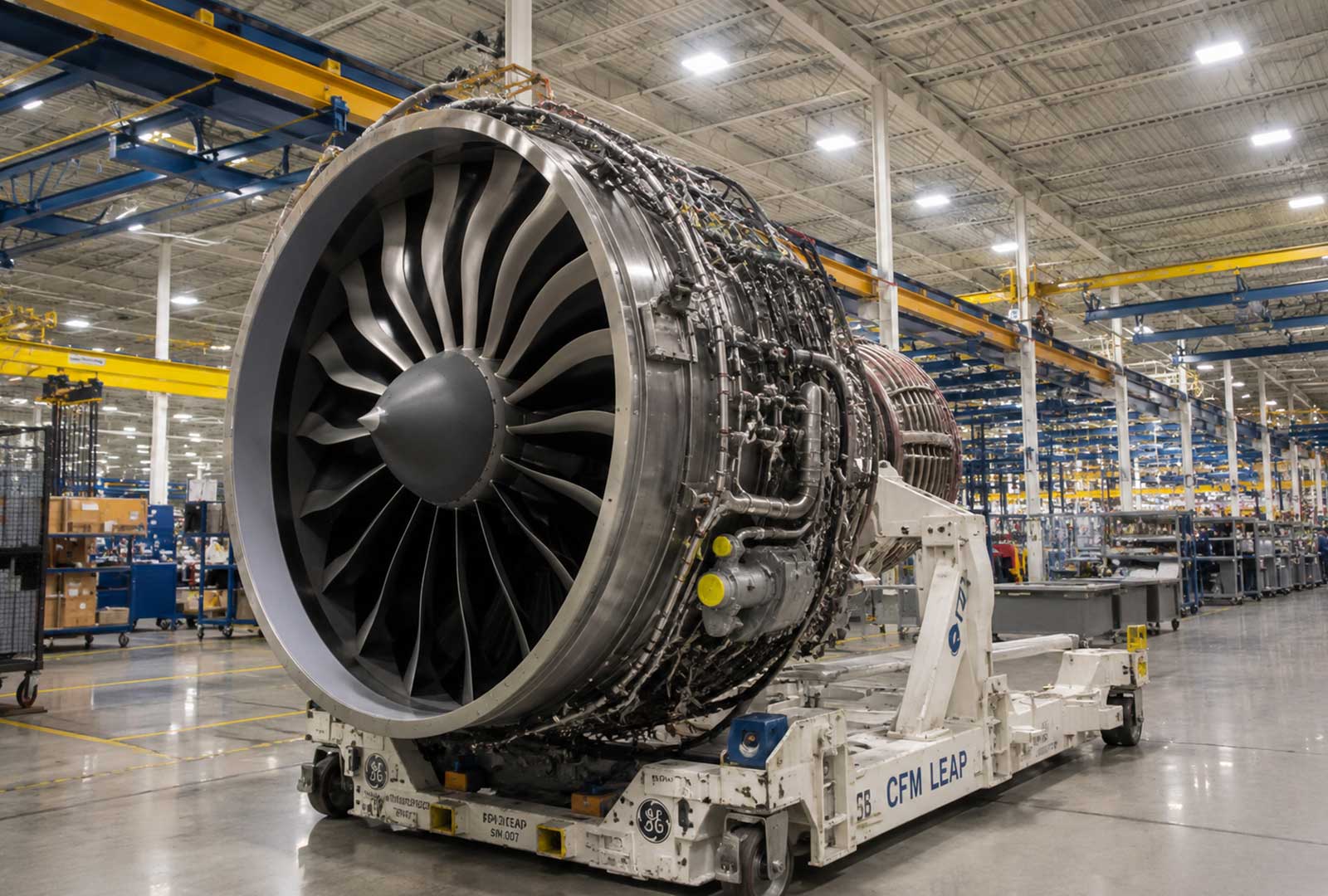
On March 9, GE Aerospace announced it would invest $1 billion in U.S. manufacturing sites during 2026 — its second consecutive billion-dollar commitment — and hire 5,000 American workers. Of that, more than $115 million is flowing directly into the Cincinnati region, with the company’s total in Ohio exceeding $160 million. The investments span three local sites: the Evendale headquarters, the West Chester additive manufacturing center, and the engine test operation in Peebles.
Most coverage treated this as a press release dressed up in hard numbers. That framing sells the story short.
The more durable question isn’t what GE Aerospace is spending. It’s why Cincinnati keeps winning — year after year, round after round — while other American cities scramble to rebuild manufacturing capacity they gave away decades ago.
A Pattern Worth Noticing
The 2026 announcement didn’t arrive in a vacuum. Consider the three-year trajectory:
| Year | National Investment | Greater Cincinnati |
|---|---|---|
| 2024 | $650 million | ~$107 million |
| 2025 | Nearly $1 billion | $113+ million |
| 2026 | $1 billion | $115+ million |
Each year, Greater Cincinnati has captured roughly 15 to 18 percent of GE Aerospace’s total U.S. manufacturing investment — a share that reflects something more structural than corporate sentiment. Since 2024, the company has committed more than $2.5 billion across its U.S. manufacturing network, with the Cincinnati region consistently serving as the center of gravity.
That’s not an accident. It reflects decades of investment compounding on itself — the same compounding effect we’ve tracked in our look at Cincinnati’s thriving industries heading into 2026.
What Is Actually Being Built Here
The 2026 money goes to three very specific things, and understanding them matters.
Evendale will see its ceramic matrix composite lab expanded. Ceramic matrix composites — CMCs — withstand temperatures far beyond what conventional metal alloys tolerate. They also weigh roughly one-third as much. In a jet engine, that combination translates directly into fuel efficiency and engine longevity. GE Aerospace has been developing and scaling CMC production in Evendale for years; the 2026 investment deepens that capability rather than starting something new.
West Chester will get next-generation systems and infrastructure upgrades for its advanced metal 3D-printing operation. Additive manufacturing builds parts layer by layer from powdered metals. That process lets engineers create internal geometries impossible to machine from a solid billet. Components that once required multiple machined and joined parts can now print as a single structure. They’re lighter, stronger, and less prone to joint failure. The West Chester site leads this work for GE Aerospace, producing components used in both commercial and military aircraft engines.
Peebles, in Adams County, handles engine testing. The test cells — massive structures built to run jet engines at full throttle — support current engine programs and next-generation development. That includes GE Aerospace’s open-fan RISE program, which targets 20 percent better fuel efficiency than today’s most advanced commercial engines.
None of these capabilities were assembled quickly. They span multiple business cycles, technology generations, and corporate structures. They are, in a meaningful sense, irreplaceable in the short term.
The Asset That Doesn’t Appear on a Balance Sheet
Cincinnati’s economy is often discussed through the lens of its Fortune 500 headquarters. Procter & Gamble. Kroger. Fifth Third Bank. Western & Southern. And now, formally, GE Aerospace itself, which established its headquarters here when it became an independent company in 2024 — bringing the region’s Fortune 500 count to eight, ranking it third per capita among comparable metro areas, according to the Cincinnati Regional Chamber’s 2025 State of the Region report.
That’s a legitimate economic story. But some of the region’s most important advantages sit behind security fences.
The engine testing cells in Evendale and Peebles and the additive manufacturing operation in West Chester represent accumulated specialized knowledge that a competitor cannot replicate by writing a check. The engineers who understand how to push a test cell to its limits, the machinists who know how to maintain a 3D metal printer running aerospace-grade alloys, the quality inspectors trained to find failure modes that don’t show up in standard inspections — that expertise lives in people who live in Greater Cincinnati. It took generations to build. That, more than the facilities themselves, may be the core asset GE Aerospace keeps choosing to expand.
Cincinnati Never Completely Lost It
The political conversation about American manufacturing often frames the challenge as a rebuilding project — how do we bring it back? That framing, however accurate for much of the Midwest, misses something important about Greater Cincinnati.
The region manufactures three times more aerospace products and parts than the national average, according to REDI Cincinnati. Cincinnati/Northern Kentucky International Airport ranks as North America’s sixth-largest cargo hub — a strength we explored in depth in our piece on Cincinnati’s hidden advantage in logistics. The region hosts hundreds of Tier 1 and Tier 2 aerospace suppliers woven into the supply chains of GE Aerospace and the companies that orbit it. Aerospace and aviation support a gross regional product of $7.8 billion and more than 30,000 workers across the Cincinnati metro, a figure that has been climbing rather than contracting.
While factories in other regions were closing, Cincinnati’s aerospace manufacturing cluster deepened.
That depth creates its own gravity. StandardAero — a leading aerospace engine maintenance, repair, and overhaul company — has now announced three separate expansions at its Sharonville campus, the most recent in June 2025 bringing its Cincinnati workforce to more than 1,000 employees and adding 300 new positions. StandardAero didn’t choose Sharonville three times because of subsidies alone. It chose Sharonville because the talent, suppliers, and infrastructure are already in place.
Companies invest where competence already lives.
The Workforce Pipeline Question
Here is the tension that honest coverage of this story requires addressing.
These are not the manufacturing jobs of the 1970s. The Evendale campus doesn’t need armies of assembly workers running repetitive tasks on production lines. The West Chester additive manufacturing center needs engineers who understand metallurgy and can interpret data from complex printing processes. The Peebles test operation needs technicians who can instrument an engine, analyze the sensors’ data, and communicate findings to the engineering teams back in Evendale.
Modern aerospace manufacturing is highly automated and increasingly requires a workforce that sits at the intersection of engineering, skilled trades, and digital systems. The sector’s aggregate vacancy rate in Greater Cincinnati is well above the regional average, and senior CNC machinists take significantly longer to place here than they do nationally.
The pipeline is real but under pressure.
That pressure is not lost on the industry or the institutions trying to address it. The GE Aerospace Foundation launched a five-year, $30 million workforce program in late 2025 to train 10,000 skilled manufacturing workers nationwide by 2030. Cincinnati State Technical and Community College received $250,000 from that program to fund two new aviation maintenance technician instructors — enough to expand enrollment from 185 students to 350.
The University of Cincinnati’s aerospace engineering program, the second-oldest in the country, feeds directly into GE Aerospace and its supply chain through the Co-op model UC invented in 1906 — placing engineering students in full-time paid roles at companies like GE before they graduate. The UC Digital Futures building, opened in early 2025, added 50,000 square feet of advanced manufacturing lab space focused on the cyber-physical systems that define how modern production facilities operate.
These are serious institutional responses to a real workforce challenge. They will take years to fully close the gap.
The One Question GE Hasn’t Answered
The 2026 announcement specifies 5,000 national hires across GE Aerospace’s U.S. operations. It does not say how many of those positions will be in Greater Cincinnati. That number would sharpen this story considerably and help workforce planners, community colleges, and prospective employees understand the actual scale of opportunity taking shape here. If GE Aerospace can provide even an estimate — or explain why it declines to break that figure down by region — that answer belongs in the public conversation about what this investment actually means for Cincinnati workers. By the time of publication, a GE Aerospace spokesperson had not responded to a request for comment on the regional hiring breakdown. If a number becomes available, we will update this story.
What This Keeps Meaning for Cincinnati
The larger frame is this: Greater Cincinnati is entering a period when the country is actively rebuilding manufacturing capacity, and Cincinnati is one of the few places where that capacity never fully atrophied. That’s an economic advantage that is easy to overlook in normal times and impossible to overlook now — and one that connects directly to the broader trends we’ve covered in our reporting on where the region’s economy is under pressure and where it remains durable.
GE Aerospace’s three consecutive years of investment — $107 million, $113 million, $115 million — are not charity directed at a community the company happens to call home. They are returns on decades of accumulated investment: the test cells built in a previous generation, the workforce trained in the programs that preceded today’s, the supplier relationships developed across economic cycles that Cincinnati’s manufacturing sector managed to survive.
The next time you drive north on I-75 and pass the Evendale campus without ceremony, it’s worth remembering what’s behind that fence: the accumulated expertise of generations of engineers, machinists, technicians, and test operators, doing work that a growing number of people have decided is worth a billion dollars a year to protect.
Sources: GE Aerospace; REDI Cincinnati; JobsOhio; Cincinnati Regional Chamber 2025 State of the Region report; WCPO; Local 12; People’s Defender; University of Cincinnati College of Engineering and Applied Science.
FAQs
How much is GE Aerospace investing in Greater Cincinnati in 2026?
More than $115 million, spread across three sites — Evendale, West Chester, and Peebles. Ohio’s total exceeds $160 million.
Why does GE Aerospace keep investing in Cincinnati?
The region has decades of accumulated aerospace manufacturing expertise that competitors cannot quickly recreate — specialized test cells, additive manufacturing operations, and a deep pool of engineers, machinists, and technicians who live and work here.
What kinds of jobs does GE Aerospace's Cincinnati investment create?
These are not traditional assembly-line roles. Modern aerospace manufacturing requires engineers, CNC machinists, quality inspectors, and technicians who work at the intersection of skilled trades and digital systems.
How big is Cincinnati's aerospace industry?
Cincinnati’s aerospace sector generates a gross regional product of $7.8 billion and supports more than 30,000 workers across the metro. The region manufactures three times more aerospace products and parts than the national average.
This article was developed with assistance from The Cincinnati Exchange’s proprietary AI workflow, which supports research organization, drafting, editing, and search optimization. Final editorial judgment, sourcing, and publication decisions are made by The Cincinnati Exchange.