
Share This Article
Article Summary
The Greater Cincinnati metropolitan area has surpassed 2.3 million residents, driven by simultaneous population gains in both the urban core and outer suburban rings. Data from the Cincinnati Regional Chamber and the U.S. Census Bureau highlights rapid expansion across Hamilton, Butler, Warren, and Clermont counties. While downtown Cincinnati is outperforming several regional peer cities in population retention, suburban growth continues to expand the metropolitan footprint outward.
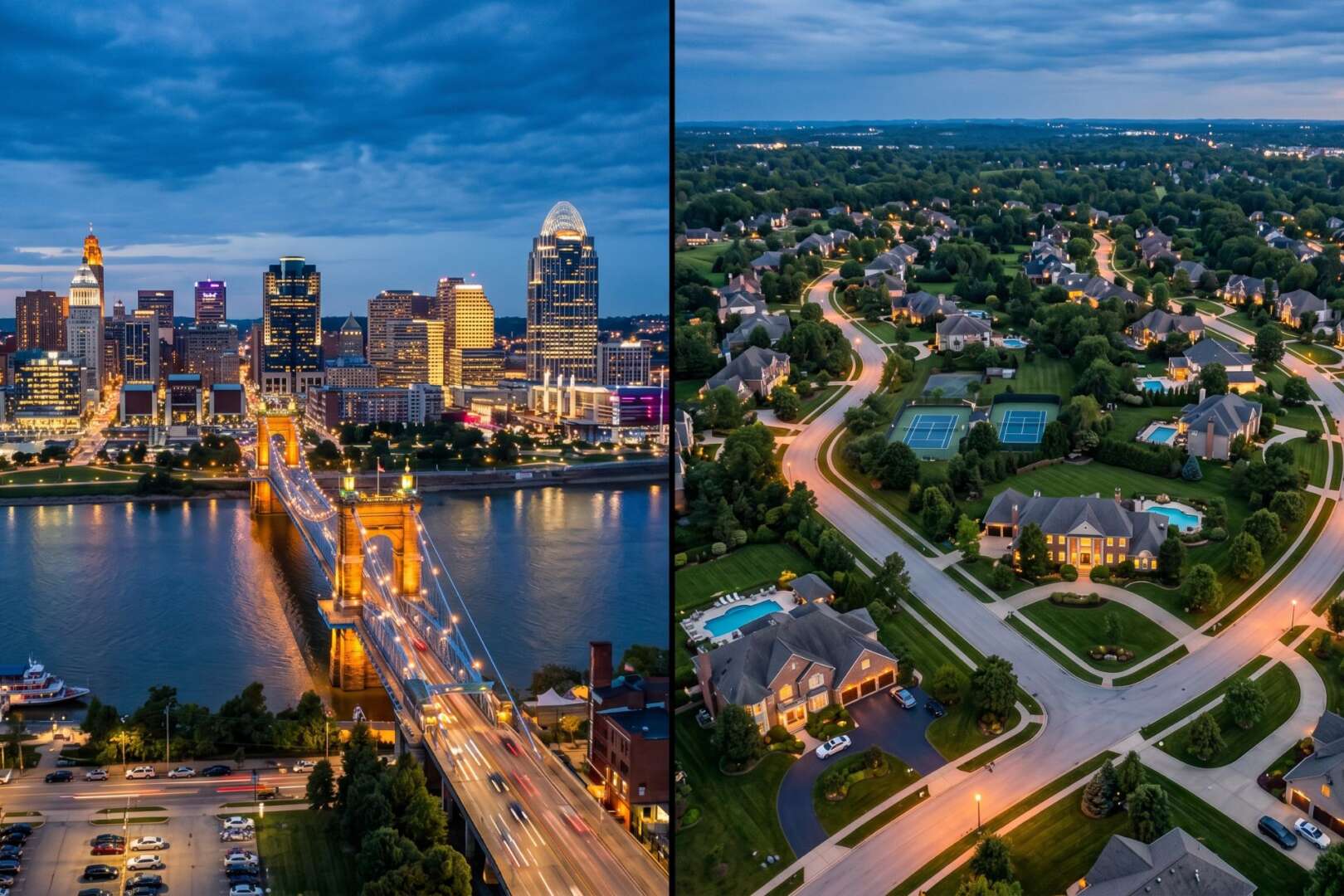
The recent population data highlights a deep contrast between Cincinnati urban sprawl and downtown growth.
We analyze how Cincinnati urban sprawl impacts local migration trends and real estate markets.
Experts are closely monitoring Cincinnati urban sprawl as regional population numbers hit record highs. While city living sees a historic revival, Cincinnati urban sprawl continues to reshape our surrounding counties. The Greater Cincinnati metropolitan area surpassed 2.3 million residents recently. This population milestone marks the best period of demographic growth this decade. Planners must balance the expanding suburban footprint with a booming urban core. A growing population brings both unprecedented economic opportunities and serious infrastructural challenges.
According to Movers & Makers, the Cincinnati Regional Chamber recently published its 2025 State of the Region report. This comprehensive report provides crucial insights into regional migration and economic health. The metropolitan area added over 20,000 new residents in 2024 alone. Most of this explosive growth occurred across the outer suburban rings. However, the core city also saw meaningful gains after years of stagnation. Understanding these dual growth engines helps leaders plan for the future.
The push and pull of Cincinnati urban sprawl
Cincinnati urban sprawl spreads primarily northward and southward into neighboring states. The city proper currently holds nearly 315,000 residents within its limits. This figure represents a remarkable resurgence after decades of historical decline. The urban core accounts for only about 14 percent of the total regional population.
This exceptionally low percentage highlights why Cincinnati urban sprawl remains a dominant regional force. People continue seeking larger homes and more acreage outside the city center.
Hamilton County experienced its best growth year of the decade recently. The county added nearly 5,800 new residents over a single year. This rapid influx underscores a renewed mass appeal for urban neighborhoods. Young professionals and empty nesters flock to downtown apartments and walkable districts.
These new residents want immediate access to amenities, restaurants, and cultural entertainment. A vibrant downtown environment creates an attractive alternative to quiet suburban streets.
Despite this urban revival, the outward push shows no signs of stopping. New highway developments and commercial centers make distant suburbs increasingly attractive. Families willingly trade short commutes for better public schools and larger backyards. Real estate developers eagerly purchase empty farmland to build sprawling residential subdivisions. This continuous outward expansion defines the modern American metropolitan experience perfectly.
Mapping suburban growth across Ohio
Suburban expansion tells a vastly different story about local migration. Butler, Warren, and Clermont counties added thousands of new residents combined last year. This aggressive outward migration fuels the ongoing Cincinnati urban sprawl directly. Many families prefer the suburbs for quieter neighborhoods and newer school facilities. Developers continue building massive new subdivisions to meet this insatiable high demand. Local governments scramble to provide adequate public services for these booming populations.
Regional data highlights several key geographical areas driving this outward expansion. According to recent demographic estimates from the U.S. Census Bureau, the population centers are shifting rapidly. Our massive region spans across diverse geographical zones and multiple state lines.
- Butler County added nearly 4,000 new residents last year.
- Boone County in Kentucky grew by more than 2,600 residents.
- Warren County experienced consistent inward migration from out-of-state remote workers.
- Clermont County welcomed over 2,600 new people searching for affordable housing.
These suburban areas offer distinct financial advantages over the urban core. Families can secure significantly more square footage for their hard-earned money. Retail centers and commercial employment hubs quickly follow these sprawling residential developments. The expanding public infrastructure creates a self-sustaining cycle of endless suburban growth. This relentless cycle inevitably pushes the boundaries of the metropolitan area further outward. Planners struggle to contain the environmental impact of this scattered regional development.
How economic shifts influence Cincinnati urban sprawl
Economic vitality plays a massive role in our regional migration patterns. Aerospace manufacturing and artificial intelligence investments create lucrative high-paying jobs locally. Surging venture capital inflows support a growing tech startup presence downtown.
These modern industries attract young, highly educated workers to the immediate area. Many of these tech professionals prefer city living over traditional suburban neighborhoods. Their arrival injects fresh capital into the local urban economy directly.
However, the broader labor market presents mixed economic signals for the region. Financial analysts recently evaluated the local economy carefully.
According to the PNC Regional Economics Analysis reported by PNC Financial Services Group, the area experienced sluggish overall job growth during the second half of 2025. Service-sector employment remained relatively flat compared to soaring national economic trends. Education and healthcare services stand out as the primary reliable growth engines. A softening local labor market could eventually slow down regional population gains.
Employment locations also dictate where new residents choose to buy homes. Companies moving their headquarters to suburban office parks encourage residential sprawl. Employees naturally want to live reasonably close to their daily workplaces.
This corporate decentralization pulls tax revenue away from the city center. A fragmented regional economy complicates efforts to build cohesive public transit systems. City officials must attract diverse industries to maintain steady demographic momentum.
Housing costs drive regional migration patterns
Housing affordability heavily influences where new residents choose to live. According to the 2025 Cincinnati Forecast reported by MMG Real Estate Advisors, real estate developers delivered approximately 3,800 new apartment units in 2024. Despite this new housing supply, average regional rent growth reached around 3.0 percent.
Higher housing costs push middle-income earners toward the distant suburban fringes. This harsh economic reality accelerates Cincinnati urban sprawl significantly every year. First-time homebuyers find themselves entirely priced out of popular urban neighborhoods.
The housing pipeline shows promising signs of stabilizing after several busy years. Developers had nearly 4,900 residential units under construction heading into 2025. This number sits above the historical average but safely below the 2022 peak. A manageable construction pipeline helps the region avoid dangerous market oversupply issues.
Submarkets in Northeast Cincinnati and Northern Kentucky lead this new development activity. Builders focus heavily on areas with the most available and affordable land.
Stable occupancy rates reflect the steady demand for housing everywhere locally. Regional multifamily occupancy stands at an impressive 94.1 percent currently. This high rate comfortably exceeds the current national benchmark for housing markets. Strong absorption rates prove that incoming residents need immediate flexible housing options. The steady influx of people absorbs new apartment inventory rapidly and consistently. Property managers enjoy high tenant retention rates despite the rising monthly costs.
How city living competes with the suburbs
City leaders actively work to retain and attract new permanent residents. They heavily promote dense, walkable neighborhoods to combat Cincinnati urban sprawl. Local governance faces challenges with 328 separate jurisdictions complicating regional infrastructure planning.
Despite these bureaucratic hurdles, the urban core proves highly resilient and adaptable. Planners focus on green spaces, public transit, and inclusive local economic growth. A unified vision helps the city compete against sprawling suburban amenities.
Recent regional tracking data shows that downtown Cincinnati outpaces several peer cities. Cincinnati added more city residents than Pittsburgh, Cleveland, and Dayton recently. This positive urban momentum creates a healthy balance against suburban flight. A vibrant, thriving city center benefits the entire metropolitan statistical area ultimately. Both the city and the suburbs rely on a strong central economic hub.
Cultural institutions and professional sports teams anchor the downtown experience perfectly. Suburban residents still travel into the city for entertainment and major events.
This interdependent relationship defines the modern metropolitan lifestyle for most residents. The city provides the cultural heartbeat while suburbs offer quiet residential space. Maintaining this delicate balance requires constant cooperation between competing local governments.
Future population trends and climate migration
Forecasting models predict continued robust growth for the Greater Cincinnati region. Optimistic demographic scenarios suggest the population could approach 2.9 million by 2050. This massive impending influx requires strategic planning to manage Cincinnati urban sprawl effectively. Leaders must quickly upgrade transportation networks and aging public utility infrastructure. Sustainable development practices will absolutely determine the long-term success of the region.
City officials are preparing for an entirely new kind of population shift. The recent Cincinnati Climate Migration Outlook report highlights future demographic changes. Extreme weather events elsewhere could drive thousands of new residents to the Midwest. Cincinnati possesses incredibly strong geographic advantages to welcome these new climate migrants. The region offers relative geographic stability and abundant fresh water resources.
Inclusive growth strategies remain essential for our long-term economic health. The city must provide quality jobs and upskill local talent continuously. A successful green transition requires bold political leadership and strong community partnerships. If managed correctly, this transition will solidify Cincinnati as a resilient metropolis. The critical choices made today will permanently shape the regional landscape for decades.
FAQs
What factors are primarily driving Cincinnati urban sprawl?
The ongoing suburban expansion is driven by families seeking lower land costs, larger single-family homes, and newer public school facilities. This outward movement is further accelerated by the decentralization of corporate offices to suburban business parks. Consequently, neighboring counties like Butler and Warren continue to absorb the majority of incoming regional residents.
How is downtown Cincinnati retaining residents against suburban growth?
The city core uses dense, walkable urban zoning to attract young professionals and empty nesters who prioritize immediate proximity to employment and entertainment. Recent demographic data shows Cincinnati is outperforming regional peers like Cleveland and Dayton in urban population growth. Investment in public parks, transit lines, and downtown residential units helps maintain this urban momentum.
What are the current population figures for the Greater Cincinnati metropolitan area?
The total regional population has officially surpassed 2.3 million residents across all integrated state counties. The city proper holds a population of nearly 315,000 residents within its defined borders. This means the central urban core accounts for approximately 14 percent of the entire metropolitan statistical footprint.
How do local housing costs impact regional migration trends?
Rising rent and property values within popular urban neighborhoods push middle-income households toward the outer suburban boundaries. Suburban development pipelines offer a higher volume of inventory, which stabilizes occupancy rates at roughly 94.1 percent region-wide. This structural cost difference makes outlying areas more financially accessible for first-time homebuyers.