



Share This Article
Article Summary
A February 19 motion introduced in Cincinnati City Council proposes creating a $5 million Real Property Reparations Program aimed at expanding homeownership and stabilizing properties in historically disadvantaged neighborhoods. The proposal cites redlining, segregation mandates, and unequal access to federal housing benefits as justification. Funding would come partly from cannabis excise tax distributions and the FY27 capital budget. The motion directs city administration to develop the program; it does not automatically establish or fund it.
What the Cincinnati Real Property Reparations Motion Directs
On February 19, members of Cincinnati City Council introduced a motion directing the city administration to design a Cincinnati Real Property Reparations Program backed by an initial $5 million investment.
The proposal is not a symbolic resolution. It outlines a specific housing-focused framework that would use public funds to help certain residents build or preserve real estate wealth. This plan is an example of Real Property Reparations aimed at addressing historic inequities in housing.

Under the motion, the program would provide:
-
Down payment assistance for home purchases
-
Relief for delinquent property taxes
-
Emergency residential or commercial property repairs
The funding structure includes Cincinnati’s share of state cannabis excise tax revenue along with dollars from the City’s FY27 capital budget. The administration is also instructed to recommend ongoing funding sources and to produce annual public reports detailing how funds are distributed and who receives assistance.
Importantly, this motion does not immediately establish or fund the program. It directs city staff to develop the operational rules, eligibility standards, and reporting structure before any funds are deployed.
Why the Word “Reparations” Was Used
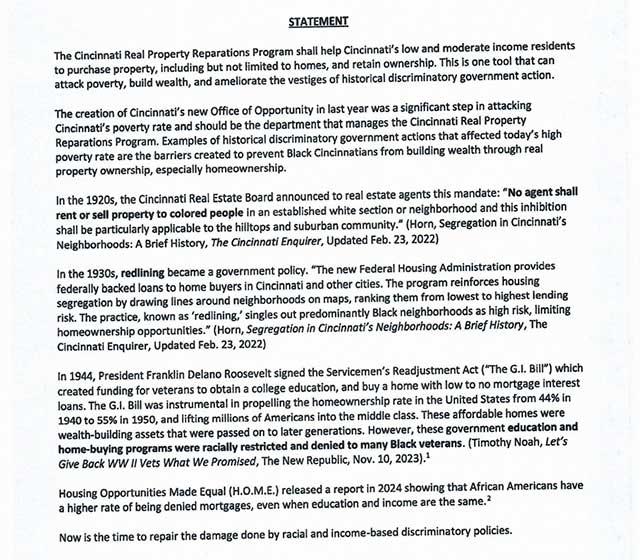
The attached statement page provides context for the terminology.
It cites:
-
A 1920s city board mandate reinforcing racial segregation
-
1930s federal redlining practices
-
Discriminatory administration of GI Bill housing benefits
-
Ongoing mortgage lending disparities
The statement says the program is intended to “ameliorate the vestiges of historical discriminatory government action” and recommends that the Office of Opportunity administer it as part of broader poverty-reduction and wealth-building efforts.
The Office of Opportunity was launched in 2025 under Mayor Aftab Pureval to coordinate anti-poverty initiatives and expand economic mobility programs.
The use of the word “reparations” signals that the sponsors view this not simply as housing assistance, but as a compensatory policy tied to historical discrimination.
Cannabis Revenue and Budget Context
Ohio legalized recreational marijuana through Issue 2 in 2023. As a host community, Cincinnati recently received approximately $2.5 million in cannabis excise tax distributions in one major payout round.
The motion proposes using part of that revenue, along with capital budget funds, to seed the $5 million initiative.
To understand scale:
Quick Budget Context (FY26 Approved Figures):
-
City Operating Budget (All Funds): ~$1.288 billion
-
Total Budget (Operating + Capital): ~$2.067 billion
-
Capital Budget: ~$779 million
-
Recent Cannabis Distribution: ~$2.5 million
-
Proposed Reparations Motion: $5 million
In percentage terms, $5 million is small relative to the full city budget. In neighborhood terms, however, it is significant enough to shape public debate about priorities.
What $5 Million Could Realistically Do
Depending on how assistance is structured:
-
At $25,000 per household, roughly 200 households could receive assistance.
-
At $10,000 per household, up to 500 households could receive support.
That assumes minimal administrative overhead.
This would be a targeted intervention, not a citywide housing solution.
Supporters argue that targeted down payment and repair assistance can reduce the racial homeownership gap. According to recent Housing Opportunities Made Equal (H.O.M.E.) lending reports, Black homeownership in the region remains around the mid-30 percent range, compared to roughly 70 percent or higher for white households.
Critics argue that municipal subsidies may not materially change long-term wealth disparities without broader economic shifts.
Legal Questions Surrounding Cincinnati Real Property Reparations
The motion’s attached statement repeatedly references discrimination against Black Cincinnatians and the racial homeownership gap as justification for the program. That framing is central to the proposal’s rationale.
However, the eligibility language in the motion does not explicitly require applicants to be of any particular race. Instead, it references income levels, specific neighborhoods, and individuals or families harmed by discriminatory housing practices.
That distinction is not accidental.
Under the Equal Protection Clause of the 14th Amendment, public programs that explicitly allocate benefits based solely on race are subject to strict scrutiny in federal court. In practice, that standard is difficult to survive unless the government can demonstrate a narrowly tailored remedy for specific past discrimination.
If Cincinnati were to structure eligibility as race-exclusive, it would likely face immediate legal challenge.
Cities pursuing reparations-style housing programs, including Evanston, Illinois, have attempted to structure eligibility around documented housing discrimination and geographic criteria rather than explicit race-only language. Even so, those programs have faced lawsuits alleging unconstitutional race-based redistribution.
For critics, the concern is not only what the motion says today, but how the final rules are written and applied. If the program functions in practice as race-based compensation funded by general public dollars, it could invite legal scrutiny.
Whether Cincinnati’s final framework withstands challenge will depend entirely on the specific eligibility rules adopted during implementation.
Accountability Questions Still Unanswered
The motion calls for an annual report describing:
-
Income levels of applicants and recipients
-
Neighborhoods and ZIP codes served
-
Status of purchased or repaired properties
However, several practical questions remain:
-
What income thresholds will apply?
-
What documentation will be required to demonstrate past discrimination?
-
Will assistance be grants, forgivable loans, or repayable loans?
-
Is there a sunset provision?
-
How will fraud prevention and favoritism be addressed?
-
What are the five-year retention and foreclosure metrics?
Without these details, both supporters and critics are debating an outline rather than a finalized program.
The Broader Policy Divide Over Cincinnati Real Property Reparations
The debate over this proposal reflects a larger philosophical disagreement about what city government is for.
Argument One: Government Should Repair Government-Caused Harm
One view holds that municipal government has both the authority and responsibility to address the long-term effects of past discrimination, especially when that discrimination was reinforced by public policy.
Under that view, redlining, segregation mandates, and unequal access to federal housing programs were not abstract social forces. They were government actions. If the government helped create the disparity, the government should play a role in correcting it.
In that framework, Cincinnati Real Property Reparations is viewed as a targeted corrective measure, not an expansion of government power.
Supporters of that position argue that housing is not just shelter. It is the primary vehicle for generational wealth in the United States. If certain communities were systematically blocked from accumulating that wealth, then targeted housing assistance under the Cincinnati Real Property Reparations motion is not redistribution. It is restoration.
Argument Two: Municipal Government Has Limited Scope
The opposing view does not dispute that discrimination occurred. Instead, it questions whether a modern city government should act as a compensatory body for policies enacted decades ago, especially when the taxpayers funding Cincinnati Real Property Reparations today are not the individuals who committed those acts.
Critics argue that municipal governments have finite bandwidth and fiscal capacity. Roads, police staffing, pension liabilities, and core infrastructure are ongoing obligations.
In that framework, targeted compensatory programs represent a shift away from universal service provision toward redistributive policy. Whether that shift is justified is a political question.
The Real Property Reparations Expansion Question
There is also a practical concern. Once a city formally adopts a reparations framework — even in a limited housing context like Cincinnati Real Property Reparations — does that create pressure for expansion into other policy areas?
Or does it remain narrowly defined, outcome-based, and subject to measurable performance standards?
A Debate About Scope, Not History
The real debate is not about whether redlining occurred. It is about scope.
What responsibilities does a city government carry into the present?
How narrowly should public funds be targeted?
What measurable results justify continuing or expanding a program like Cincinnati Real Property Reparations?
Those are governance questions, not slogans.
Read More
FAQs
Has the Real Property Reparations Program been approved?
No. This is a February 19, 2026 motion directing the administration to develop the program. It has not yet been fully established or funded.
Is eligibility explicitly race-based?
The motion does not list race as a requirement. It references income, geography, and discriminatory housing practices.
Where would the money come from?
The proposal lists cannabis excise tax distributions and the FY27 capital budget as initial funding sources.
What is the Office of Opportunity?
A city office was created in 2025 to coordinate poverty reduction and economic mobility initiatives.
Could this face legal challenges?
Potentially, depending on how the eligibility criteria are structured in the final program design.