
Share This Article
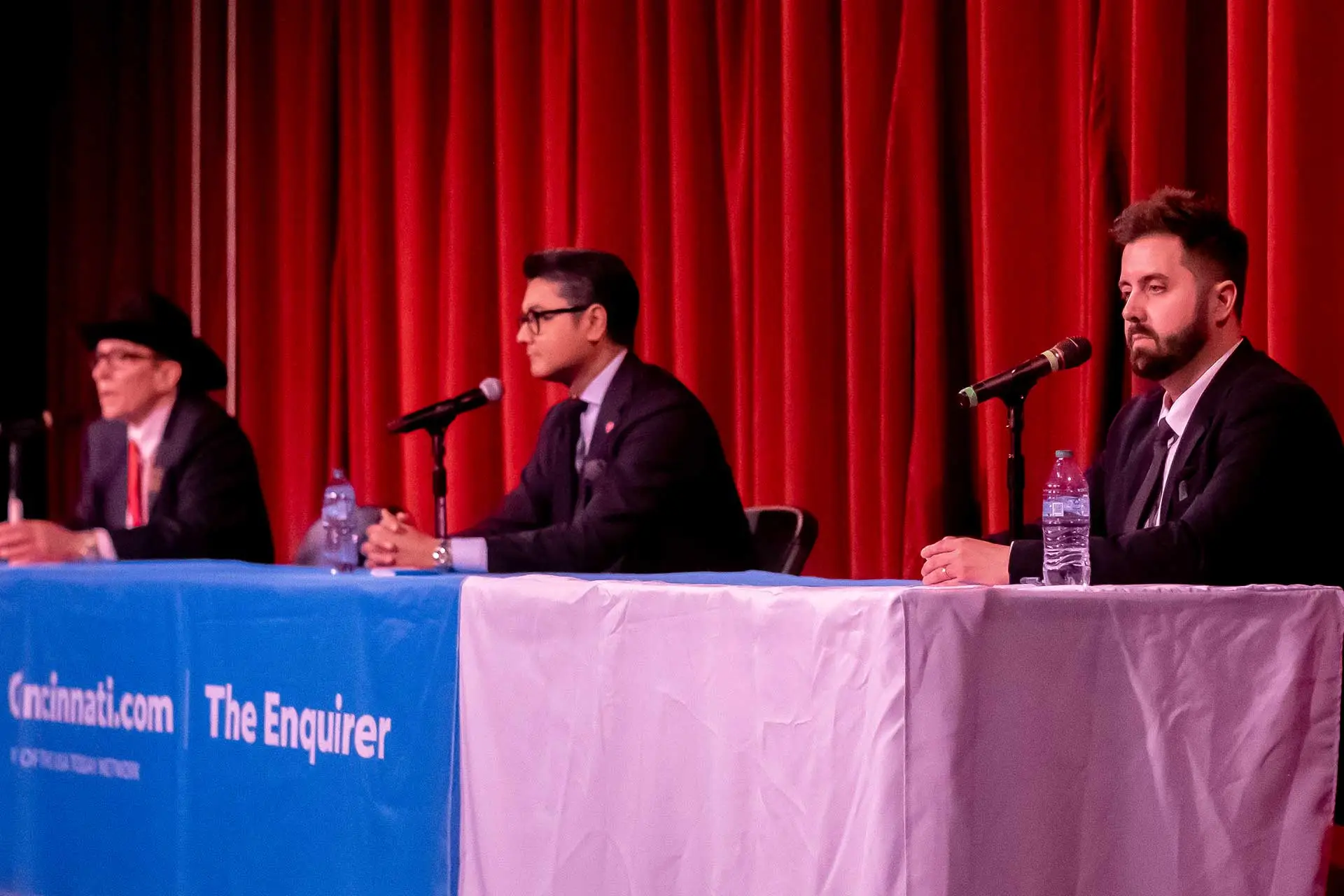
The first public showdown of Cincinnati’s 2025 mayoral race kicked off Tuesday evening at the Covedale Center for the Performing Arts in Price Hill with no shortage of tension, sharp exchanges, and ideological divide.
Incumbent Mayor Aftab Pureval took the stage alongside Republican challengers Cory Bowman and Brian Frank, marking the first time since 2009 that Cincinnati voters will see GOP candidates on the mayoral ballot. The event was moderated by Enquirer opinion editor Kevin Aldridge and attended by over 100 engaged—and at times vocal—residents.
A Disrupted Start: The Pledge That Wasn’t
The debate opened with controversy. Brian Frank interrupted the moderator during introductions, stating, “We have the flag here. We’re Americans. Let’s say the Pledge.”
Aldridge, citing time constraints and format, declined the request. A veteran in the audience stood up and respectfully asked the crowd to recite it, but the Pledge of Allegiance was never observed. The moment created early tension and framed the cultural undercurrent of the night—tradition versus structure, symbolism versus procedure.
City Manager Criticism, and a Half Apology
The debate quickly turned heated over the leadership of City Manager Sheryl Long. Frank referred to her as “incompetent,” citing high-profile incidents like the firing of Fire Chief Michael Washington and the theft of Long’s city-issued vehicle. He pledged to ask for her resignation if elected and said he would terminate her if necessary.
Mayor Pureval responded sharply, defending Long’s performance and calling Frank’s comments “ignorant.” He credited her with managing key reforms and budget decisions that helped stabilize city operations.
Notably, Frank used the moment to walk back a controversial comment he had previously made to the Business Courier, where he called Long a “DEI hire.” During the debate, he clarified:
“I misspoke when I said she was hired because she was DEI, and she should get fired. I apologize for that, but I still find that she’s incompetent.”
Rail Lease Numbers Disputed
A moment that raised eyebrows among policy watchers came when Mayor Pureval defended the $1.6 billion sale of the Cincinnati Southern Railway to Norfolk Southern. In an attempt to justify the deal, Pureval stated the city would have only received $25 million a year had it continued leasing the line.
But according to documents from the Cincinnati Southern Railway Board, Norfolk Southern’s most recent lease offer was $37.3 million per year—a figure not disclosed by the mayor. Critics say that offer could have been negotiated upward, especially given that Norfolk Southern is now paying more than $90 million annually to finance debt on the purchase. The discrepancy has drawn criticism for being misleading and potentially undervaluing a major public asset.
Fort Washington Arena Plan Draws Confusion
Debate over a new arena to replace the aging Heritage Bank Center led to one of the more perplexing moments of the evening. Frank floated the idea of building an arena near Paycor Stadium and appeared to suggest placing it on top of Fort Washington Way, which triggered audible confusion in the audience.
The suggestion, while attention-grabbing, presents major engineering and logistical challenges. There are no known feasibility studies or design precedents that would support such construction, and the proposal seemed to leave even supporters uncertain of its seriousness.
Bowman and Frank both opposed using taxpayer money for any new arena, while Pureval maintained that some level of public-private partnership would be necessary to make it viable.
Connected Communities in the Crosshairs
All three candidates addressed the city’s controversial Connected Communities zoning reform effort.
Mayor Pureval strongly defended the plan, saying it was a necessary update to outdated zoning laws that restricted housing supply and limited affordability.
Bowman took issue with what he described as the program’s lack of economic vision for residents:
“There’s an entire generation being left behind. Yes, they can afford the housing, but there is no way out for these children.”
Frank echoed skepticism, arguing the plan gives too much power to developers:
“I think the developers are taking control of the city. It’s not being maintained and controlled enough by the residents.”
Streetcar Expansion Rejected by All
In a rare moment of consensus, all three candidates agreed that expanding Cincinnati’s streetcar system is not a priority. Pureval said there would be no expansion without federal funding. Bowman and Frank both pointed to the poor condition of existing roads as a higher priority.
Bowman Addresses Past Voting Record
Bowman, a pastor and small business owner, used his closing remarks to address past questions about his own voting history:
“The Enquirer just posted in the last mayoral election 26% of voters showed up… 73% didn’t vote. If there’s anything that got me into the race, it’s wanting more people to be involved.”
He called for a cultural shift toward civic participation and leadership that connects with voters feeling politically alienated.
A Divided Crowd Reflects a Divided Race
The crowd, while respectful, showed clear partisan leanings throughout the night. Supporters of Bowman wore MAGA gear and made their enthusiasm known. Frank’s backers applauded his bold language, while Pureval received steady support from establishment-aligned attendees.
The contrast in tone between the candidates was stark—Pureval calm and methodical, Bowman earnest and community-focused, Frank aggressive and often unfiltered.
The Road to May 6
With just weeks to go before the May 6 primary, this first debate laid bare the ideological lines shaping the race. From infrastructure to public trust, from zoning to the Pledge of Allegiance, the candidates offered sharply different visions for the city’s future—and voters will have a clear choice to make.