
Share This Article
Article Summary:
Cincinnati goetta began as a 19th-century German immigrant thrift food, meat stretched with oats to survive scarcity. Glier’s turned it into a two-million-pound-a-year industry and Goettafest, now in its third decade on the Newport riverfront, while rival Queen City Sausage quietly built its own claim as the official sausage of the Cincinnati Reds.
Newport’s riverfront smells like frying goetta this weekend, but the dish began far from a festival stage.
German immigrants arriving in 19th-century Cincinnati brought a grain sausage designed to stretch scarce meat with inexpensive oats.
In Porkopolis, that early Cincinnati goetta tradition found exactly the right place to survive. The city’s slaughterhouses and butcher shops turned a household thrift food into something the whole region would eventually claim as its own.
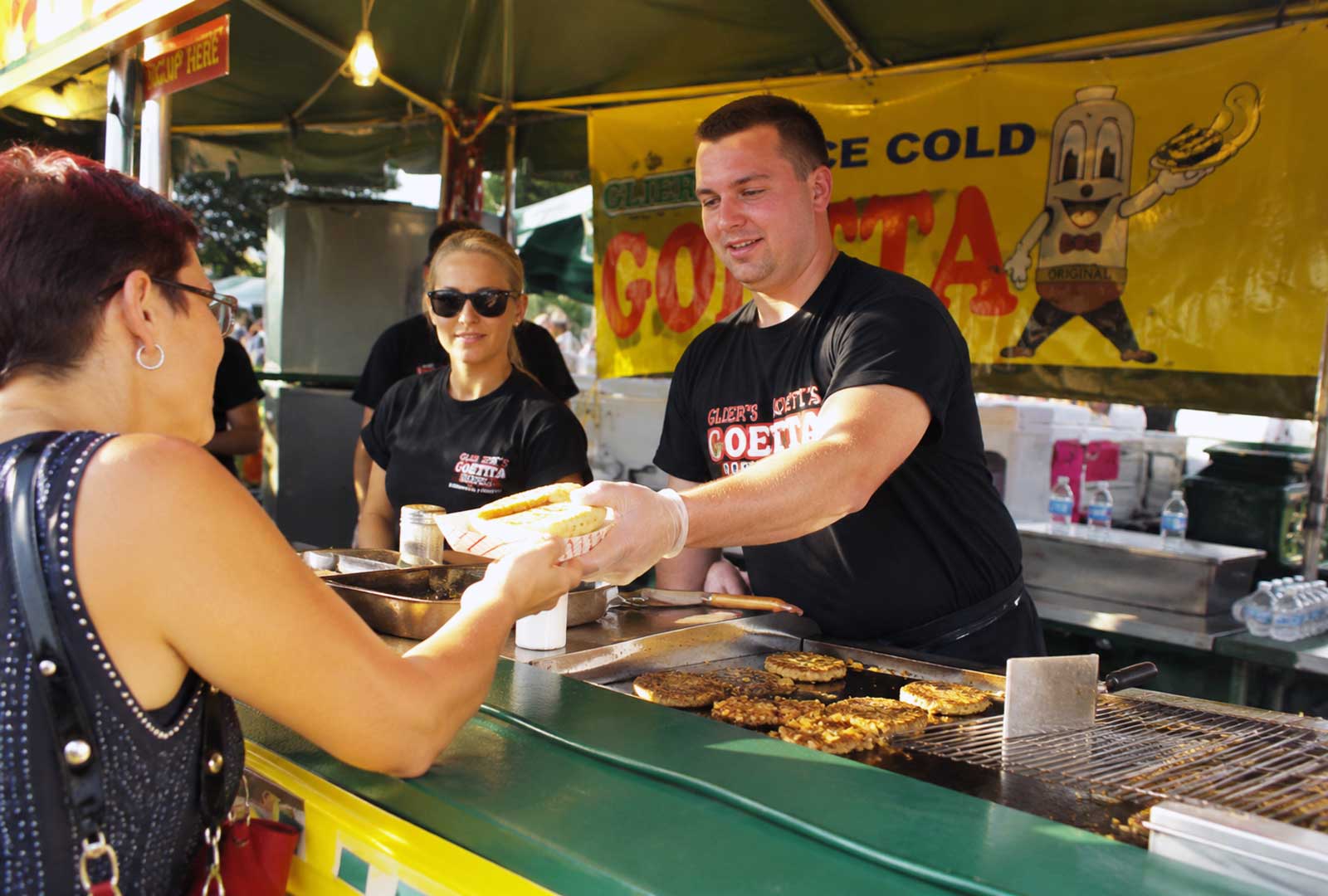
Glier’s Goettafest now fills Newport’s Festival Park with more than 50 variations on that food, two stages of live music, and the self-proclaimed “world’s only goetta vending machine.” The festival runs through today, then returns July 30 through August 2. People wait in line to pay for dishes centered on a food that began as a way to make expensive meat last longer. That’s an unusual journey for any regional specialty. It’s even more unusual that Cincinnati never stopped eating it.
From Family Recipe to Cincinnati Goetta Industry
Robert Glier opened a sausage shop on Pike Street in Covington in 1946. He worked out of a small kitchen and smokehouse. What he built has grown into the largest commercial goetta producer in the world. The company now moves more than two million pounds a year, according to its own figures.
That’s the part most people know. What’s less visible is everything Cincinnati built around the dish once one family’s recipe started drawing a crowd. The festival began as a small customer thank-you party in 2001. It’s now in its third decade, running two weekends and eight days. Grocery stores across Ohio, Kentucky and Indiana carry it. Restaurant menus build around goetta sandwiches, casseroles and vegan versions, the same Restaurant Week spirit that fills tables across the region every spring. The regional identity runs deep enough that people ship it to relatives who’ve moved away. Few American cities have taken a dish this humble this far, the way other big events turn local habits into full tourism draws.
Two Companies, One Cincinnati Goetta Obsession
Glier’s isn’t the only serious name in goetta. The region’s loyalty splits more than the festival’s marketing lets on.
Queen City Sausage, founded in Camp Washington in 1965 by Elmer Hensler, is the other company that matters. Glier’s dominates the festival circuit and the grocery shelf. Queen City dominates a different arena entirely. It’s the official sausage of the Cincinnati Reds. Cincinnati Magazine reported that the Reds sold about 75,000 pounds of Queen City bratwurst and mettwurst per season at Great American Ball Park.
Ask ten Cincinnati families which goetta they buy, and the region splits into two camps. Glier’s leans into pork skin and offal for a funkier, richer flavor. Queen City’s leaner cut lets the seasoning come through more. The two companies have spent decades quietly competing to define Cincinnati’s signature breakfast. Their histories are more tangled than the rivalry suggests. Food historian Dann Woellert traced the lineage of the region’s sausage makers. He found that a Glier’s employee once helped Queen City refine its own goetta formula. Nearly every serious Cincinnati meat business- Oehler, Jaeger, Stehlin, Kahn’s, Eckerlin- traces back through the same small handful of apprenticeship lines.
Cincinnati Claims Its Food Like Few Cities Do
Goetta isn’t an isolated case. Cincinnati has built an unusually large list of foods that belong almost entirely to this one region: goetta, Cincinnati-style chili, Grippo’s chips, Montgomery Inn barbecue sauce, Graeter’s ice cream, mettwurst, even old-fashioned mock turtle soup.
Other regions celebrate their own thrift foods too. Pennsylvania’s scrapple gets its own annual festival at Philadelphia’s Reading Terminal Market. Cincinnati has taken goetta further, though. Glier’s alone now produces more than two million pounds annually. Its festival stretches across two summer weekends with more than 50 dishes. What began in household kitchens now has its own retail network, tourism calendar and riverfront crowd. Cincinnati’s outsized German immigrant population and its history as one of the country’s largest meatpacking centers gave the region a food culture that stayed distinct instead of blending into a generalized Midwestern diet. That history left the city with enough civic pride to keep building on it.
If You Go
The second weekend of Goettafest runs July 30 through August 2 at Newport’s Festival Park at the Levee. Hours are 5–11 p.m. Thursday and Friday, noon–11 p.m. Saturday, and noon–9 p.m. Sunday. Admission is free.
FAQs
What is Cincinnati goetta made of?
Goetta is a mixture of ground pork and beef, steel-cut oats, onions, and spices, formed into a loaf and pan-fried until crispy on the outside. German immigrants developed it in 19th-century Cincinnati as a way to stretch scarce, expensive meat with cheaper oats.
When did Goettafest start?
Goettafest began in 2001 as a small thank-you party for Glier’s customers. It has since grown into an eight-day festival split across two weekends every summer at Newport’s Festival Park, drawing tens of thousands of visitors.
Is Glier's the only company that makes Cincinnati goetta?
No. Queen City Sausage, founded in Camp Washington in 1965, is Glier’s main rival. Glier’s dominates the festival and grocery shelf, while Queen City holds the title of official sausage of the Cincinnati Reds.
How much goetta does Glier's produce each year?
Glier’s now produces more than two million pounds of goetta annually, making it the largest commercial goetta producer in the world, according to the company’s own figures.
When is the second weekend of Goettafest 2026?
The second weekend runs July 30 through August 2 at Newport’s Festival Park at the Levee. Hours are 5–11 p.m. Thursday and Friday, noon–11 p.m. Saturday, and noon–9 p.m. Sunday. Admission is free.
This article was produced using a combination of original reporting, publicly available information, and AI-assisted editing and was reviewed and fact-checked by a human editor before publication.