
Share This Article
Article Summary:
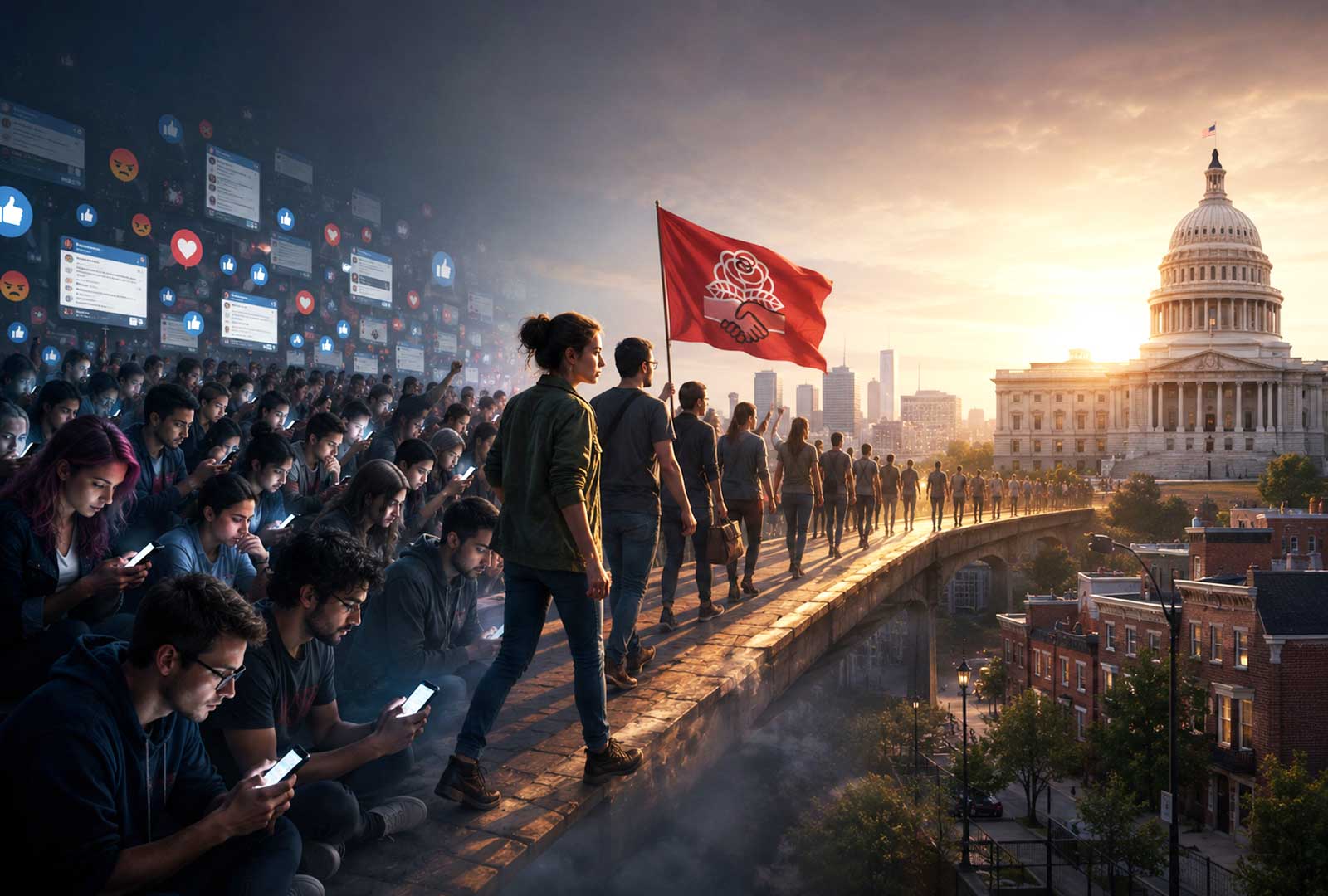
The Democratic Socialists of America surged to more than 120,000 members nationally in 2026, and its Metro Cincinnati & Northern Kentucky chapter now backs an active City Council campaign, “Olivia for Cincinnati.” The piece traces that growth through a chain of cultural and political developments: social media grievance culture, Bernie Sanders’ 2016 campaign, the r/antiwork movement, and COVID-era policies that showed the government could directly override employers.
A Cincinnati chapter of a rapidly growing national organization meets every other week in Walnut Hills.
That local presence mirrors a national resurgence that just made Democratic Socialists of America the largest socialist organization in American history.
Metro Cincinnati & Northern Kentucky Democratic Socialists of America, the local Cincinnati DSA chapter, runs an active local operation. The chapter is organized around member-led working groups, including one focused specifically on electoral politics. It’s also currently running a 2026 campaign to raise $10,000 toward canceling up to $1 million in local medical debt. None of that happened in isolation. It’s the local branch of a national organization. That organization announced in July 2026 that it had passed 120,000 members, more than the Socialist Party of America ever had under Eugene Debs.
Understanding why that national growth is happening means going back further than the pandemic. It also explains why a movement focused on expanding worker power has found new traction in Cincinnati politics, a city where one-party governance already shapes how City Hall operates.
A Generation Learned to Broadcast Its Complaints
Millennials were the first generation to move through early adulthood with social media functioning as a giant public break room. Complaints about bosses, schedules, customers and workplace expectations were no longer private conversations among friends. They could become viral content and attract thousands of people offering validation.
That helped produce a vocabulary in which nearly every unpleasant experience took on a structural meaning. The boss was “toxic.” Low wages were “violence.” Ordinary employment was “wage slavery.” That didn’t describe every millennial, but it created a very visible subculture, one with its own shorthand for turning a bad shift into evidence of a bigger problem.
The Internet Rewarded a Certain Kind of Story
Twenty years ago, complaining about a bad boss earned sympathy from friends and not much else. Social media changed the payoff. Posting a screenshot of a confrontational text from a manager could earn hundreds of thousands of views. The employee usually came out looking like the hero of the story, since the boss rarely got a chance to explain scheduling shortages, payroll costs, or a customer complaint that started the whole exchange.
Algorithms don’t reward nuance particularly well. They reward conflict and a clear villain. That incentive shaped which workplace stories got told and which ones went viral, a pattern that would eventually feed into how groups like the Cincinnati DSA chapter recruit members today. It rewarded framing an ordinary bad day as evidence of a bigger, structural problem rather than just a bad day.
Sanders Gave the Frustration a Political Language
DSA itself predates this. It formed in 1982 through a merger of two older socialist organizations. It stayed small, around 5,000 to 6,000 members, for decades. Bernie Sanders’ 2016 presidential campaign changed that. Sanders offered younger people a simple framework: a bad employer or unaffordable housing wasn’t just bad luck. It was a consequence of capitalism and concentrated ownership.
Democratic Socialists of America isn’t simply another progressive organization advocating higher taxes or larger social programs. Its long-term goal is to democratize economic power itself, shifting more authority from private owners toward workers, unions and public institutions. That philosophy helps explain why workplace relationships occupy such a central place in the organization’s politics.
DSA’s membership grew from about 6,000 in 2015 to roughly 87,000 by 2020, a growth curve that eventually reached even small chapters like Cincinnati DSA. It then peaked near 95,000 in 2021, before a steady decline to about 50,700 members by October 2024. The organization’s own retrospective attributed the decline in part to a quieter political environment during the Biden presidency. By the time COVID arrived, though, the organizational infrastructure was already in place. It was waiting for the right moment to grow again.
Sanders had given the movement a political language. COVID would soon give it something else: proof that political power could bend an employer in ways individual workers never could. Social media had created the grievance. Sanders translated it into politics. COVID was about to demonstrate the leverage. DSA gave it an organization.
Cincinnati DSA and the Workers Most Shaped by This Era
DSA’s membership today skews educated and white-collar, but that doesn’t mean service work skipped its members entirely, in Cincinnati DSA circles or nationally. Many college-educated millennials spent formative years waiting tables, tending bar, working retail, staffing hotels or taking other hourly jobs during college and after graduation.
Alexandria Ocasio-Cortez became the most recognizable example. She graduated from Boston University but worked as a bartender and waitress before entering Congress. Her story reflected a broader experience among educated millennials. Many believed they’d done what society asked of them, yet still found themselves in jobs they considered temporary, underpaid, or beneath the career path they expected.
Those jobs gave them firsthand experience with managers, customers, unpredictable schedules, tipping and workplace hierarchy. Online communities then provided a political interpretation of those experiences. A frustrating shift was no longer merely a frustrating shift. It became evidence of exploitation. A disagreement with a manager became proof that workplace hierarchy itself was unjust. Many of those workers eventually moved into education, nonprofits, media, technology, government, or other professional fields. The worldview formed during their service-industry years often stayed with them anyway.
The Pandemic Turned Workplace Leverage Into a Spectacle
r/antiwork existed years before COVID, but the pandemic gave it an audience, the same audience that groups like Cincinnati DSA would eventually try to organize. The subreddit grew from about 180,000 subscribers in October 2020 to nearly 1.7 million by January 2022. It became Reddit’s fastest-growing community during what media outlets called the Great Resignation.
Then, on January 25, 2022, moderator Doreen Ford appeared on Fox News with host Jesse Watters. Redditors and other social media users widely mocked the interview. The subreddit went private the next day, too, amid what moderators called “brigading.” Subscriber counts kept climbing afterward. Still, an academic study of the subreddit found that its actual posting activity collapsed right after the interview. The format that had made the community popular, a confrontation with a boss, a screenshot, thousands of strangers applauding, had also made it an easy target. It became a news story instead of a private venting space.
Government Became the Enforcement Arm
Before the pandemic, many frustrated workers still believed their options were personal: find a better employer, acquire new skills, or start a business. COVID temporarily shifted that mindset. Government became the institution deciding which businesses could open, who could work, and when public benefits would replace lost income. Politics no longer simply regulated the economy. For many people, it appeared capable of directly reshaping it.
For people who already viewed employers as having too much power, the pandemic reinforced an existing idea: political power could accomplish what individual negotiation couldn’t. If government could dictate workplace rules during an emergency, activists naturally began asking what else government could require once the emergency ended. Critics argue that some of those temporary protections gradually expanded beyond emergency health measures into broader expectations about work itself, making it harder for employers to enforce standards that had previously been routine.
That’s where DSA’s appeal becomes easier to understand. DSA argues that most workplaces are “fundamentally authoritarian” because employees spend much of their working lives under managerial control, a premise that helps explain why the organization focuses not just on wages, but on transferring workplace authority itself to unions, workers, and government.
The enhanced unemployment benefits that ran alongside pandemic shutdowns also served a real emergency purpose, a point that groups like Cincinnati DSA would later cite in their own organizing materials. Research on their labor market effects, though, is fairly consistent. An NBER working paper by Harry Holzer, Glenn Hubbard, and Michael Strain examined states that ended those benefits early. It found that the flow of unemployed workers into jobs rose by roughly two-thirds in those states. That’s compared to states that kept enhanced benefits through September 2021.
That doesn’t mean the benefits single-handedly caused a labor shortage. Childcare disruptions, fears of COVID exposure, and workers switching jobs mattered too. It does mean the incentive effects were real, not imagined.
The Movement Claimed to Fight Corporations but Hit Small Employers
The greatest irony of this whole period is who actually got hurt. The businesses most damaged by the cultural and regulatory shift weren’t Amazon, Walmart or other giant corporations. They were restaurants, salons, spas, retailers, contractors and family-owned businesses.
Large companies could absorb higher labor costs, automate positions, spread compliance expenses across thousands of locations, and employ entire legal and human resources departments. A small employer had none of those advantages. When an employee repeatedly called off, arrived late, or failed to meet ordinary expectations, the owner frequently had to cover the shift personally. If the regulations changed, the owner had to interpret them on their own. When labor costs rose, there was often no corporate reserve to absorb the difference.
Policies presented as restraints on corporate power therefore gave large corporations another competitive edge. The more expensive and legally hazardous it became to employ people, the harder it became for small businesses to compete. The anti-work movement imagined itself confronting billionaires. In practice, much of the pressure landed on the neighborhood employer instead. That’s someone who’d invested personal savings, signed the lease, and was already working longer hours than everyone else.
The owner of a neighborhood restaurant doesn’t get to call off. She covers the shift herself, answers the customer complaint, negotiates with the supplier who’s raised prices again, and worries about making payroll Friday morning. During the anti-work era, many small employers like her found themselves cast as villains. Their crime was doing nothing more than expecting an employee to show up on time or work the schedule they’d already agreed to.
Social media celebrated screenshots of employees quitting dramatically, walking out mid-shift to a chorus of approval. Far fewer posts showed the owner who worked a double the next day because nobody else showed up. The algorithms rewarded the confrontation. They had no interest in the consequences.
That owner rarely appeared in the discourse at all. She wasn’t posting screenshots or giving interviews. She was working the line, training a replacement for the third time that month, and wondering whether raising prices again would finally drive away the regulars who’d kept the place open through the pandemic. The anti-work movement had a villain in mind when it talked about exploitative employers. It usually wasn’t picturing her.
Emergency Expectations Became Permanent Political Demands
The federal benefits eventually expired. Businesses reopened. Labor shortages eased. The most visible anti-work communities lost momentum. But the political expectations survived.
The government had demonstrated that during an emergency, public policy could temporarily separate income from employment. It also showed that debts and payments could be suspended by political command, and that political authority could override workplace rules entirely. For some younger adults, those emergency arrangements became the norm rather than the exception.
Many of the specific policies that followed- healthcare disconnected from employment, debt cancellation, rent controls, expanded income support, stronger protection against dismissal- were already long-standing priorities for democratic socialists before COVID. The pandemic didn’t invent those ideas. It made them appear more achievable to many supporters, proof that government could deliver at scale when it chose to.
DSA’s own numbers show how that argument found a second wind. Sanders had supplied the language. To many activists, COVID had supplied the proof of concept. Now the organization supplied the structure to make it permanent. After bottoming out at around 50,700 members in October 2024, the organization grew to over 90,000 by December 2025. It then surpassed 120,000 by July 2026, a surge largely tied to Donald Trump’s reelection and Zohran Mamdani’s New York mayoral campaign.
Nationally, DSA-backed candidates now hold roughly 250 local offices. What began as a temporary response to a public-health crisis became evidence, in the eyes of many activists, that government could reorganize much of economic life if the right movement controlled it.
What the Cincinnati DSA Chapter Means Back Home
Cincinnati’s chapter is a small piece of that larger movement, but it’s no longer hypothetical. One Cincinnati DSA member, Olivia Merrill, is running an “Olivia for Cincinnati” campaign for City Council, the Electoral Working Group’s current priority. It’s a real, organized effort backed by a Cincinnati DSA chapter with working groups, recurring meetings, fundraising operations, and an established record of activity.
The larger question isn’t simply whether one socialist candidate wins a City Council seat. It’s about whether the political habits formed during the pandemic keep reshaping local politics long after the emergency itself has faded, with a tendency to look first to government rather than to markets, employers, or individual advancement to solve economic problems.
A generation learned to broadcast workplace grievances online. Sanders gave those grievances a political vocabulary. The pandemic then demonstrated that government could override employers, separate income from work, and suspend ordinary economic consequences. Small employers absorbed much of that disruption while large corporations stood ready to survive it either way.
Cincinnati didn’t create this movement. It’s simply where a much larger national story is now arriving. Social media created the grievance. Sanders translated it into politics. COVID demonstrated the leverage, at least to those already primed to see it that way. DSA organized whatever remained.
Whether Cincinnati embraces that philosophy is ultimately up to local voters. But the debate itself didn’t begin in Cincinnati, or with the Cincinnati DSA chapter specifically. It began online, accelerated during the pandemic, and eventually found an organization willing to turn a cultural movement into political power.
FAQs
How many members does DSA have nationally in 2026?
DSA announced on its own website that it surpassed 120,000 members in July 2026, making it the largest socialist organization in American history, surpassing the Socialist Party of America’s membership under Eugene Debs.
Is there an active DSA chapter in Cincinnati?
Yes. Metro Cincinnati & Northern Kentucky Democratic Socialists of America meets every other week in Walnut Hills, organizes through member-led working groups, and is running a 2026 campaign to cancel up to $1 million in local medical debt.
What caused r/antiwork's decline in early 2022?
A moderator’s January 25, 2022, Fox News interview with Jesse Watters drew widespread mockery. An academic study found the subreddit’s actual posting activity collapsed afterward, even though subscriber counts kept climbing.
Did enhanced unemployment benefits actually reduce employment during COVID?
Research is fairly consistent on this. An NBER working paper found that the flow of unemployed workers into jobs rose by roughly two-thirds in states that ended enhanced benefits early, compared to states that kept them through September 2021.
This is an opinion piece and reflects the views of the author. It was produced using a combination of original reporting, publicly available information, and AI-assisted editing, and was reviewed and fact-checked by a human editor before publication. Where this article draws conclusions about why these events are connected, those conclusions reflect the author’s analysis and interpretation of documented events, not settled historical fact.