
Share This Article
Article Summary
Cincinnati is currently undergoing massive urban redevelopment driven by billions of dollars in public and private investments. The transformation is anchored by an $800 million overhaul of the Convention District, which includes the expanded First Financial Center and a $536 million Marriott Headquarters Hotel. Beyond tourism, the city is actively increasing residential density and community resources through historic building conversions, the $65.5 million Findlay Community Center, and the $4.4 billion Brent Spence Bridge Corridor infrastructure project.
The recent surge in Cincinnati downtown development reshapes the urban core.
This new era of development is turning traditional business districts into vibrant neighborhoods.
3CDC and local partners are rapidly transforming the city. This downtown development is shifting the core from a traditional 9-to-5 business district. It is now becoming a thriving 24/7 community. Billions of dollars are currently flowing into mixed-use spaces.
Historic conversions and massive infrastructural upgrades are reshaping the skyline. Planners expect these ambitious projects to draw residents and tourists alike. The sweeping changes signal a bold vision for the future.
Cincinnati downtown development centers on conventions
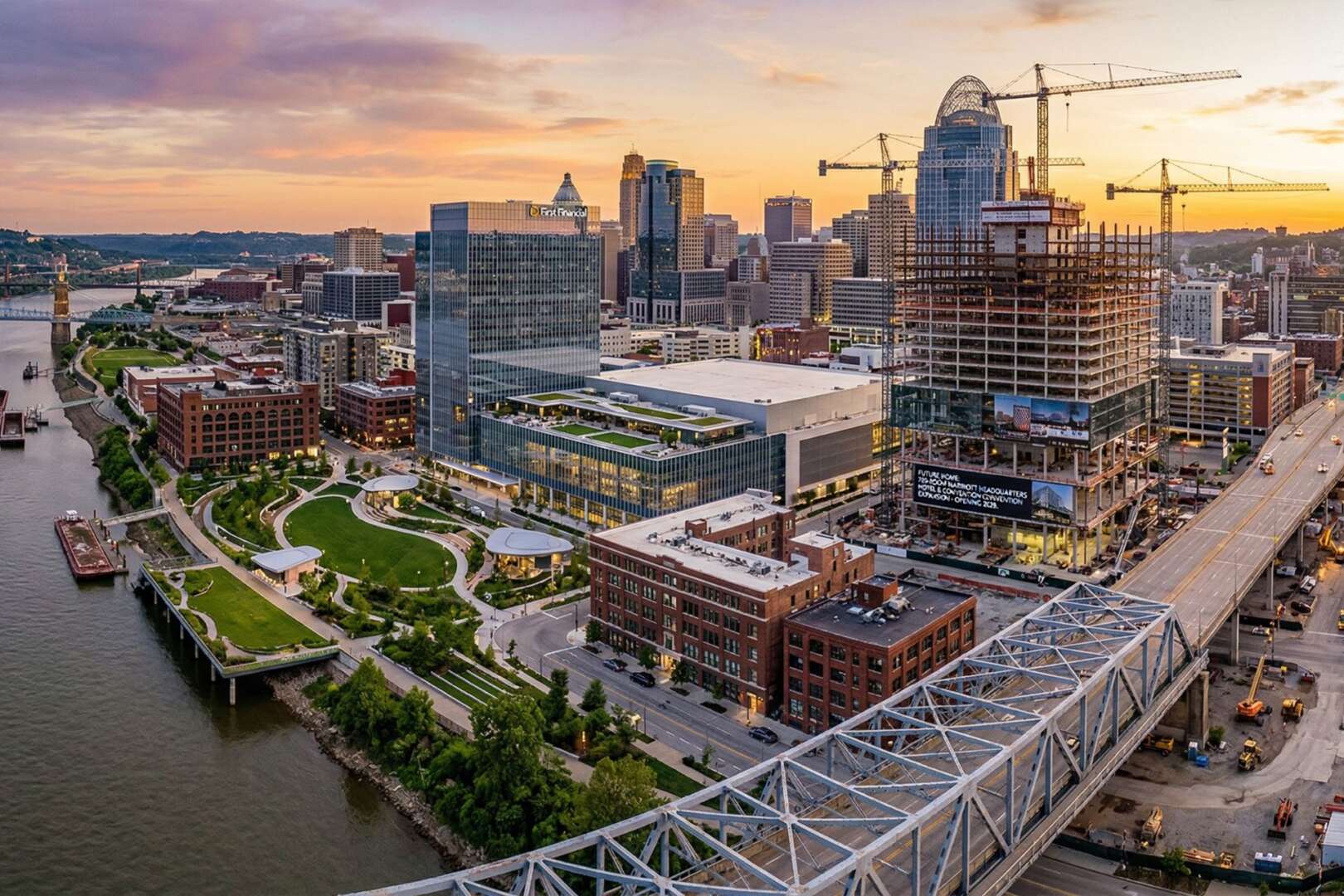
The current anchor of the city’s transformation is the Convention District. Planners designed this $800 million overhaul to attract major events.
The First Financial Center just reopened in January 2026. Crews successfully completed a massive $264 million modernization. The facility now boasts a spectacular rooftop terrace. It also features upgraded technology and a completely modern exterior.
Expanding exhibition and ballroom spaces
The expanded convention center totals 750,000 square feet. It includes setup and support space alongside 257,268 square feet of exhibit space and 74,033 square feet of ballroom space to attract larger galas. They also included 30 distinct breakout rooms for smaller corporate meetings. The facility boasts a full-service banquet kitchen. It is highly capable of serving 5,000 guests at once.
Creating an outdoor plaza for connection
A brand-new outdoor park officially opened in late 2025. The Elm Street Convention Plaza spans two sprawling acres. This greenspace connects directly to the convention center. Visitors enjoy winding walking paths and spacious pavilions. Food trucks and live music regularly activate the outdoor space. This plaza provides a fresh social hub for locals and convention attendees alike.
A massive hotel anchors the Cincinnati downtown development
A new Marriott Headquarters Hotel broke ground in early 2026. Developers are actively investing $536 million into this ambitious project. The 700-room hotel sits directly south of the convention center. Planners currently slate the grand opening for 2028. The site will feature 15,000 square feet of premium retail space. It brings unprecedented luxury directly to the city center.
Elevating luxury with skyline views
Construction crews are working diligently to meet the ambitious 2028 deadline. Inside, the property will feature more than 62,000 square feet of meeting space, while planners also designed a 17,000-square-foot event terrace for outdoor gatherings. To top it off, a full-service, three-meal restaurant will constantly cater to guests.
Meanwhile, the panoramic skyline views from the outdoor bar are expected to draw massive crowds. Beyond the amenities, a new skywalk will seamlessly connect the hotel to the convention center. Ultimately, the new district sets a bold industry standard, and the massive project firmly positions the city as a premier Midwest destination.
Converting historic offices to residential hubs
To dramatically increase urban density, developers are getting highly creative. They are rapidly converting aging, historic office spaces into residential units. These older buildings now house luxury apartments, condos, and boutique hotels. The $69 million Textile Building conversion sits prominently on Fourth Street. This traditional business corridor is gaining vibrant new life. Residents enjoy modern rooftop amenities, a fitness gym, and dedicated co-working spaces.
Bringing new energy with boutique hotels
Another massive conversion is the recently finished Hyatt Centric Cincinnati. Specifically, this project opened in early 2026 within the iconic @580 building. In doing so, it completely transforms a stagnant commercial complex into a stunning 170-room hotel. Furthermore, the site smartly pairs upscale residential units with vibrant restaurant spaces.
Meanwhile, boutique hotels are also booming across the wider downtown area. For instance, the Moxy Hotel brings highly sought-after modern Bavarian vibes, and as a result, its lively rooftop bar attracts energetic crowds every weekend. Similarly, developers also transformed the historic Gwynne Building into the Fidelity Hotel.
Boosting community assets in Over-The-Rhine
Over the last two decades, 3CDC has invested heavily in the city. They poured over $2 billion into the downtown core and Over-The-Rhine. Much of this early funding built mixed-use retail and housing. However, the development focus recently shifted heavily toward essential community amenities. Leaders desperately want to build resources that serve long-term residents and families. This ensures the neighborhood remains livable for everyone.
Building the Findlay Community Center
The highly anticipated Findlay Community Center will finish construction in fall 2026. The $65.5 million facility spans an impressive 65,000 square feet. It includes an indoor pool, a roller rink, and an indoor running track. A modern rooftop fitness space provides a massive anchor for active families. The new building addresses local community demands head-on. The indoor pool will offer vital year-round swim lessons for local youth.
Expanding affordable housing options
Affordable housing heavily remains a top priority for local city leaders. 3CDC and its dedicated partners are actively working on mixed-income developments. They recently passed a major housing milestone in the urban core.
Developers built hundreds of affordable units integrated seamlessly with commercial spaces. This approach deliberately ensures neighborhoods remain accessible to diverse income levels. It prevents lower-income residents from being entirely priced out.
Reconnecting the city with mega-infrastructure
Cincinnati is smartly using major transportation upgrades to reclaim public land. In fact, local leaders are literally reshaping the geographic map of the city. To achieve this, the city and county proposed a $187 million project for Fort Washington Way.
Specifically, they plan to build a 5.6-acre greenspace “lid” directly over Interstate 71. Ultimately, this project will finally bridge the glaring gap between The Banks and the urban core, as it seamlessly connects the riverfront directly to downtown.
Expanding infrastructure in Queensgate
Construction on the Brent Spence Bridge Corridor is currently underway. While citizen advocacy groups originally envisioned a design that would reclaim land in the industrial Queensgate area for a vibrant residential and shopping district, the actual Ohio Department of Transportation mega-project goes in a different direction.
The physical impact of highway expansion
With estimated costs recently rising to $4.4 billion as of early 2026, the massive widening of Interstate 75 is expanding the highway footprint to fix critical regional bridge traffic. This expansion is currently consuming land rather than freeing it up, requiring the recent demolition of the eastern edge of the historic Longworth Hall.
FAQs
What are the main upgrades to the Convention District?
The $800 million district overhaul centers on the modernized First Financial Center, which now features over 257,000 square feet of exhibition space. The district also includes the newly opened two-acre Elm Street Convention Plaza and a 700-room Marriott Headquarters Hotel slated for 2028.
How is downtown Cincinnati repurposing its older buildings?
Developers are actively converting aging commercial office spaces into residential units and boutique hotels to increase urban density. Recent examples include the 2023 completion of the Textile Apartments and the 170-room Hyatt Centric inside the @580 building.
What new amenities are being built for local residents?
The $65.5 million Findlay Community Center is scheduled to open in fall 2026 to serve local families. This 65,000-square-foot facility provides an indoor pool, a roller rink, and an indoor running track. Furthermore, developers are integrating mixed-income housing into commercial spaces to maintain downtown affordability.
How will upcoming infrastructure projects change the city layout?
The $4.4 billion Brent Spence Bridge Corridor project is actively widening Interstate 75, which expands the highway footprint into the Queensgate area to alleviate regional traffic bottlenecks. Additionally, local leaders have proposed a $187 million project to build a greenspace “lid” over Interstate 71 to finally bridge the gap between The Banks and the urban core, connecting the riverfront directly to downtown.