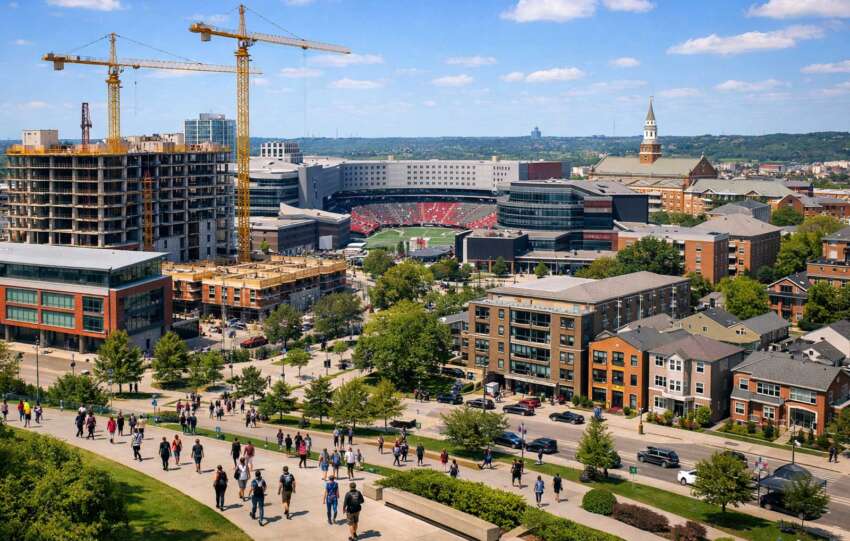
Cincinnati city leaders formally proposed the Cincinnati Office of Strategic Growth to streamline economic development.
The Cincinnati Office of Strategic Growth is a central piece of a broader neighborhood planning overhaul aimed at guiding future investment.
Officials say the proposal will reduce bureaucracy and make Cincinnati more competitive for development. At the same time,…
Community
Article Summary:
University of Cincinnati research is driving local innovation and strengthening Cincinnati’s economy through record funding, major partnerships, and commercialization successes. From biomedical breakthroughs to federally funded translational science, UC research drives regional impact. Local startups and collaborations are creating jobs and advancing Cincinnati innovation. With strategic funding and community-focused projects, UC continues to…
Article Summary
Cincinnati public transportation is entering a transformative phase with major Metro bus expansion plans and new transit funding initiatives. Local leaders are directing resources toward fleet modernization, Bus Rapid Transit (BRT) rollout, and infrastructure upgrades. These investments are funded by local sales taxes, regional grants, and federal assistance. The goal is to improve…
Cities don’t usually fail in a single dramatic moment.
They don’t wake up one day broken, unsafe, or unrecognizable. Instead, they drift—slowly, quietly, and often unnoticed by the people who care about them most.
This kind of civic drift happens when small compromises go unexamined. Temporary workarounds become permanent habits. Complexity replaces clarity. And no…
What Ohio recreational marijuana means for Cincinnati
Ohio recreational marijuana moved from ballot measure to storefront reality faster than many expected.
After voters approved Issue 2 in November 2023, adult-use sales began in January 2025 at existing medical dispensaries.
Cincinnati quickly became one of the state’s busiest markets because of its population density, interstate access,…
The Cincinnati housing shortage is stretching resources for renters and buyers alike, city officials say.
Demand for apartments and affordable housing Ohio has surged in recent years, and supply is struggling to keep pace.
Vacancy rates in the Cincinnati metro area remain low, contributing to higher monthly rents and fewer options for households…
Article Summary
From 2019 to 2022, Cincinnati’s arts economy generated over $1.6 billion in regional economic impact, driven by ArtsWave funding and marquee events like BLINK. The sector supports thousands of jobs, contributes millions in tax revenue, and fuels local businesses in hospitality, retail, and services. BLINK alone added $249 million in direct impact…
Article Summary
The downtown Cincinnati office market is stabilizing post-pandemic as it adapts to the hybrid era. With vacancy rates plateauing near 24%, the city is aggressively converting obsolete office towers, such as Carew Tower, into residential units to reduce inventory. Simultaneously, businesses are rightsizing into smaller, amenity-rich Class A spaces—a trend known as "flight…
Article Summary
Cincinnati Riverfront development is transforming growth along the Ohio River in both Cincinnati and Northern Kentucky. Major projects like The Banks, Ovation on the River in Newport, and Covington Central Riverfront are adding mixed‑use residential, commercial, and recreational spaces. Infrastructure upgrades, including the Brent Spence Companion Bridge and the 20‑mile Riverfront Commons trail,…
Article Summary
Cincinnati is expanding gun violence prevention efforts across neighborhoods to curb shootings and support affected families. City officials and nonprofits are launching neighborhood hubs in Avondale, East Price Hill, and the West End. These will offer mentorship, job programs, food access, and youth engagement. Data-driven initiatives, including the Cincinnati Initiative to Reduce Violence…