

Share This Article
Article Summary
Ohio sports teams are pushing for an exemption to a proposed law restricting land ownership tied to China and other foreign adversaries. The debate highlights a broader national security push while raising questions about whether powerful organizations should receive carveouts from policies designed to limit foreign influence.
Several of Ohio’s major professional sports teams are lobbying state lawmakers to carve out an exemption.
They are focused on a bill designed to limit land and property ownership tied to foreign adversaries, including China.
In a March 24, 2026, what appears to be a letter to Ohio House Speaker Matt Huffman, organizations representing teams such as the Cincinnati Reds, Cleveland Cavaliers, Columbus Crew, and FC Cincinnati urged lawmakers to amend Substitute House Bill 1.
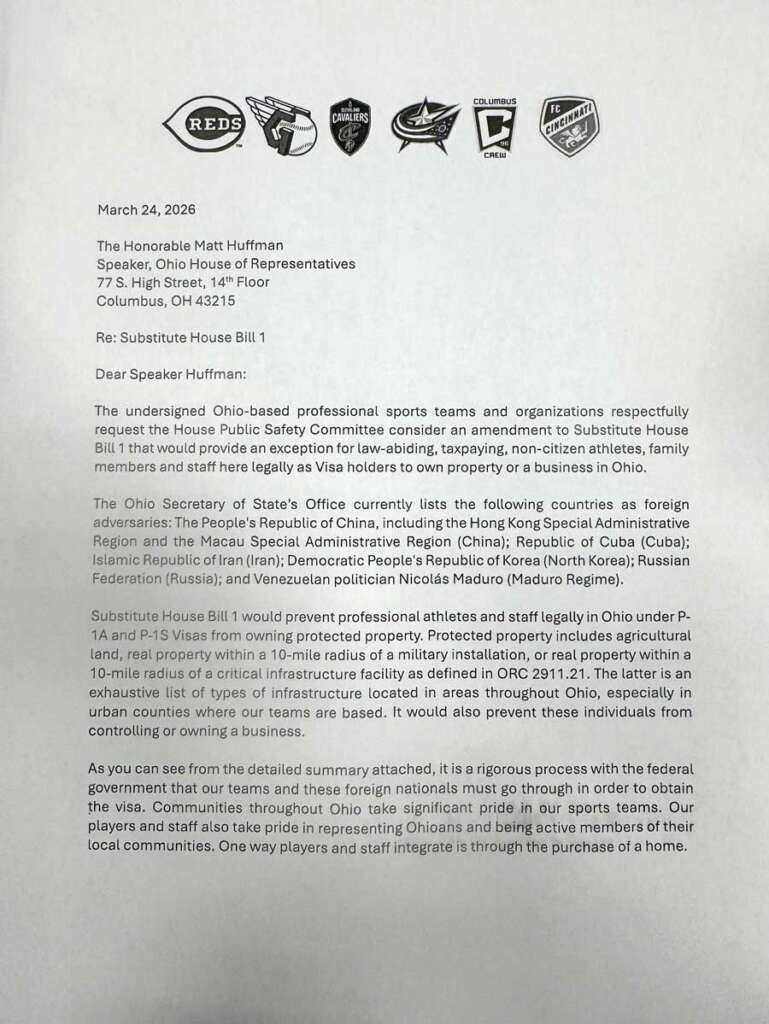
Their request would allow certain foreign nationals, specifically athletes, staff, and family members in the United States on visas, to continue purchasing property or owning businesses in Ohio. In other words, this exception would apply even if they are from countries designated as foreign adversaries.
Part of a Broader National Shift
Ohio is not acting alone here. Across the country, lawmakers have been moving in a similar direction, especially when it comes to China and land ownership near sensitive sites.
During the Trump era, federal officials expanded national security reviews of foreign investments. This included closer scrutiny of land purchases near military installations and critical infrastructure. That approach has continued at the state level. In fact, several states have passed laws focused on agricultural land and strategic locations. Ohio’s House Bill 1 fits directly into that broader trend. Additionally, it arrives at a time when state policy fights in Ohio are increasingly centered on security, control, and long-term competitiveness.
A Bill Grounded in National Security Concerns
Substitute House Bill 1 is structured around one core question: who controls land in sensitive areas, and why does it matter over time?
The legislation targets ownership tied to countries identified as foreign adversaries, including China, Cuba, Iran, North Korea, Russia, and Venezuela. Moreover, it would restrict ownership of:
- agricultural land
- property near military bases
- property near critical infrastructure
Supporters view the bill as a preventative measure. The concern is not limited to what is happening today. Instead, it is about what could happen over time if strategically important land is allowed to move into the hands of people or entities tied to adversarial governments.
Why China Is Central to the Debate
China is governed by the Chinese Communist Party, and that has shaped how American policymakers evaluate economic and strategic risk tied to land ownership.
According to USDA reporting on foreign-owned agricultural land, Chinese investors account for a relatively small share of overall foreign-held farmland in the United States. But the policy concern is not just about acreage. It is about location, proximity, and leverage.
Land near military installations, transportation corridors, energy systems, or other critical infrastructure carries a different level of scrutiny than land in the abstract.
That is why this issue has gained traction with Republican lawmakers nationally and in states like Ohio. The argument is that a strategic competitor does not need to own a huge percentage of American land to create a long-term national security problem. In fact, it only needs to control the wrong parcels in the wrong places.
Teams Push for a Targeted Land Ownership Exception
The teams argue the bill is written too broadly and could unintentionally affect individuals who are already in the United States legally and have been vetted through federal immigration processes.
They point to P-1A and P-1S visas used by internationally recognized athletes and essential staff, emphasizing that these individuals are living and working within the system. Under their proposal, those visa holders would still be able to purchase homes or operate businesses in Ohio.
From the teams’ perspective, this is not really about foreign influence or large-scale investment. Rather, it is about the practical realities of players and staff relocating for work, sometimes for years at a time, and wanting the same housing options available to everyone else in their organization.
Is Ownership Necessary?
That argument raises a practical question, though, and it is a fair one.
Professional athletes move frequently. Some stay in one city for years, but others are traded, released, or reassigned with little notice. Coaches and staff can be more stable. However, the larger point still stands: land ownership is not required to live or work somewhere.
In many countries, foreign nationals are not permitted to own land at all. They can still rent, lease, or buy into certain forms of housing without holding the underlying land. That distinction matters because it reframes the issue.
The question is not whether these individuals can live in Ohio. They can. However, the question is whether owning land should be treated as a standard convenience or as a privilege the state can restrict for national security reasons.
China Land Ownership vs Influence
There is no public evidence that Ohio’s professional sports teams have ownership tied to Chinese entities or the Chinese government.
But ownership is not the only way influence works. In global sports, financial relationships run through sponsorships, media rights, league partnerships, and international market access. For example, in some leagues, access to the Chinese market has had real financial value. This can shape incentives even without any direct ownership connection.
That does not prove control, and it should not be overstated. Still, it does raise a legitimate question about whether broader global business interests can affect how major organizations approach state policy fights.
Two Different Risks, One Underlying Question
The debate around House Bill 1 is operating on two different levels at the same time.
One level is strategic. That is the level supporters of the bill are focused on. They want to limit the possibility of land near agriculture, infrastructure, or defense assets ending up under the influence of foreign adversaries.
The second level is structural. When large, high-profile organizations ask lawmakers for carveouts, it raises a different question about how public policy gets shaped and who gets treated as an exception to the rule.
Last year, the Governor spent Ohio taxpayer money on one sports team.
Update:
In return, the sports team owners are (big surprise) lobbying for more special favors. This time on behalf of the Chinese communist party. https://t.co/Dcj4PakSca pic.twitter.com/yGytXQd7z6
— Gabe Guidarini (@GabeGuidarini) March 24, 2026
Those are not the same issue. But they intersect in a way that is hard to ignore. At the center of both is the same basic question: who influences policy decisions, and whose priorities end up carrying the most weight?
A Familiar Dynamic in a New Context
Ohio’s professional sports teams have stepped into state-level debates before, particularly when money, development, or operations were on the line. This time the substance is different. Nevertheless, the pattern feels familiar.
Instead of public financing or stadium politics, the issue now is national security and land ownership. But the operating logic is similar. When policy decisions directly affect team operations or personnel, these organizations engage. Readers who follow Ohio politics on The Cincinnati Exchange have seen this broader pattern before. Policy may be sold one way publicly, but once powerful institutions feel real friction, the push for special treatment begins.
What Comes Next With Ohio House Bill 1
Lawmakers have not yet indicated whether they will adopt the requested exemption. If the bill moves forward without changes, it could restrict property ownership for certain foreign nationals, including those legally working in Ohio. If it is amended, it may shape how similar legislation is structured in the future.
Either way, this issue is bigger than a housing question for athletes. It is part of a broader debate over how policy choices affect competitiveness, migration, and long-term state strategy. In this case, though, the stakes are not just economic. They are also strategic.
Read More
Ohio daycare overpayments reach $1.1M amid massive fraud investigations
FAQs
What is Ohio House Bill 1 designed to do?
It would restrict certain land and property ownership tied to countries designated as foreign adversaries, particularly near military bases, agricultural land, and critical infrastructure.
Why are Ohio sports teams asking for an exemption?
They argue the bill could impact foreign athletes and staff who are legally in the United States on visas and want to purchase homes or establish businesses while working in Ohio.
Does this mean Ohio teams have Chinese ownership?
No. There is no public evidence that Ohio’s major professional sports teams are owned by Chinese entities. The issue is about policy restrictions, not current ownership.
Is owning land necessary for foreign players or staff to live in Ohio?
No. Individuals can rent, lease, or use other housing arrangements without owning land, which is common in many countries that restrict foreign land ownership.
This article is based on publicly available legislative materials, official data, and reported communications attributed to Ohio sports organizations. Where applicable, documents and claims have been contextualized within broader national policy discussions. Analysis reflects interpretation of the policy implications and should not be taken as confirmation of any single unverified document.