
Share This Article
Article Summary
The No Kings protests in Cincinnati followed a pattern seen across the country—rapid mobilization, consistent messaging, and support from established activist networks. Public reporting and congressional inquiries have raised questions about how these protests are funded and organized. While many participants appear motivated by genuine concerns, the structure behind these demonstrations suggests something more coordinated than it first appears.
Where did all of this organization begin?
The crowds in Cincinnati felt immediate. Signs appeared quickly. Messaging spread even faster.
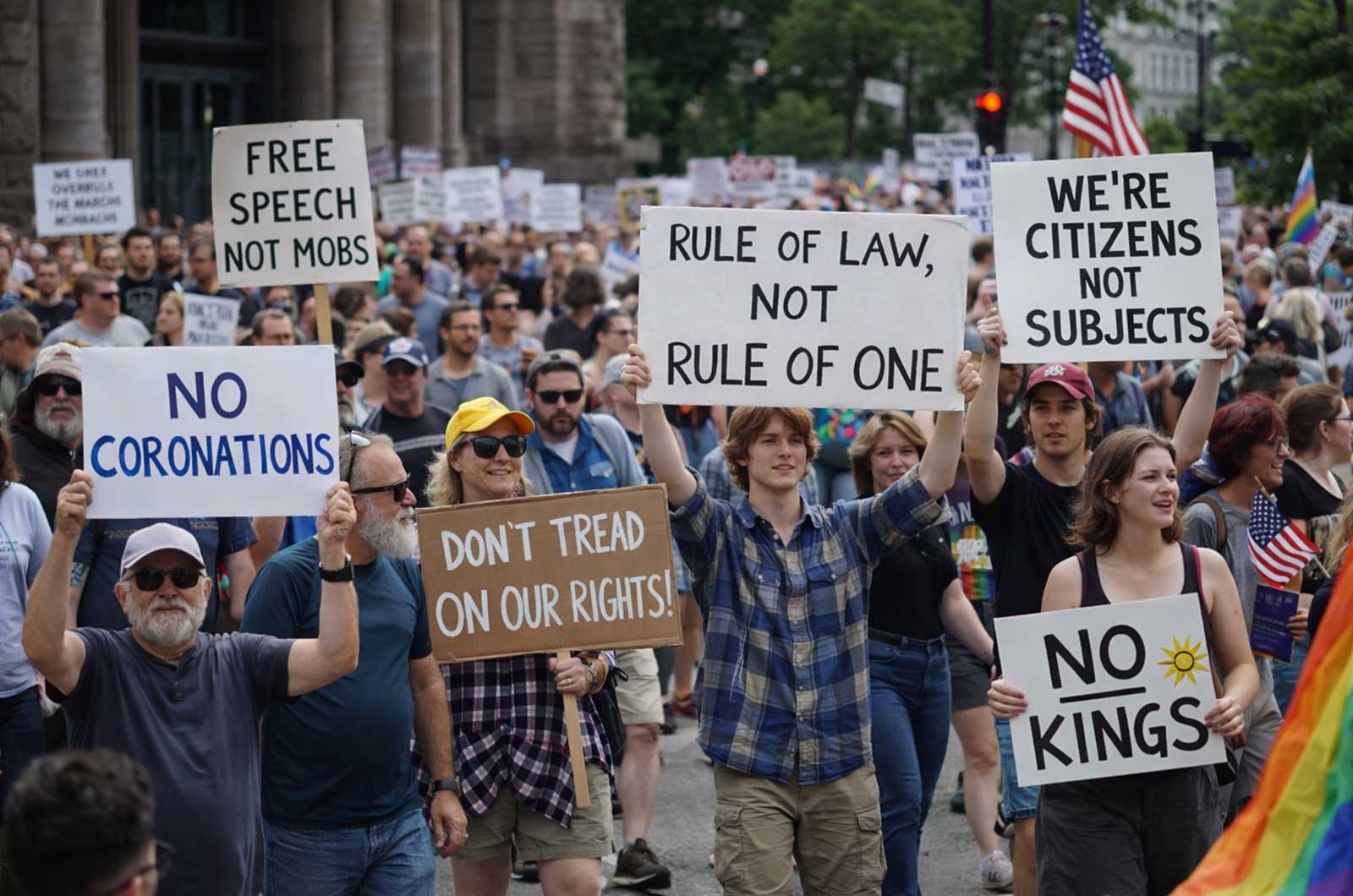
Cincinnati No Kings Protests weren’t an outlier. It was one of dozens of cities where the same protest showed up at roughly the same time.
Across the country, the framing was nearly identical. The same phrases. The same tone. In some cases, even the same signage.
That kind of consistency doesn’t come from coincidence. It points to coordination.
The System That Already Exists
There’s still a tendency to think of protests as something that builds from the ground up. And sometimes that’s true.
But increasingly, movements are plugging into infrastructure that’s already there.
According to reporting highlighted by outlets including Yahoo News and AOL, more than 500 organizations—with a combined $3 billion in annual revenue—are connected in some way to protest organizing, funding, or amplification across the United States.
That changes the starting point.
Instead of building momentum from scratch, organizers can activate existing networks, communicate instantly across cities, and scale messaging in a way that wasn’t possible even a decade ago.
What looks like a sudden surge is often a system switching on.
The Same Names, Different Causes
Follow the activity long enough, and the overlap becomes familiar.
Organizations like the ANSWER Coalition and the People’s Forum have appeared in connection with multiple protest movements, from anti-war demonstrations to pro-Palestinian rallies and broader political actions.
Research from the Program on Extremism at George Washington University has documented how activist networks often share infrastructure, communication channels, and organizing resources across different movements—even when those movements appear unrelated on the surface.
Different issues. Same infrastructure.
Once built, it doesn’t need to be recreated. It just shifts focus.
How the Message Moves
One of the more revealing aspects isn’t just who organizes No Kings protests—it’s how quickly the message spreads.
A slogan appears in one city and shows up somewhere else almost immediately. The same language, the same framing, the same emotional cues.
That kind of speed usually reflects coordination—shared digital toolkits, overlapping audiences, and networks that already know how to amplify something once it’s introduced.
Investigative reporting—including coverage from Fox News—has also drawn attention to funding networks connected to figures like Roy Singham, whose ties to activist organizations have been the subject of both media scrutiny and congressional interest.
That doesn’t prove centralized control. But it does show how narratives can be reinforced at scale.
What Money Actually Changes
Money doesn’t explain everything. But it does determine what’s possible.
A movement with resources doesn’t operate the same way as one without them. It can sustain itself longer and move faster. It can look more organized because, in many cases, it is.
- Full-time organizers instead of volunteers
- Travel and logistics covered without hesitation
- Professional media that spreads cleanly across platforms
- The ability to stay active well beyond a typical news cycle
From the outside, that difference isn’t always visible.
But it’s there—and it shapes how these protests take form.
The Role of Communist Party USA and PSL in No Kings Protests
Alongside the broader mix of attendees, No Kings protests also draw a more defined ideological layer that shows up consistently across cities.
In larger cities especially, socialist- and communist-aligned groups participate openly. For example, the Communist Party USA (CPUSA) has acknowledged joining “millions” at No Kings protests and has encouraged members to attend and help build turnout.
In addition, groups like the Party for Socialism and Liberation (PSL) appear at No Kings protests nationwide with their own signage, messaging, and organizing presence. While these organizations do not usually lead the events, they show up prepared, coordinated, and active.
As a result, they use the environment to distribute literature, connect with attendees, and expand their reach. Large crowds give them direct access to people who are already politically engaged.
This creates a layered dynamic inside No Kings’ protests. On one hand, mainstream organizers such as Indivisible and MoveOn frame the movement around institutional accountability and policy concerns. On the other hand, smaller ideological factions often push broader critiques of political and economic systems.
Those perspectives do not always align; however, they operate in the same space and often at the same events.
Supporters describe that overlap as coalition-building. Critics, by contrast, argue it signals that more ideological agendas operate beneath the surface of No Kings protests.
Either way, the overlap is visible—and in some cases, the groups themselves openly document their participation.
The Investigation Didn’t End in 2025
Questions about the No Kings Protest funding haven’t stayed confined to headlines.
In 2025, the House Oversight Committee announced an investigation into funding behind protests, raising concerns about whether certain nonprofit networks could be connected to foreign-aligned influence.
Since then, reporting from NewsNation indicates that lawmakers have continued pressing the issue—calling for subpoenas, financial reviews, and deeper examination of how money moves through activist networks.
No final public conclusion has been issued. But the investigation hasn’t gone away either.
The fact that it has continued across multiple protest movements suggests these concerns are not isolated.
Are No Kings Protests Leaderless or Structured Movements
No Kings protests often describe themselves as decentralized. No central authority or a single leader. That framing matters—but it doesn’t tell the whole story.
In practice, structure doesn’t always look like hierarchy. Instead, No Kings protests appear to operate through overlapping networks of organizations, messaging channels, and funding streams that move together without a visible chain of command.
Recent reporting points to this kind of model. Rather than top-down control, these protests function more like coordinated ecosystems—where groups share language, amplify the same narratives, and activate across multiple cities at the same time.
One report described it as a “coordinated money machine.” That phrasing is open to interpretation. However, the underlying pattern is harder to ignore.
When the same messaging shows up across different cities, when the same organizations appear across different causes, and when turnout follows the same activation patterns, it suggests something more structured than it first appears.
That doesn’t require a single leader. It requires a system—and No Kings protests increasingly look like one.
If Everyone Already Agrees, What Are These Protests Doing?
In Cincinnati, the issue isn’t whether people have the right to protest. That’s obvious. The real question is what No Kings protests are actually doing—and who they’re really reaching.
This is a city where the current Democrat mayor won with roughly 78% of the vote, reflecting a clear political alignment. If most local leadership and much of the voter base already agree with the core messaging, then persuasion isn’t the primary function.
So what is?
At that point, these protests start to look less like local pressure campaigns and more like signals—events that reinforce narratives, generate content, and feed into a broader national conversation that extends well beyond Cincinnati.
That matters because once a movement operates at that level, it doesn’t just influence people in the crowd. It creates material that spreads across platforms, gets picked up by media, and contributes to how the country—and sometimes the world—perceives what’s happening in American cities.
And that raises a more uncomfortable question.
If these protests consistently produce the same imagery, messaging, and narratives across cities, who benefits from that consistency? Domestic political groups clearly do. However, so do foreign actors who have a long track record of amplifying division, promoting instability, and using American political movements—on all sides—as raw material for influence campaigns.
There’s no evidence that most participants see it that way. But they don’t have to.
In a networked environment, movements can serve multiple purposes at once. What feels local can become national. What feels national can become global. And what feels organic can still be shaped, amplified, and used by people far outside the city.
Cincinnati is part of that system now. And once you look at it through that lens, the question isn’t just what these protests stand for—but what they ultimately feed into.
What We Know vs What We Don’t About the Protest Organizers Network
The things we know:
- Large networks of nonprofit organizations are involved in protest activity
- Funding across these networks reaches into the billions
- The same groups often appear across multiple movements
- Congress has investigated funding structures and raised concerns
And what we don’t know:
- No definitive public finding proving direct foreign control of these protests
- No confirmed illegal funding structure tied specifically to Cincinnati events
- No single centralized authority directing all protest activity
The absence of a conclusion doesn’t eliminate the questions. It shows how complex these networks are to fully trace.
What Most People Miss About No Kings Protests
Most people in the crowd aren’t thinking about who organized it, who funded it, or how it spread. They’re reacting to what feels immediate. That’s exactly why this works.
When coordination is done well, it disappears. It looks like energy and feels like a movement. The people are real. The concerns are real. But the structure behind it is real, too—and far more consistent than most people realize.
The same networks, the same playbook, the same presence showing up again and again across different cities and different issues. If you’re not looking for it, you won’t see it. Once you are, it’s hard to unsee.
FAQs
What are No Kings protests?
No Kings protests are coordinated demonstrations held across multiple cities, typically organized by progressive groups focused on political and institutional issues.
Who organizes No Kings protests?
They are primarily organized by coalitions of progressive organizations such as Indivisible, MoveOn, and other activist groups.
Are No Kings protests grassroots?
They include grassroots participants, but also involve structured networks of organizations that coordinate messaging and turnout.
Do ideological groups attend No Kings protests?
Yes. Alongside mainstream participants, some socialist and communist-aligned groups have been documented attending and participating.