



Share This Article
America watched in disbelief Wednesday afternoon as two National Guard members were ambushed and shot just blocks from the White House — a D.C. Shooting that officials quickly described as “targeted,” “brazen,” and deeply destabilizing.
The two soldiers — members of the West Virginia National Guard — were shot, and one confirmed dead after the attack, according to updated reporting from the Associated Press. The shooting occurred in broad daylight near Indiana Avenue NW. A suspect was arrested shortly afterward, as first reported by Reuters
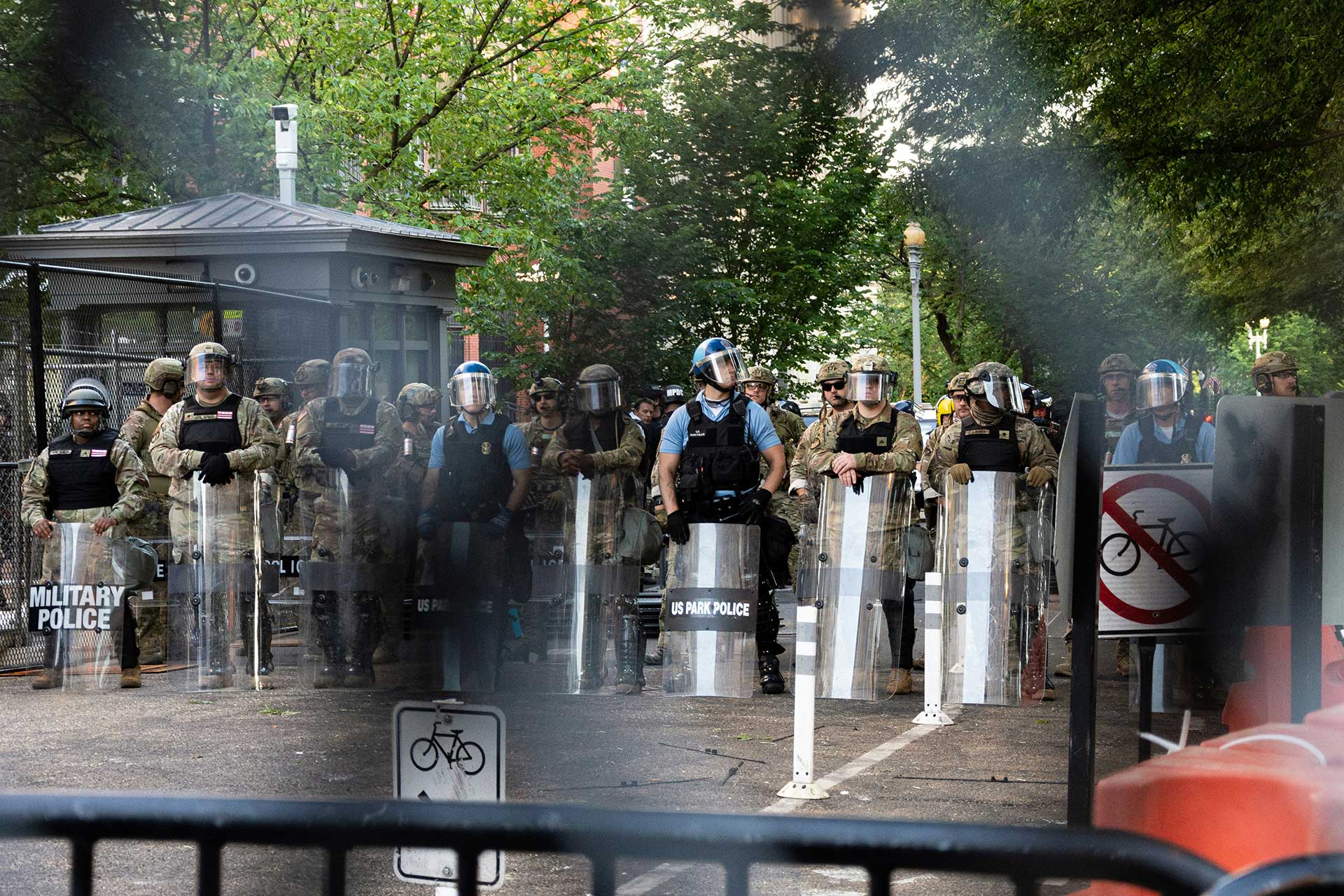
The Pentagon has already moved to send an additional 500 National Guard troops into Washington, D.C., in response to this recent shooting incident, but the symbolism of an attack such as the D.C. Shooting may prove even more significant than the military response. This latest D.C. Shooting raises concerns about national security. If armed soldiers aren’t safe in one of the most heavily protected cities in the world, Americans are left asking what this means for the rest of the country.
The D.C. Shooting wasn’t an isolated failure of security. It was another sign of how fragile public order has become — not only in the nation’s capital but also across major American cities facing their own trust crises.
The D.C. Shooting is A Pattern That’s Becoming Impossible to Ignore
The attack fits into a larger pattern of violence against law enforcement and military personnel nationwide. In recent years, the frequency of attacks like the one in D.C. highlights these alarming trends:
- Two Air Force recruiters were shot in Colorado Springs in 2024.
- Las Vegas officers were ambushed in their patrol car in 2023.
- Federal officers outside a Phoenix courthouse came under rifle fire in early 2025.
- And ambush-style attacks on police have surged, according to FBI data.
You don’t need a political lens to see what’s happening. The country is growing less predictable — and less stable.
Memphis: A Case Study in Aggressive Enforcement
The most dramatic example of instability is unfolding in Memphis, one of the cities selected for a sweeping federal-state “safe task force” operation this fall. According to the Associated Press, more than 2,800 arrests have been made in roughly two months, alongside 28,000 traffic citations, the recovery of over 450 illegal firearms, and the location of 114 missing children.
State leaders point to those numbers as evidence of decisive action. But for residents, the experience is more complicated. When a city experiences thousands of arrests in weeks, the effect isn’t just increased enforcement — it’s increased unpredictability, something not far removed from the volatility seen after the shooting in D.C.
That distinction matters. Safety and predictability are not the same thing. A city can become statistically safer while feeling more volatile in everyday life.
D.C. Was Supposed to Be the Counterexample
That’s what makes the D.C. Shooting so jarring. Unlike Memphis — which has struggled with violent crime and instability for years — Washington, D.C., had spent much of 2024 and 2025 pointing to genuine, measurable improvement.
According to the city’s own annual metrics, homicides were down nearly 30%, armed robberies saw double-digit declines, and carjackings — once the face of D.C.’s safety crisis — had fallen sharply. Local leaders touted the turnaround. Even skeptics admitted the city appeared to be stabilizing.
And yet, despite the progress, the D.C. Shooting involving two National Guard soldiers occurred in the shadow of the White House. A city that was supposedly improving couldn’t prevent one of the most symbolic breakdowns imaginable. This highlights that despite improvements, such incidents can still occur unexpectedly.
That’s the deeper message: When violence breaks through even where crime is “trending down,” the public no longer sees statistics. It sees instability caused by events like another D.C. Shooting.
A Conservative Perspective: This Isn’t Just Crime — It’s Culture
You don’t have to be partisan to see the implications. But a conservative reading of the moment highlights something many leaders don’t want to acknowledge:
America’s public order problem is rooted not just in enforcement, but in eroding norms.
For years:
- violent offenders have been released early,
- cities have downplayed crime statistics,
- consequences for serious offenses have weakened,
- anti-police rhetoric has escalated,
- mental-health crises go untreated,
- and public institutions avoid confronting the cultural shifts driving violence.
The result was predictable: Criminals feel emboldened. Officers feel unsupported. And ordinary people lose confidence in the institutions meant to protect them.
The events following the D.C. Shooting are a symptom of that deeper breakdown — not because the city failed tactically, but because the country is failing culturally. Such incidents add to a growing pattern of erosion of cultural norms.
A society without shared norms of respect, responsibility, and accountability cannot maintain public order. And a society that cannot maintain public order cannot remain free.
The D.C. Shooting is A Warning for Every American City
If National Guard soldiers can be ambushed in Washington, D.C.,
- What does that mean for police in Chicago, Philadelphia, St. Louis, or Atlanta?
- What does it mean for cities deploying Guard units to manage crime or civil unrest?
- What does it mean for citizens who already don’t trust their local institutions?
This is not alarmism. It’s recognition of a new reality:
Public safety cannot be taken for granted anywhere — not even in our nation’s capital. Regardless of statistics or trends, the recent incident of this D.C. shooting reminds us of the importance of prioritizing public safety.
Order First, Politics Second
Americans don’t want militarized cities. They want predictable ones, safe ones, and leaders who tell the truth about what’s happening and enforce the law consistently.
A serious response requires clear principles:
- enforce laws uniformly,
- prosecute violent offenders fully,
- support police and the Guard instead of second-guessing them,
- uphold consequences, not excuses,
- restore civic norms before they disappear entirely.
These aren’t radical ideas. They’re the basics of a functioning society.
Until leaders confront the reality that cultural drift, institutional timidity, and weakened norms are driving instability — not just “root causes” or “economic circumstances” — the next incident in D.C. won’t be a surprise. It will be the new normal. Let’s just hope we don’t have another D.C. Shooting.
America isn’t collapsing. But it is drifting. And Wednesday’s attack made that drift impossible to ignore.
Read More
The Cincinnati Trust Crisis: How a Low-Trust America Shows Up in Our City
Cincinnati OTR nightclub shooting investigation: Police probe second incident