
Share This Article
Article Summary
Cincinnati is currently undergoing massive road infrastructure projects, including the Brent Spence Bridge Corridor Project and the Western Hills Viaduct replacement. These developments aim to improve regional traffic flow and are supplemented by the city’s Vision Zero initiative to eliminate traffic fatalities through targeted street modifications. To navigate the resulting lane closures and construction zones, officials encourage commuters to utilize public transit or stay informed via the CincyAlert text service and the 311Cincy mobile app.
New construction projects are generating crucial Cincinnati traffic updates for daily commuters.
Review these Cincinnati traffic updates to navigate road safety improvements effectively this year.
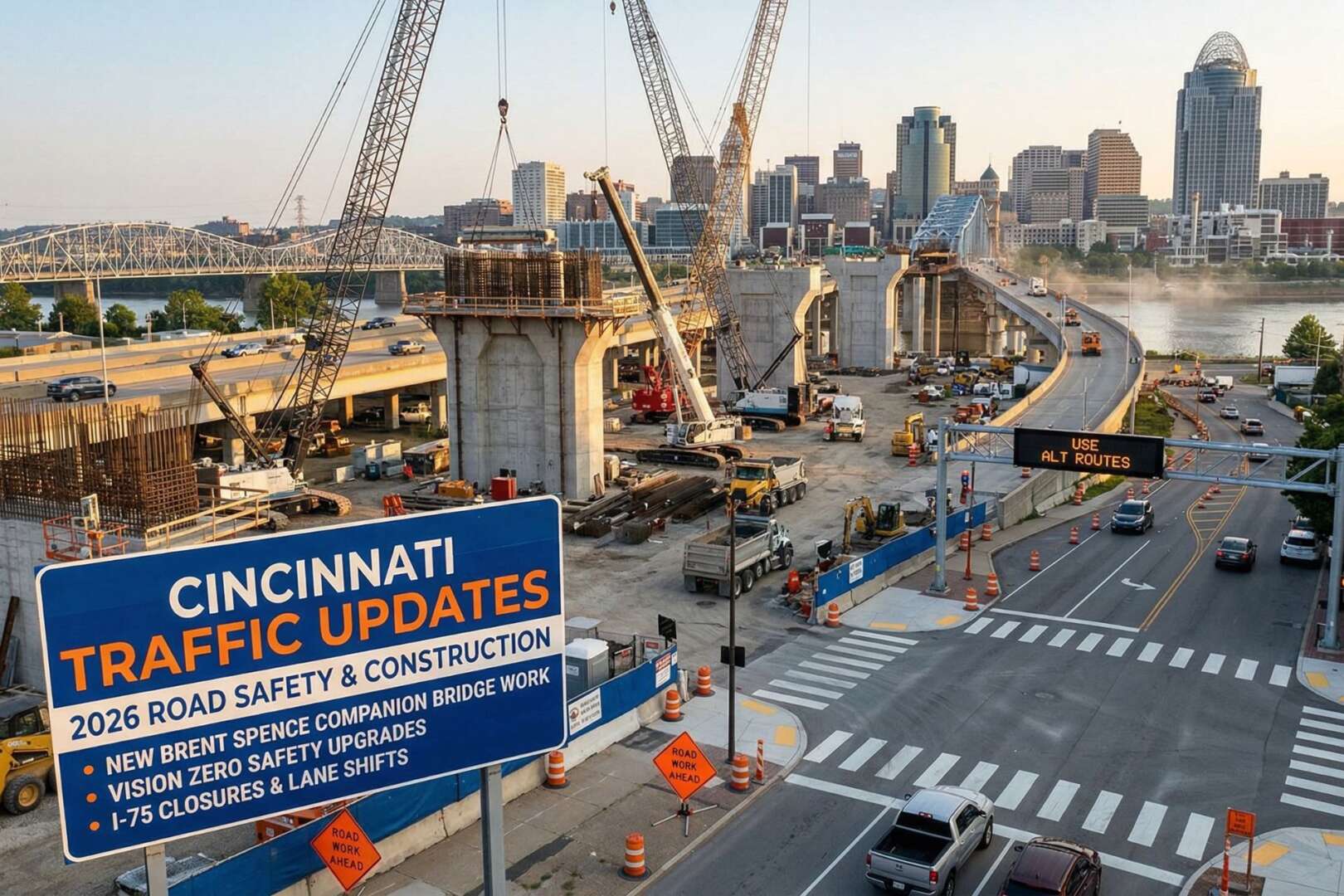
Daily commuters need the latest Cincinnati traffic updates as massive construction projects reshape the city. These Cincinnati traffic updates highlight major shifts in highway routing and neighborhood road safety. Heavy machinery now dominates the horizon near the Ohio River. Planners have moved from theoretical designs to concrete construction. These rapid changes aim to reduce accidents and shorten commute times. Drivers must adapt to a rapidly evolving urban environment immediately. City officials emphasize that temporary frustration brings permanent security.
Brent Spence companion bridge drives Cincinnati traffic updates
The centerpiece of regional development remains the Brent Spence Bridge Corridor Project. An official groundbreaking for the companion bridge is set to take place this spring. This multi-billion dollar endeavor represents a massive regional investment.
According to the Ohio Department of Transportation, the project eventually separates local and through traffic. This vital separation eliminates dangerous highway weaving movements. These sudden lane changes cause frequent side-swipe accidents on the existing span.
Weekend highway closures accommodate new bridge piers
The 2026 construction phase focuses heavily on local access points. Demolition of older overpasses requires temporary full closures of I-75. These disruptive closures typically occur during specific weekend windows. Weekend scheduling minimizes the severe impact on weekday commerce. Engineers are clearing space for the new bridge’s massive support piers. The Cincinnati Enquirer reported that officials are installing advanced sensors during this phase. These specialized sensors monitor structural integrity throughout the build.
Vision Zero goals improve Ohio road safety
Beyond massive highway projects, the city embraces its Vision Zero initiative. This strict policy aims to eliminate all traffic fatalities locally. Mayor Aftab Pureval recently highlighted pedestrian safety in the 2026 budget. Planners identified several critical network streets for immediate intervention. Rapid-response crews are installing new safety features across ten neighborhoods. Improvements feature several proven traffic calming techniques.
- Crews are building raised crosswalks in high-density residential zones.
- Technicians activated leading pedestrian intervals at downtown signals.
- Contractors installed new bump-outs to reduce pedestrian crossing distances.
- Police expanded automated speed enforcement pilots in school zones.
Traffic calming islands reduce neighborhood accidents
These targeted measures already show a measurable decrease in accidents. Neighborhoods like Over-the-Rhine and Northside report significant positive changes. Traffic calming islands now force vehicles to reduce speed naturally. Residents praise the additions for making streets more accessible. Some critics argue these changes increase congestion during rush hours. The city maintains that slower traffic saves human lives.
Western Hills viaduct replacement impacts local commuters
The complete replacement of the Western Hills Viaduct is well underway. This aging bridge serves as a vital western connection. Decades of heavy salt use compromised the original structure’s integrity. The new viaduct features dedicated transit lanes and wider bike paths. According to reports from WCPO, the massive project remains on schedule.
The target completion date for the new viaduct is 2030. Site preparation and early phases are well underway, but the existing viaduct will continue to carry through-traffic until the new extradosed bridge is entirely finished at the end of the decade.
Mill Creek valley construction creates daily lane shifts
Crews currently focus on foundation work in the Mill Creek valley. Drivers should expect regular lane shifts on Spring Grove Avenue. Western Avenue will also see disruptions throughout the current year. This project complements broader regional safety goals perfectly. The resilient new path improves emergency vehicle response times. The old structure required strict weight limits that hindered fire trucks. The modern design eliminates these dangerous restrictions entirely.
Long-term closures require essential Cincinnati traffic updates
Navigating the local I-75 corridor requires extreme patience this year. The stretch near Ezzard Charles Drive remains a constant active work zone. Significant alerts warn drivers about several upcoming local closures. Commuters must plan alternate routes to avoid severe delays and stay updated on commuting news Cincinnati provides.
- Exit 1D (U.S. 50): Crews scheduled periodic night closures for overhead sign installation.
- Linn Street: Officials closed the street between 8th and Court Streets.
- Seventh Street Ramp: Workers narrowed lanes to relocate major utility lines.
- Gest Street: The city closed sections near the viaduct for extended reconstruction.
Transit options bypass heavy downtown construction zones
Many commuters turn to public transit to avoid these active zones. The Connector streetcar reports record ridership numbers recently. Metro also expanded its high-frequency bus routes to bypass heavy construction. These specific transit routes utilize dedicated priority lanes downtown. You can learn more about these options in our Cincinnati transit expansion guide. Commuters should sign up for the CincyAlert text service immediately. This system sends real-time SMS updates for construction-related lane shifts.
Hamilton County launches comprehensive safety action plan
The Hamilton County Engineer’s Office recently launched a new safety plan. This data-driven approach aims to eliminate severe traffic accidents regionally. The county relies heavily on active community feedback for this initiative. Officials encourage residents to use the new interactive hazard map. This online tool lets citizens report dangerous intersections directly. The county uses this crowdsourced data to prioritize immediate funding.
Rural road upgrades target dangerous highway curves
The current budget specifically targets high-risk county roads. Maintenance crews are actively widening narrow shoulders in rural areas. They are also installing rumble strips along dangerous curves. These simple physical additions prevent drivers from drifting off the road. WLWT reported that these simple upgrades reduce roadway departures significantly. The county hopes to expand these features across all jurisdictions soon.
Leveraging technology for city construction projects
Technology plays a silent but vital role in modernizing local roads. The city recently installed AI-optimized traffic signals at major intersections. These smart signals use cameras to evaluate actual vehicle flow. The system adjusts timing dynamically to reduce stop-and-go traffic. Research indicates that smoother traffic flow lowers rear-end collision rates. These technological upgrades make daily driving significantly safer for everyone.
Reporting hazards directly via 311Cincy
The city recently revamped its mobile application, launching the 311Cincy app. This is the city’s official all-in-one service app for residents to report non-emergency infrastructure hazards directly to the city for repair.
It lets users:
- Report issues like potholes, traffic problems, and street damage
- Use GPS mapping to pinpoint locations
- Track service requests and city responses
- Access trash/recycling schedules and city updates
Engineers and city planners analyze this crowdsourced data to identify recurring infrastructure issues and prioritize repair schedules. Cincinnati continues to leverage these modern tools to protect its citizens. Check back frequently for more Cincinnati traffic updates as these projects progress.
FAQs
What are the main construction projects affecting Cincinnati traffic in 2026?
The primary projects include the Brent Spence companion bridge construction and the Western Hills viaduct replacement. Both endeavors involve significant lane shifts, weekend highway closures on I-75, and localized road reconstructions.
How is the city working to improve pedestrian safety?
Through its Vision Zero initiative, Cincinnati is installing new safety features across ten high-density neighborhoods. These physical upgrades include raised crosswalks, traffic calming islands, bump-outs, and leading pedestrian intervals at downtown traffic signals.
When will the new Western Hills Viaduct be completed?
The target completion date for the new extradosed bridge is 2030. The existing viaduct will remain open to carry through-traffic until the new structure is entirely finished.
How can residents receive real-time traffic alerts or report road hazards?
Commuters can sign up for the CincyAlert text service to receive instant SMS updates regarding construction-related lane shifts. Additionally, residents can use the 311Cincy mobile app to map and report non-emergency infrastructure hazards directly to the city.