



Share This Article
Article Summary
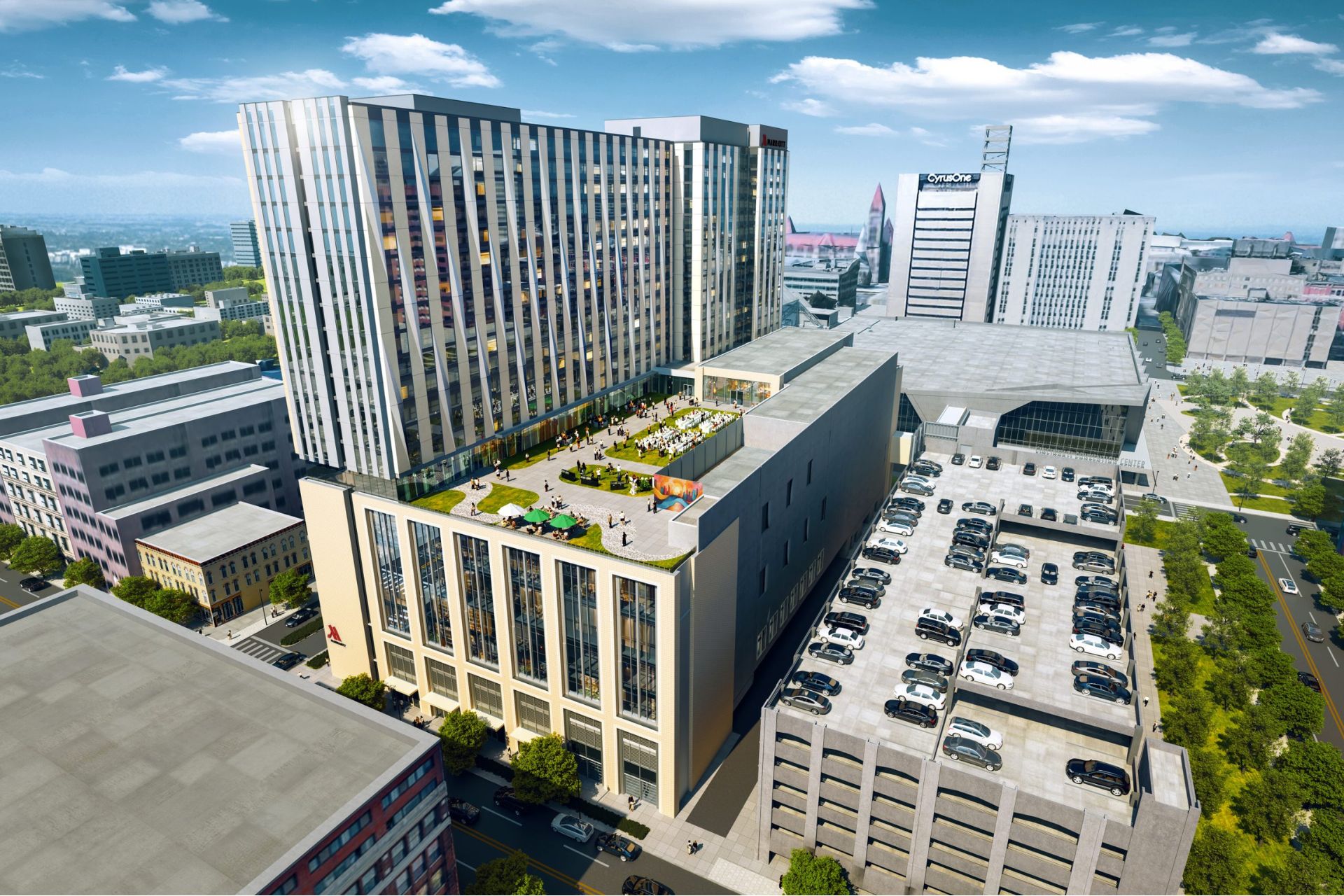
Cincinnati developers are seeking final approval of more than $100 million in public subsidies for a planned convention headquarters hotel connected to the First Financial Center. The 700-room Marriott project, led by 3CDC and Portman Holdings, requires city council and Hamilton County funding votes this week. Supporters say the convention headquarters hotel will boost Cincinnati’s competitiveness in the regional meetings market, while negotiations over tax abatements and community charges continue. Construction could begin in spring 2026 with a projected late-2028 opening if subsidy approvals are secured.
The convention headquarters hotel remains at the center of a major funding debate in Cincinnati.
The project’s developers are pushing for approval of public subsidies. These subsidies would unlock construction of a 700-room Marriott property connected to the reimagined First Financial Center.
The key funding vote is expected this week from both the Cincinnati City Council and Hamilton County commissioners.
City leaders frame funding push as essential for local convention market
Cincinnati’s proposed convention headquarters hotel relies on a package of public incentives. City officials argue those incentives are critical to attract large conventions. Located on the parking lot at Plum Street and Fifth Street south of the convention center, the hotel would include roughly 62,000 square feet of meeting space. It would also offer multiple ballrooms, retail, and an events terrace.
Officials with the Cincinnati Center City Development Corp. (3CDC) and Atlanta-based Portman Holdings told the Budget, Finance & Governance Committee that more than $100 million in public subsidies must be secured. Only then can construction move full speed ahead. Council members approved several funding ordinances in committee. In addition, a vote by the full City Council is slated this week.
Supporters see the convention headquarters hotel as necessary for Cincinnati’s competitive position. Downtown already has a renovated convention space. Planners say a connected hotel is a draw that could boost bookings, visitor spending, and room nights in the city.
Public funding details and outstanding approvals
The complex subsidy plan includes a mix of city, county, and state contributions. The city has already authorized a $50 million loan toward the project. This combines savings from the convention center renovation and debt issuance mechanisms. A tax increment financing (TIF) real estate abatement is also part of the funding stack. Project-based transient occupancy tax (TOT) abatements from both city and county support the plan as well.
In addition, businesses within Cincinnati’s Fountain Square and convention district will contribute through a community authority charge. This charge is a voluntary fee of 1¢ for every dollar of sales, and helps defray construction costs.
State support arrives through a grant and tax credits. Developers and city officials say these incentives are vital to closing the financing gap. Under earlier state allocations for mixed-use development, the hotel project was awarded transformational mixed-use tax credits and grants. These grants offset some capital costs.
Despite these commitments, final approval from Hamilton County commissioners is still pending, making this week’s votes crucial. If both the city and county agree, developers plan an April 2026 groundbreaking with a target opening in late 2028.
Development partners highlight long-term economic impacts
Portman Holdings, which has developed large hotel projects in other cities, is leading the private side of the build. Their experience includes convention headquarters properties. According to the city’s planning documents, the site is currently a surface parking lot. The new hotel is expected to significantly increase Cincinnati’s available room inventory for meetings and group travel.
City officials argue that the project aligns with broader efforts to revitalize the Convention District. They also seek to maintain momentum following the First Financial Center renovation. That project rebranded and reopened the convention center. It positions Cincinnati for larger events. However, it lacks enough adjacent hotel capacity without the new headquarters facility.
Business leaders and hospitality groups in Cincinnati have generally supported the public investment. They say the convention hub could yield sustained economic activity across retail, dining, and tourism sectors. Such development could also enhance Cincinnati’s appeal relative to nearby convention markets in Columbus and Louisville.
Critics raise questions over public subsidy scale and community impact
Not all stakeholders are fully on board. Conversations around the community authority charge and long-term tax abatements have drawn scrutiny from residents. They question the scale of public support for private development. Some observers worry about committing decades of revenue from hotel taxes and abatement programs, since there are no guaranteed returns.
Urban planning debates have also surfaced in related development topics. Topics such as the proposed Hyde Park Square mixed-use project have seen zoning and community feedback shape council decisions.
However, city officials reject claims that the subsidy agreement will burden taxpayers. They note that revenue streams tied to hotel stays and increased economic activity should balance long-term public investment. Officials maintain that without this level of support, the convention headquarters hotel may not move forward in a competitive market.
Outlook and next steps for the convention headquarters hotel
As the City Council and Hamilton County prepare for key votes, developers and city staff continue outreach to stakeholders. If approvals are secured, site preparation and utility work could begin soon after. This would accelerate Cincinnati’s pipeline of hospitality infrastructure.
The eventual completion of the convention headquarters hotel could reshape Cincinnati’s downtown hospitality landscape and reinforce the city’s position as a regional destination for large conventions and events.
FAQs
What is the convention headquarters hotel project in Cincinnati?
The project is a planned 700‑room Marriott hotel connected to the First Financial Center. It will feature ballrooms, meeting space, retail, and event terraces. Developers say it will boost Cincinnati’s convention and tourism market.
How much public funding is being requested for the hotel?
Developers are seeking more than $100 million in public subsidies. The package includes city and county tax abatements, a community authority charge, state grants, and tax credits. These funds are critical to make the project financially viable.
Who is developing the convention headquarters hotel?
The project is led by 3CDC and Portman Holdings, experienced developers in large urban hotel projects. The city and county are partnering through subsidies and loans. Construction is contingent on final funding approvals.
When could construction and opening take place?
If all approvals are granted, developers plan to break ground in spring 2026. The hotel is expected to open by late 2028. The timeline depends on the city council and the county’s votes on subsidies.
Why is the public subsidy needed?
Officials argue the subsidies are essential to attract large conventions to Cincinnati. Without financial support, the project may not compete with other cities offering connected convention hotels. The hotel is expected to generate long-term economic benefits for downtown Cincinnati.